Distance: 12km
The bus from Reykjavik to Landmannalaugur leaves the bus depot at BSÍ at 7am and arrives in Landmannalaugur at 11:15am after one stop at a service station in Hella and a river crossing. Mel and I woke at 5:45, left our luggage with Hotel Von, and headed out, backpacks packed somewhat haphazardly, but on our backs nonetheless. The plan was this: Mel would stop at the bakery, Brauð & Co, which opened at 6:30am. I would continue on to the BSÍ terminal to get us a seat towards the front of the bus (two carsick people on a bouncing bus is not a great scenario).
The plan worked well. The bus depot was heaving when I arrived. Dozens of brightly-clad people, much like myself, stood around stuffing hiking poles into backpacks, and three huge buses with signs labeled “Þórsmörk” or “Landmannalaugur” waiting in the lot. I fell into the line beside an older man, who turned to look at me and said, “And what’s your name?” I gave it, and then he asked if I was on the tour as well. I told him no, that we’d be hiking on our own.
“How long are you hiking for?” I asked him.
“Seven days,” he told me. “They carry all of our bags, and they cook dinner for us every night!”
I looked around and saw that most people were older (we later found out that the youngest person in one of the two tour groups we kept running into was 57) and clustering together around tour guides. A man with an iPad waved me over to one of the buses and suggested I get on that one. He found my name on the list and checked me in. I tossed my bag beneath the bus and grabbed a seat at the front.
Minutes later, Mel emerged from the depot with water and two paper bags from the bakery.
“They’re apparently famous for their cinnamon rolls, but they didn’t have them yet, so I got us samplers and some croissants,” Mel said. A man boarded the bus after her and pointed at our bags.
“You already got pastries? You’re organized!” he exclaimed. (Later on the bus journey, this man would rescue my sandwich, which I’d placed in the overhead space and had been sent backwards as the bus clambered over rocks and rivers, sending objects backwards and forwards.)
Two tour guides checked in their groups as we waited. Overhead, a rainbow arched across the parking lot. Mel and I smiled. It was a good omen, we decided. Our bus headed out beneath the half-rainbow, conveying us through Iceland’s mossy landscape and then off the main road and onto Iceland’s gravelly F-roads. Here, the landscape was lunar; it’s no surprise that NASA has used Iceland’s terrain to train for moon landings. Everything suddenly becomes black ash, barren, rocky. It’s extraterrestrial.
Mel fell asleep, and the bus paused to let a long line of horses trot across, following riders decked in black veils to keep the gnats away (and there were many).
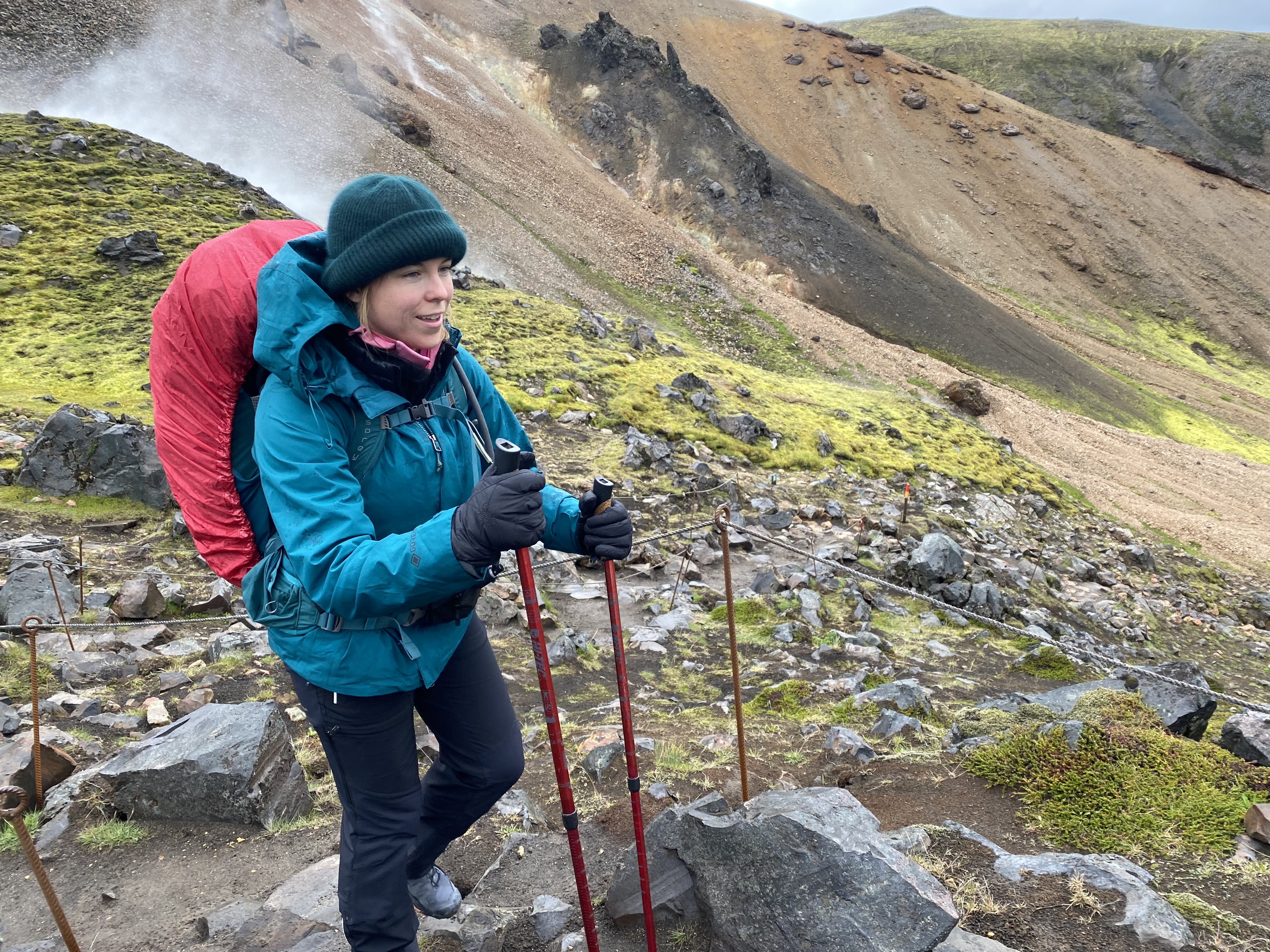
When we finally crossed the river down to Landmannalaugur, the glimpses of sunshine had largely given way to dark clouds and smatterings of rain. We unloaded our backpacks – mine had gotten wet, presumably from the river crossing – and immediately tied on our rain covers. Spoiler alert: We didn’t remove them the entire trip.
There was some reshuffling and rearranging of items, extending and adjusting hiking pole length, and repacking our backpacks in the protection of a plastic tent where dozens of campers were doing the same, or boiling water on trangias, the wind and the rain kept out by the thick flaps of the tent.
Tour groups huddled together for lunch, but Mel and I were ready to set off. It wasn’t difficult to find the path marker pointing toward Hrafntinnusker, signposting 12km to go. We crossed the stream and we were off!
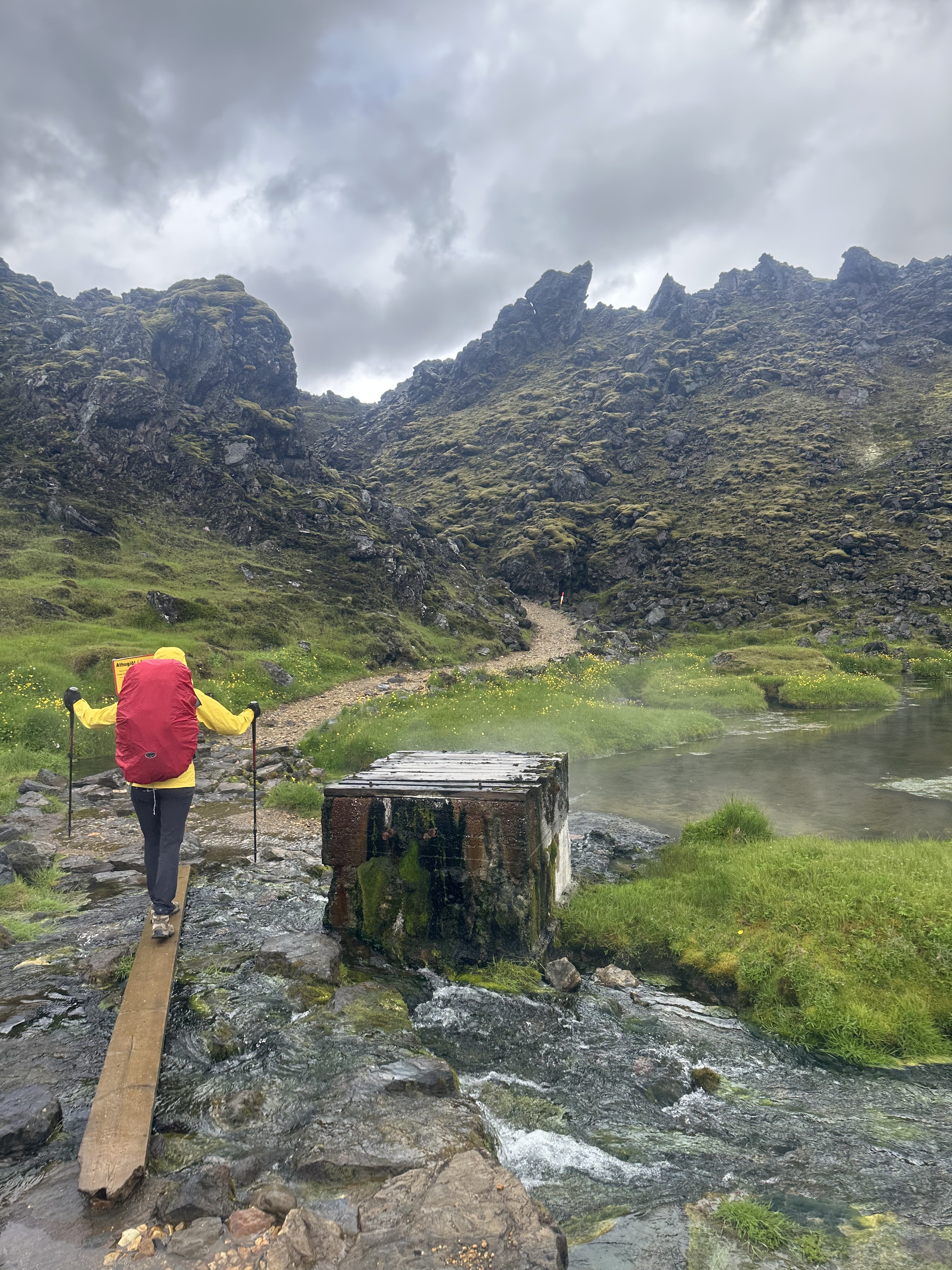
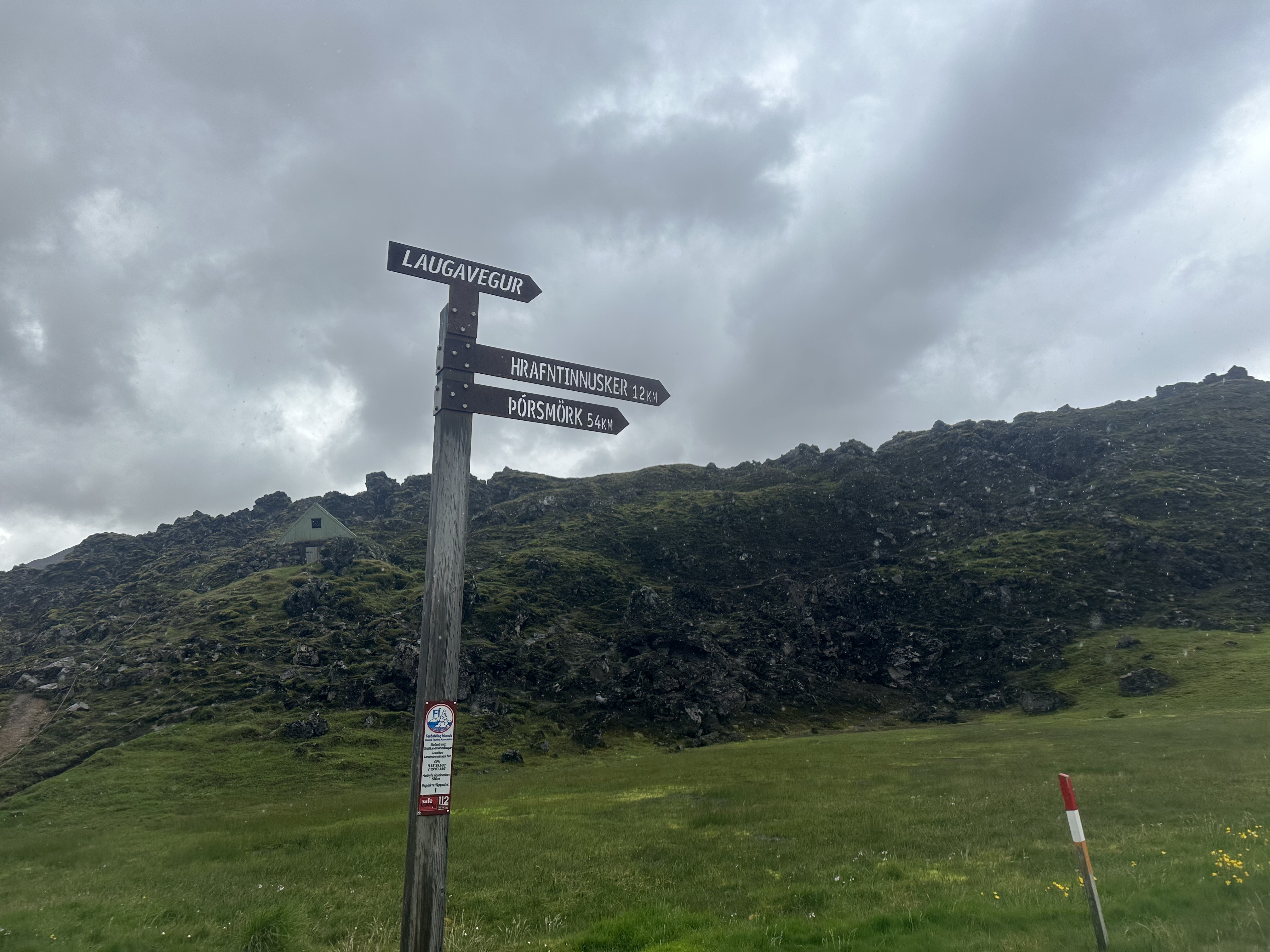
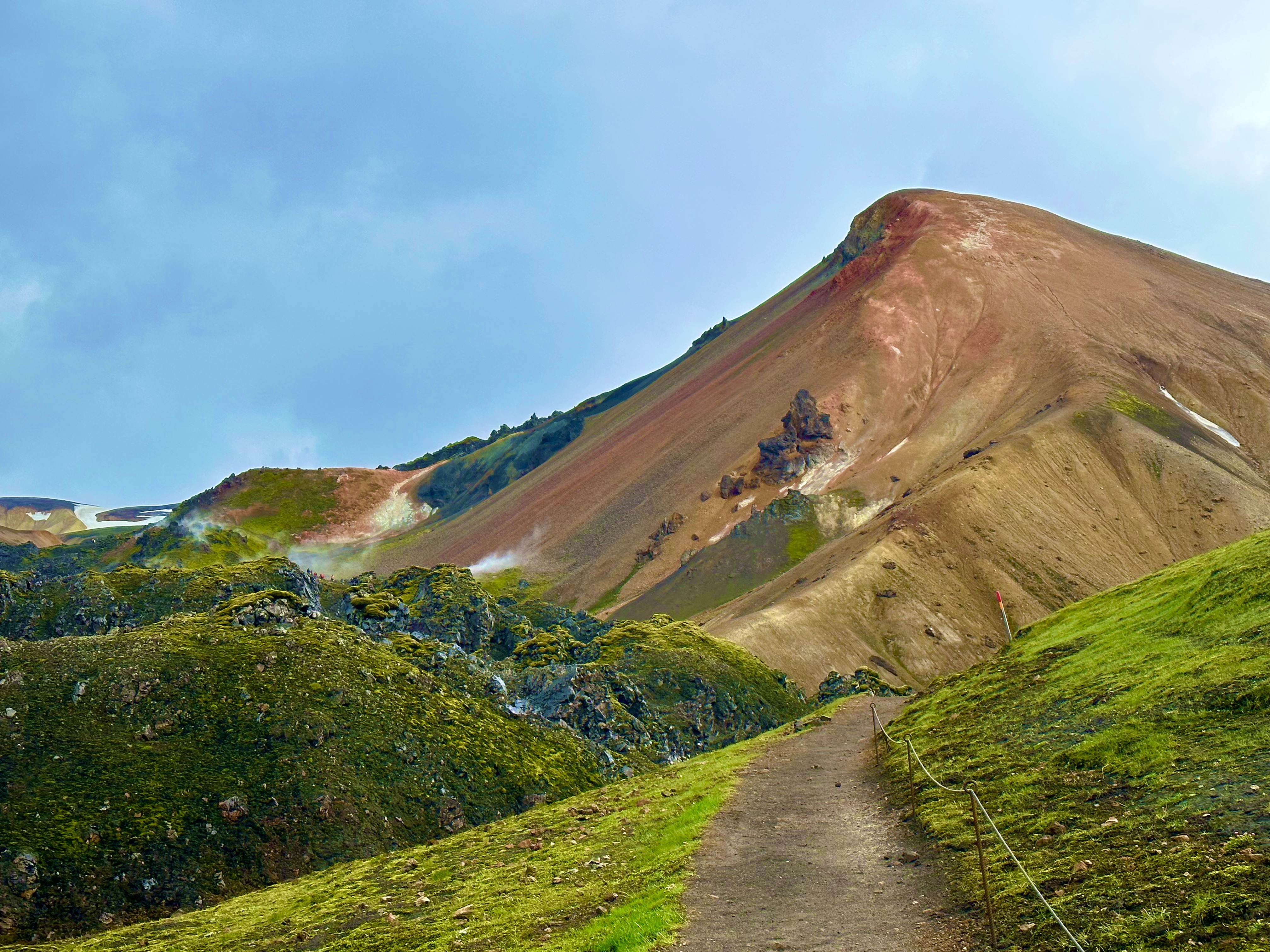
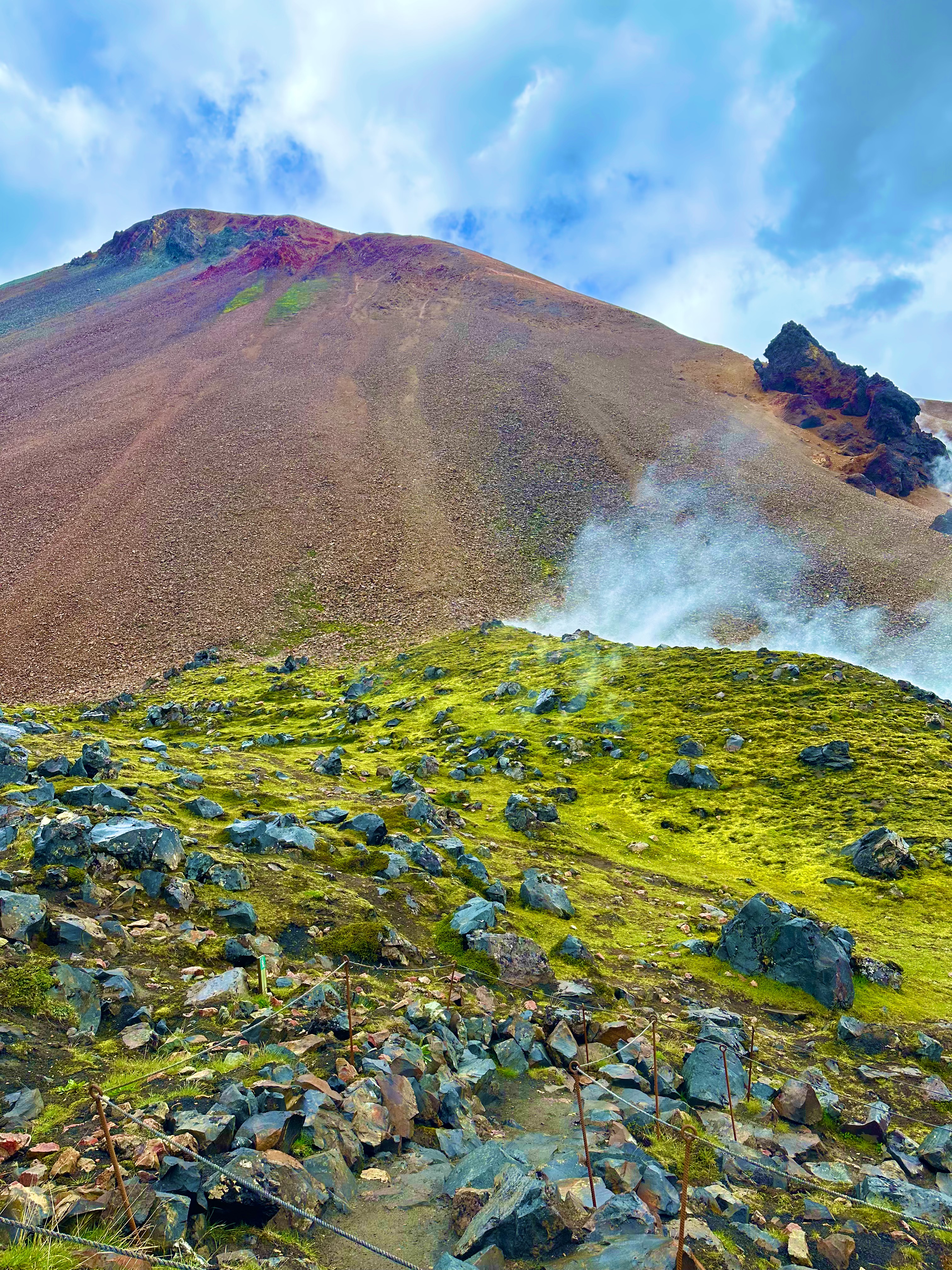
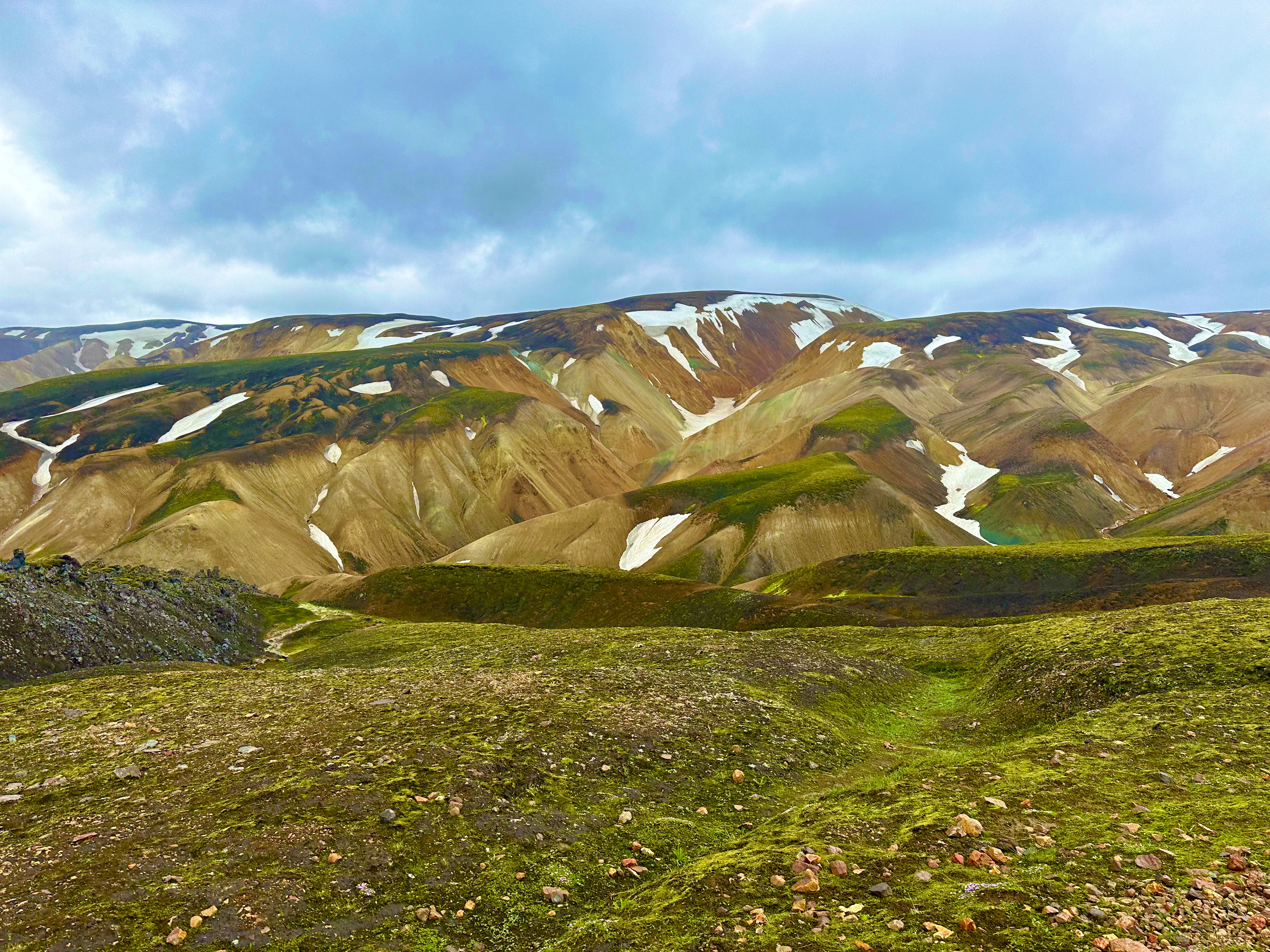
All we knew of the first day was that it would be mostly uphill. Our elevation gain for the trek was about 1100 meters, and that was mostly hit on the first day. We also knew we’d be treated to views of rainbow-colored rock, the sherbet-y rhyolite mountains that peek up among the brown, sandy hills.
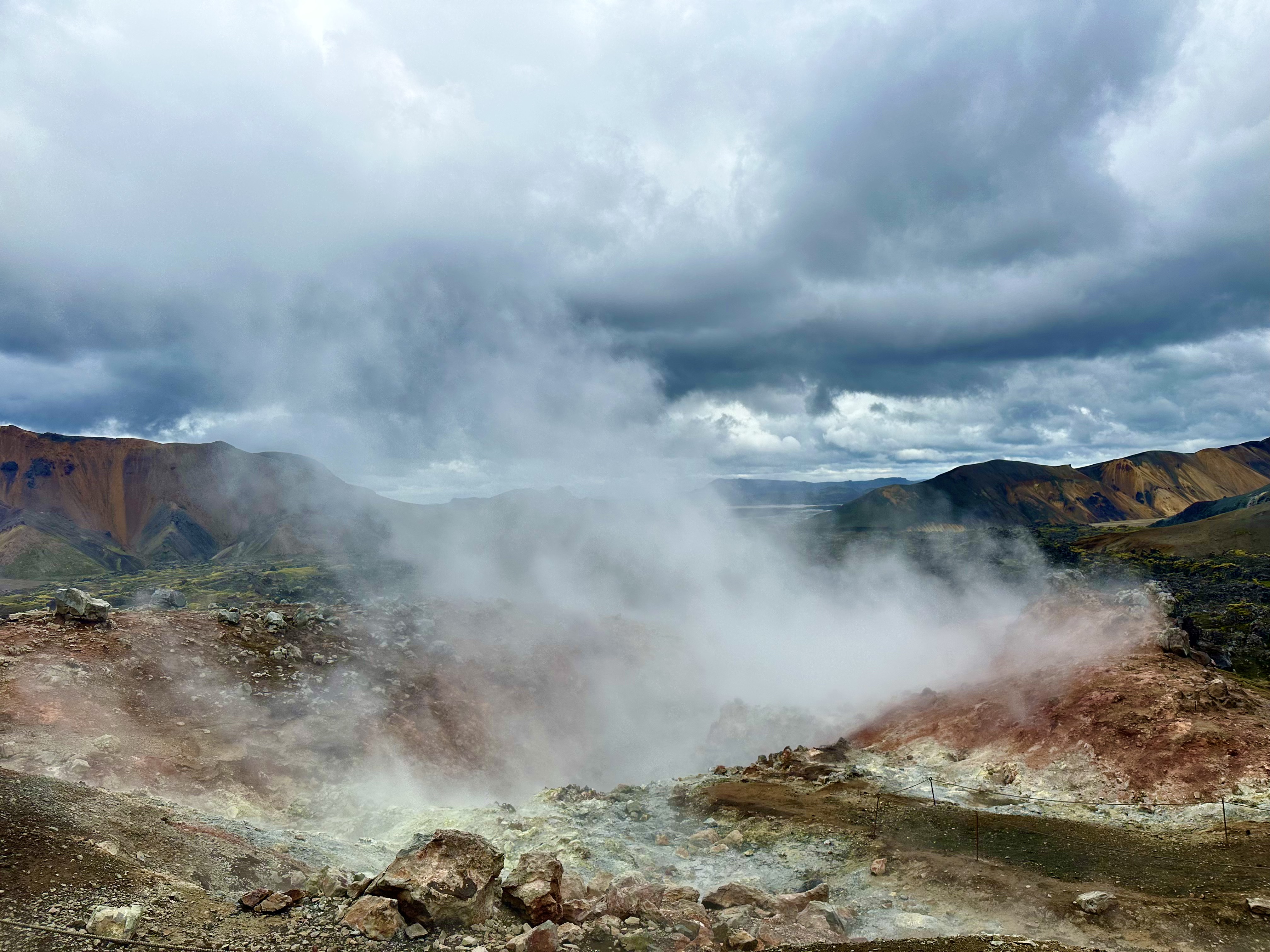
The beginning of the hike was sunshine mixed with rain, lots of uphill, and an assortment of geological wonder: there were fumeroles, the smell of hot sulfur in the air; there were rivers and brooks and streams winding through the meadow; up ahead, there were the rhyolite mountains. We overtook and fell behind groups of day-hikers (sans backpacks) and tour groups (also sans backpacks, having paid for the service of a car driving their big bags from hut to hut).
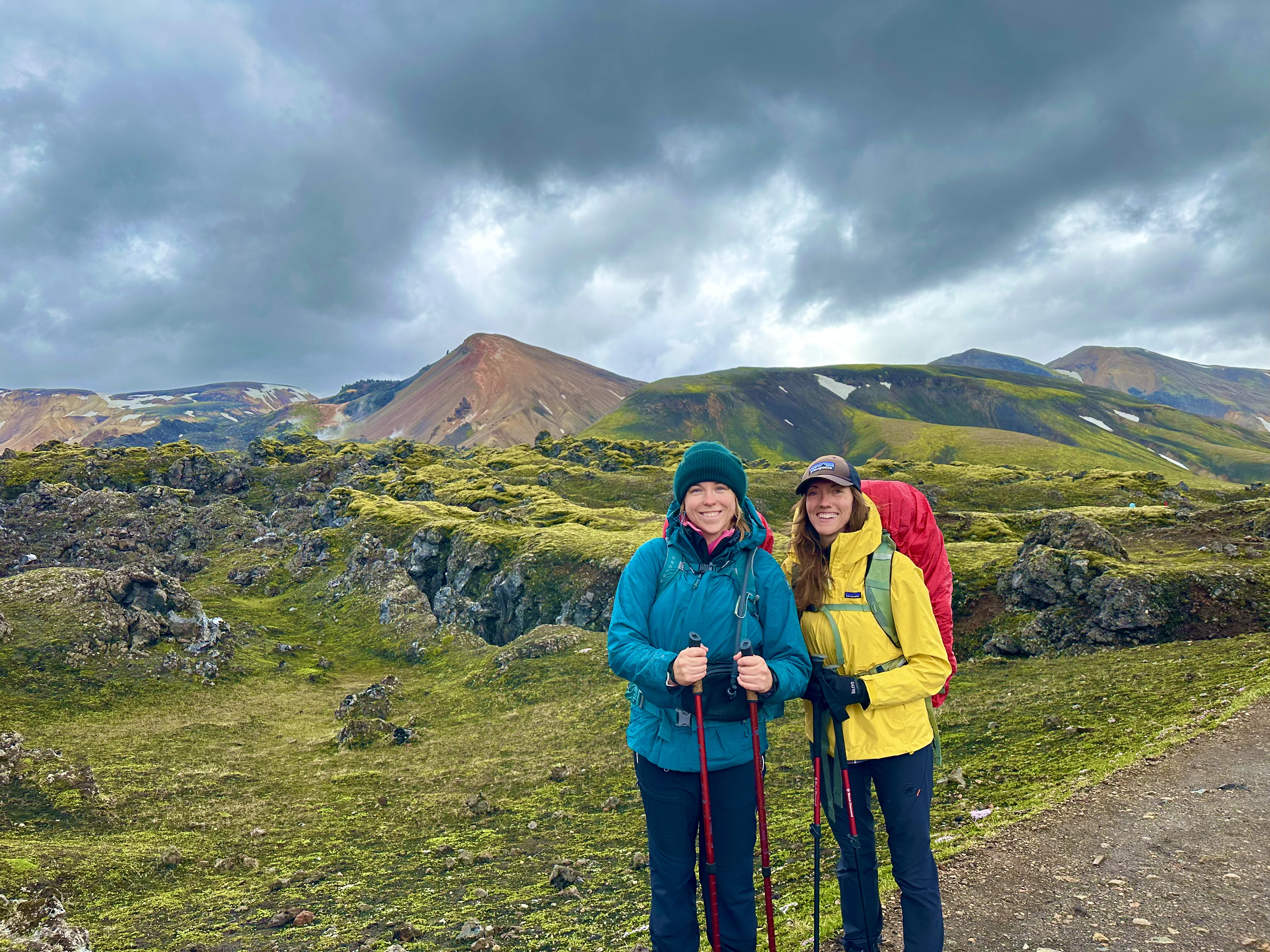
Eventually, we crested a rhyolite hill and descended into a snowfield. This wasn’t entirely surprising. The trail officially opens to hikers in mid-June, but peak season is July, when the weather is warmer and more consistent. Early June, we’d been warned, was a meteorological grab bag: anything could happen. You might hike in shorts or in down jackets, in rain or in hail or in snow.
Our first few snow field traverses were just fine. The snow was packed down and dirtied with boot tracks that showed us where to walk. Again, the terrain changed from rhyolite to rubble, and the weather changed from variably sunny to decidedly rainy. It rained without ceasing. The clouds above were devoted to getting us completely soaked, and they succeeded.
At one point, Mel asked, “Do you think we should put on our rain pants?”
My Mammut hiking pants were doing okay thus far, and putting on rain pants meant taking off my hiking boots, so I foolishly suggested we keep going. Maybe the rain would stop. It wasn’t far til the hut now.
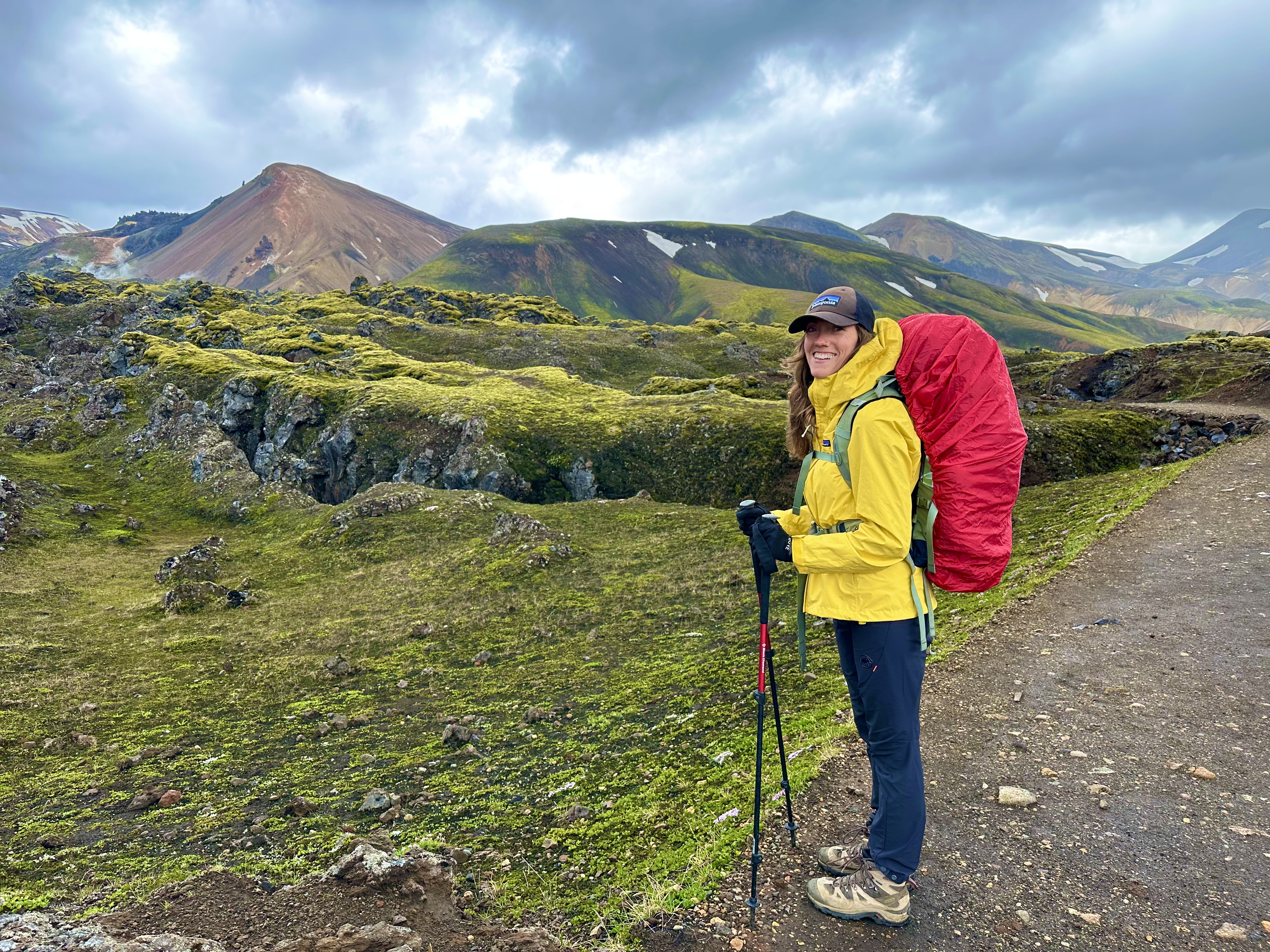


By this point, I was realizing how ill-prepared my hands were for the cold. My GoreTex gloves were a miracle in the wind; I would feel the cold wind on my cheeks, whereas my hands were shielded. But the rain was another matter. Soon, my fingers were so cold they began to hurt. This isn’t unusual for me – circulation in my hands isn’t great – but it was highly unpleasant.
Each uphill brought warmth into my fingers, but every downhill made them cold and painful. I imagined myself freezing to death, my fingers impossible to pry off the handles of my hiking poles.
We were descending into another snowfield and my pants were soaked with rain and clinging to my legs. By now, the snowfields had added a new element of fun: some of them had been melting, or streams were flowing beneath them, and they threatened to cave in. More than once, I stepped onto a snow field to see running water beneath the icy surface.
Behind me, I heard a yelp. Mel had stepped onto a snowfield and her boot had gone into the water below.
“My entire boot is soaked,” she said.
Not wanting to miss out, I planted my boot down on the snow a little later and felt the ice cover break and my foot flood with cold water. We slogged the next kilometer to the hut in sopping boots, my left foot squelching water down each time I took a step.
The last kilometer was one of those that feels like it’s actually three kilometers and someone mislabeled the sign, and you spend every step wanting to strangle that person. But soon the huts were in sight, and what a joyous sight indeed! We were 18th century whalers sailing home the sole survivors of a whale attack, clinging to driftwood, the three magi catching their first glimpse of the star that would lead them to the savior.

My email about the huts instructed me to present my reservation to the warden upon arrival, but when we entered the warden’s cabin, my hands were so cold I couldn’t remove my gloves.
“That’s okay,” said the woman. “I just need your name.”
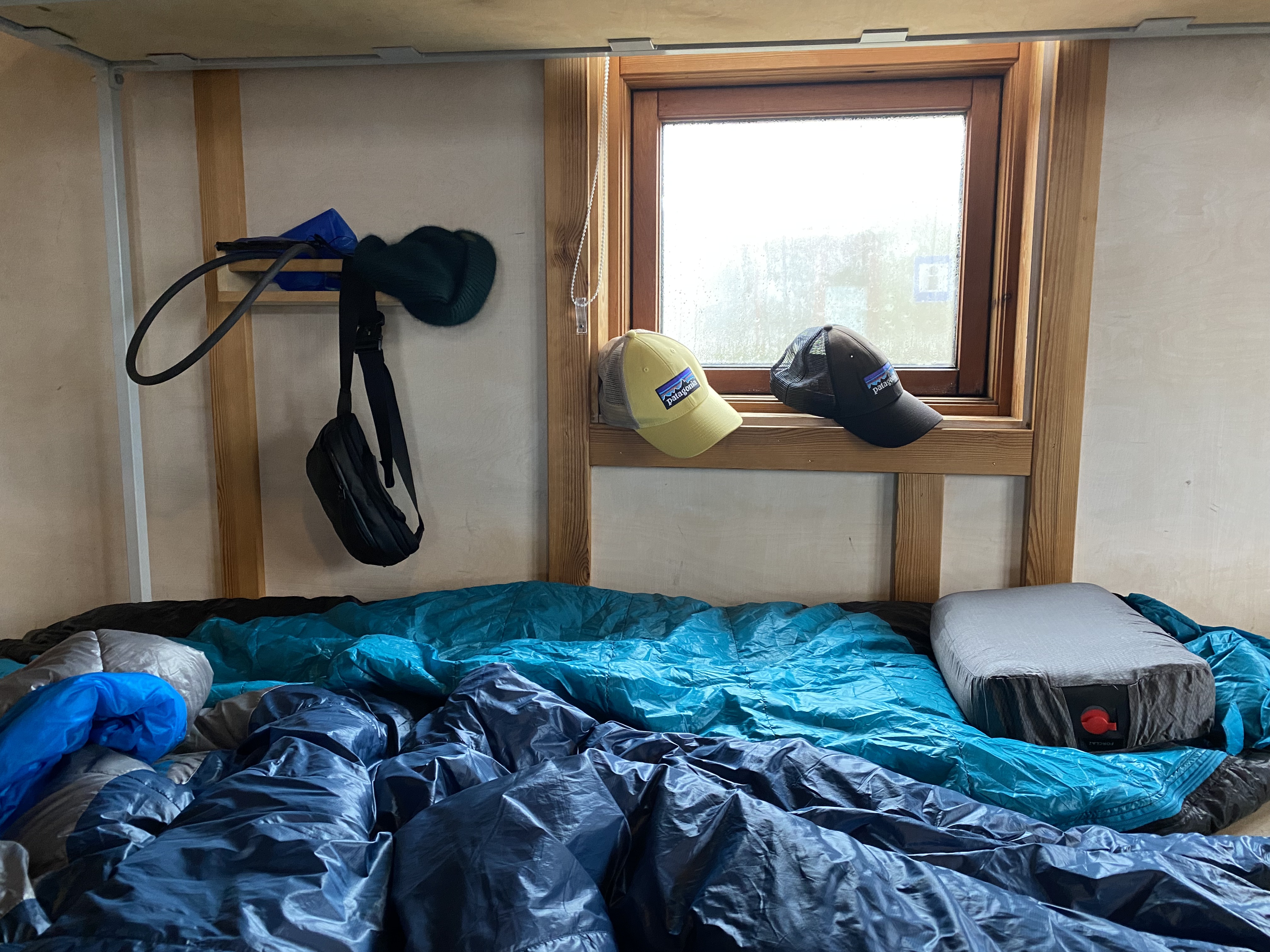
She explained that we were in room 2, and that there were bunk beds in the room. The bottom bunk slept two people, while the top slept one. We were to leave our wet gear in the entry room to dry, and the shared kitchen was available until 10pm.
Sodden and shivering, we entered the hut and peeled off our hiking boots. We made our way into the shared area, where a man in a beanie sat completing a jigsaw puzzle, and then entered our room. We claimed the bottom bunk of the bed nearest the door. (Two tour groups were occupying the dormitory-style rooms upstairs.)
The room was already occupied. Two tall men were lying on the bottom bunk nearest us, a woman sat at a wooden table in the middle of the room, slicing cabbage. A man was lying on the other bottom bunk across from us, drawing on an iPad, and two younger guys were coming and going.
We immediately began sifting through our bags, trying to get sorted. Our sleeping bags were packed down at the bottom, and Mel expertly introduced me to the bottom zipper on my bag, which allowed me to grab my sleeping bag and pull it out without taking anything else out. While in there, I selected my dinner for the evening by grabbing one of the dehydrated food bags: vegetables with couscous.
I piled on layers and layers of clothes and a warm hat, shivering while I ate part of a Clif Bar.
“I’m worried,” said Mel. “Your lips are blue.”
“I’ll warm up,” I told her, but really, I was feeling quite unsure about the whole thing. It was supposed to rain again tomorrow – was I really prepared for this? Would every day be a battle to keep my fingers warm? Would I get gangrene and lose them, and never play guitar again? Who knew?
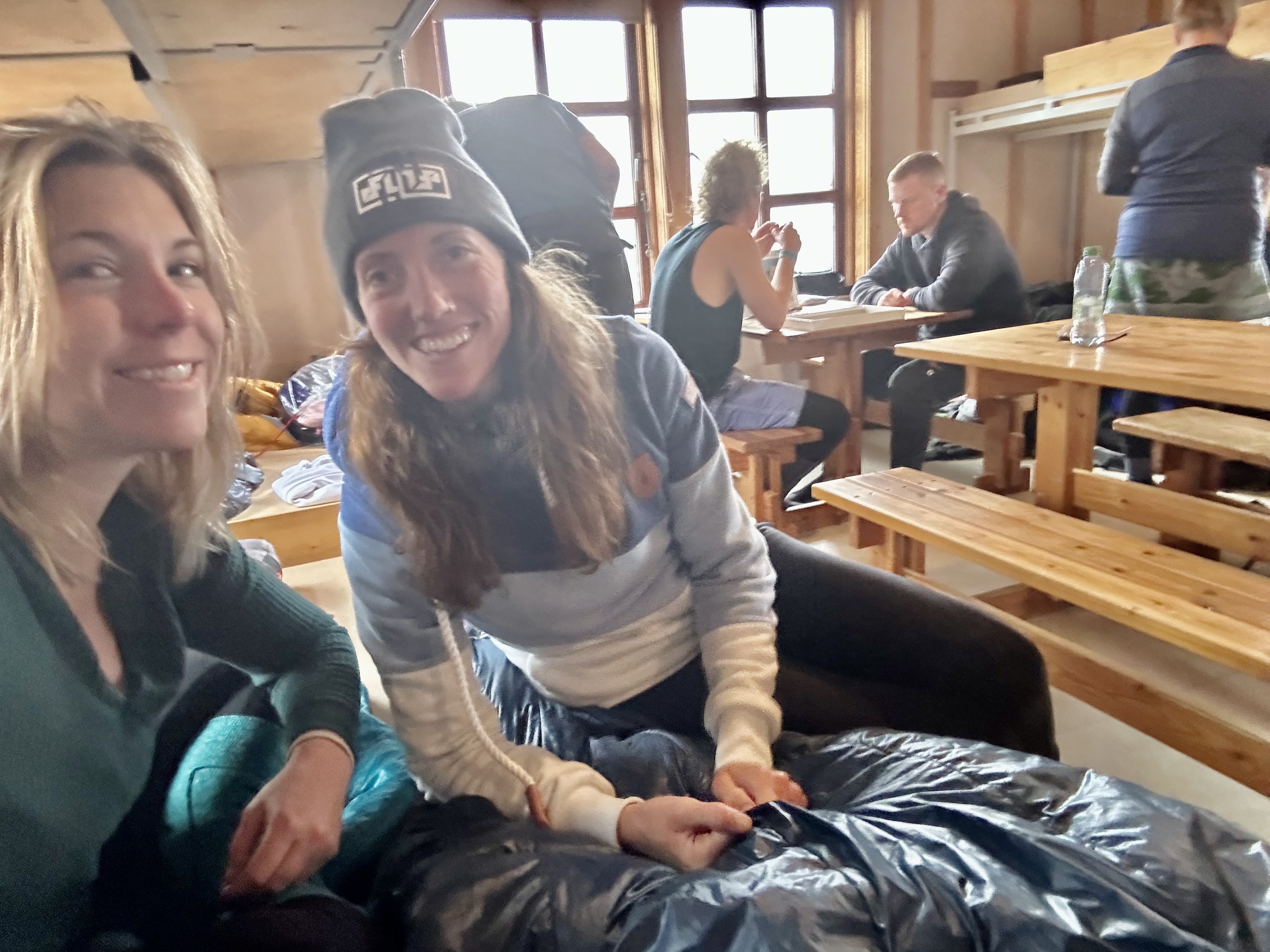
I sifted through the top part of my pack and lamented the fact that I had no idea where anything was. Where was my chapstick? My cutlery? My charging pack?
“Your bag is your house,” said the woman at the table. “You gotta figure out where your bathroom is, your kitchen. Your bedroom. Once you do that, you’re set.”
The woman’s name, we found out much later in the trip, was Anna. She was traveling with her husband, two sons, and their friend, and her hiking know-how, wit, and general cheerfulness led Mel and I to call her “the matriarch” until we learned her name.
Where Mel and I were newbies in the hiking world, this was not Anna’s first rodeo, and she was fast to share what she knew.
Our hiking boots, sitting in puddles in the entryway?
“Take out the soles and wring them out,” she told us. “They’ll dry faster.”
Wringing mine out, a deluge of water poured out and into the rubber mat on the floor. Mel tipped the boots upside down on the heater and left them there to dry.
Need to spice up your meals?
“I always bring carrots – they’ll last a long time – capsicum, you know, red pepper,” she explained. “And limes. They’ll spice up any dinner.”
As Mel and I boiled water and poured it into our bagged dinner, Anna handed us a mug.
“Have a sniff and tell me if you’re interested,” she told us. Inside the mug was a “centimeter” of Australian vodka – “from Sydney,” she told us – and two slices of lime. I am not a lover of vodka, but my freezing fingers and slightly dented morale made a vodka drinker of me.
Anna held up a Sea to Summit pouch.
“I bring this on every trip. It carries the alcohol,” she said. She went out and came back in with two mugs for Mel and I, two limes, and some vodka.
Soon, everyone in the room was chatting. Anna’s younger son, Gil, mentioned that there was an obsidian raven outside the hut, and so we all tried our best to recite Poe’s “The Raven”, with Mel and Gil filling in most of the lines.
(This is now the second time Edgar Allan Poe has entertained me in a sort of lockdown situation. The other was in Cairo, during a power-outage, where we sat on my friend’s balcony smoking shisha in the dark while one guest recited Poe’s “The Conqueror Worm”. See? It pays to be a lifelong reader and lover of lit.)
At one point, I read to Mel from my Laugavegur book: “Look,” I told her. “It says here that some drainages will have snow bridges in various states of decay.:
“Yes,” said Mel, “We realized that today. A snow bridge decayed on my foot.”
The two Dutch men passed around a bag of candy called Duos, half-licorice, half-fruity gummy – and asked us our names, where we were from, and immediately what we thought about American politics.
Slowly, because of the passing of time or maybe the Australian vodka, I began to warm up and feel like a human again. I showed Mel my vedur.is website that predicted lots of rain for the next day.
“What if we get out on the trail around 6?” I said. I pointed out the window at the warden’s hut, where the weather forecast was written on a whiteboard. It said, for the next day, 9am would be cloudy, but noon it would be rainy and very windy. In fact, there was a wind warning in effect for southeastern Iceland the next day.
“Let’s get up at 5:30,” Mel suggested. With this plan hatched, we went into the kitchen to make dinner (aka boil water to pour into our bags). Anna and her husband, Simon, were making a proper dinner, a pot full of pasta and vegetables that Anna had been preparing when we’d entered, when one of the tour guides, Edith, entered the kitchen.
“Are you with the other tour group?” she asked us. We said we were not.
“We’re independent travelers,” Anna told her.
“Are you aware there is a storm coming in tomorrow?” she said. “It’s not going to be good. It will be the worst at 6pm, but by 1pm, it will rain so much, you will think it isn’t possible for any more rain to come.”
We all exchanged worried looks.
“I know the hut rules are quiet hours from 10pm until 7am, but I have been asking everybody if they wouldn’t mind us getting up at 5:30 so we can get out early to beat the storm,” she said.
We all agreed that we did not mind the noise; in fact, if the tour groups were leaving early, it meant Mel and I could have coffee before we left. The hut kitchen was closed until 7am, which meant the gas wouldn’t turn on until after 7. But the tour groups included breakfast for everyone, so they couldn’t leave until food was cooked. The warden would have to turn on the gas. In our minds, it was a win-win.
We shared our plan with the Dutch men in our room as Mel and I ate dinner. (My couscous was super filling, especially after the sandwich I’d eaten, and it was also super salty. Mel’s pasta primavera looked way better.)
A few minutes later, the other tour guide, Greta, entered. Greta was a formidable blonde woman who wore her Icelandic sweater the entire trip and looked like she could reroute the weather if she wanted.
“I am just double-checking that Edith came to talk to you,” she said. “The warden has said no to our request to leave early. I want to be sure everyone in the hut agrees that we can be up at 5:30am.”
We all agreed again, but even Greta’s plea to the warden was met with a “no.”
“He’s pissed off two Icelandic women,” Greta said later. “And we will be filing a complaint. It isn’t safe.”
With the wind warning, it would be especially dangerous on the ridge the next day. Plus, the first river crossing was tomorrow. Edith’s tour group was apparently one of the fastest that had ever come through. Greta’s was a little slower. Either way, they didn’t want to risk being out in the weather.
We all agreed that we’d get up anyway. Around 8pm, we climbed into bed. The window was open, the door to the room ajar, and a cool breeze filtered through. As soon as my head hit my pillow – a packing cube stuffed with my warm clothes – I was asleep.
Categories: Iceland
 Lost Among Latitudes