In the morning, Mel and I awoke to the most stunning sight of all: sunlight over the lake. Clouds were parting and the sky was all shades of violet, strawberry pink, and light gold. We made coffee and our apple crumble dehydrated meal (labeled a dessert, we can both attest that it serves quite well as a breakfast, too) and discussed the events of the night before.
We both decided that, if you are a person who snores and you choose to go on a group tour or an excursion that requires you to share a room with other people, you must sign a waiver that gives consent for any member of the group to turn you over if you begin snoring.
“For the good of the group,” we agreed.
“For the record, if I snore, please, please roll me over,” I told her.

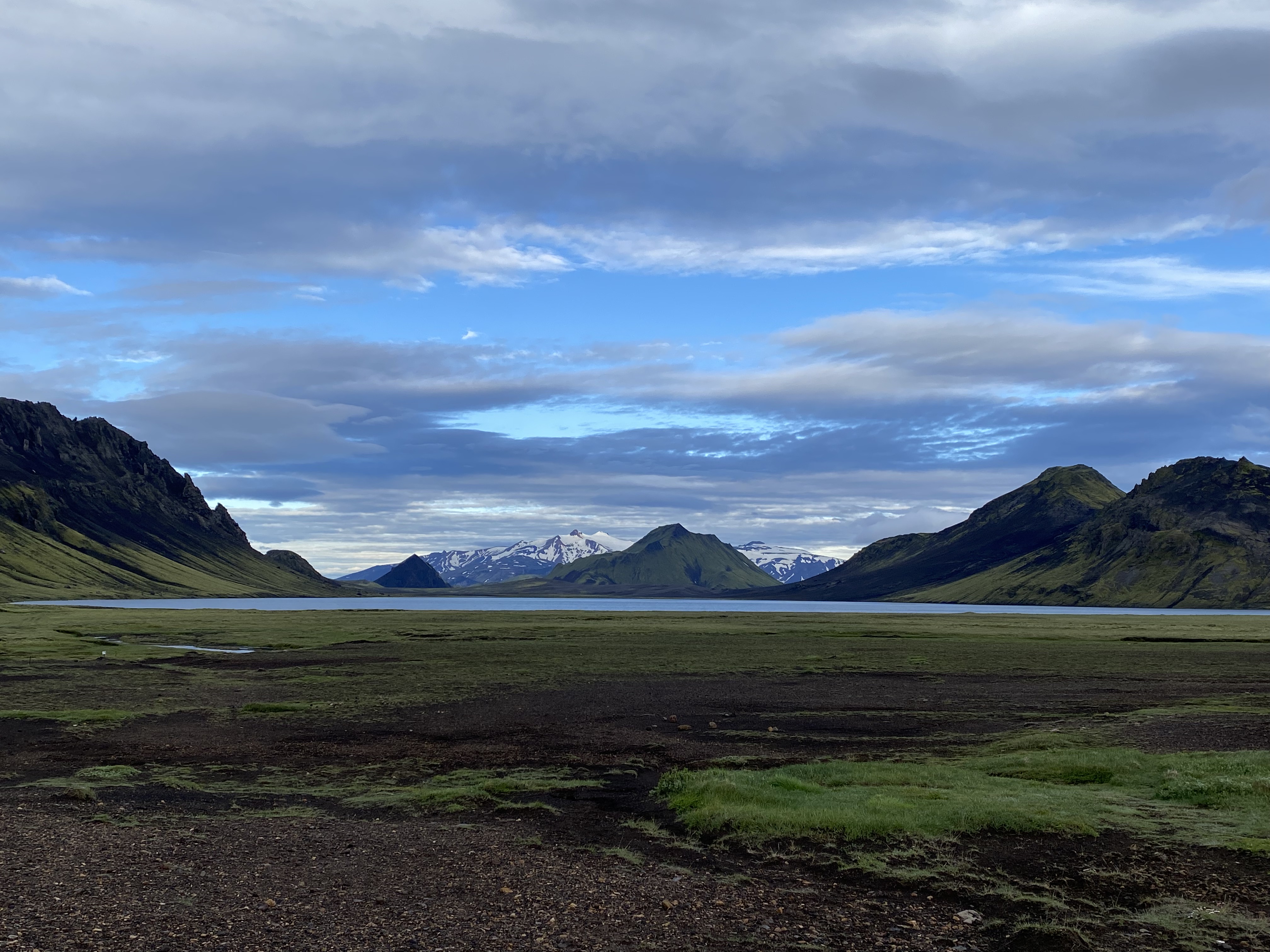
We set out around 6:30/7:00 in the morning. Without the threat of bad weather, we took our time and relished in the glory of the sun. (Not to be caught unprepared, we kept our backpack covers on the whole time, as well as our rain pants.)
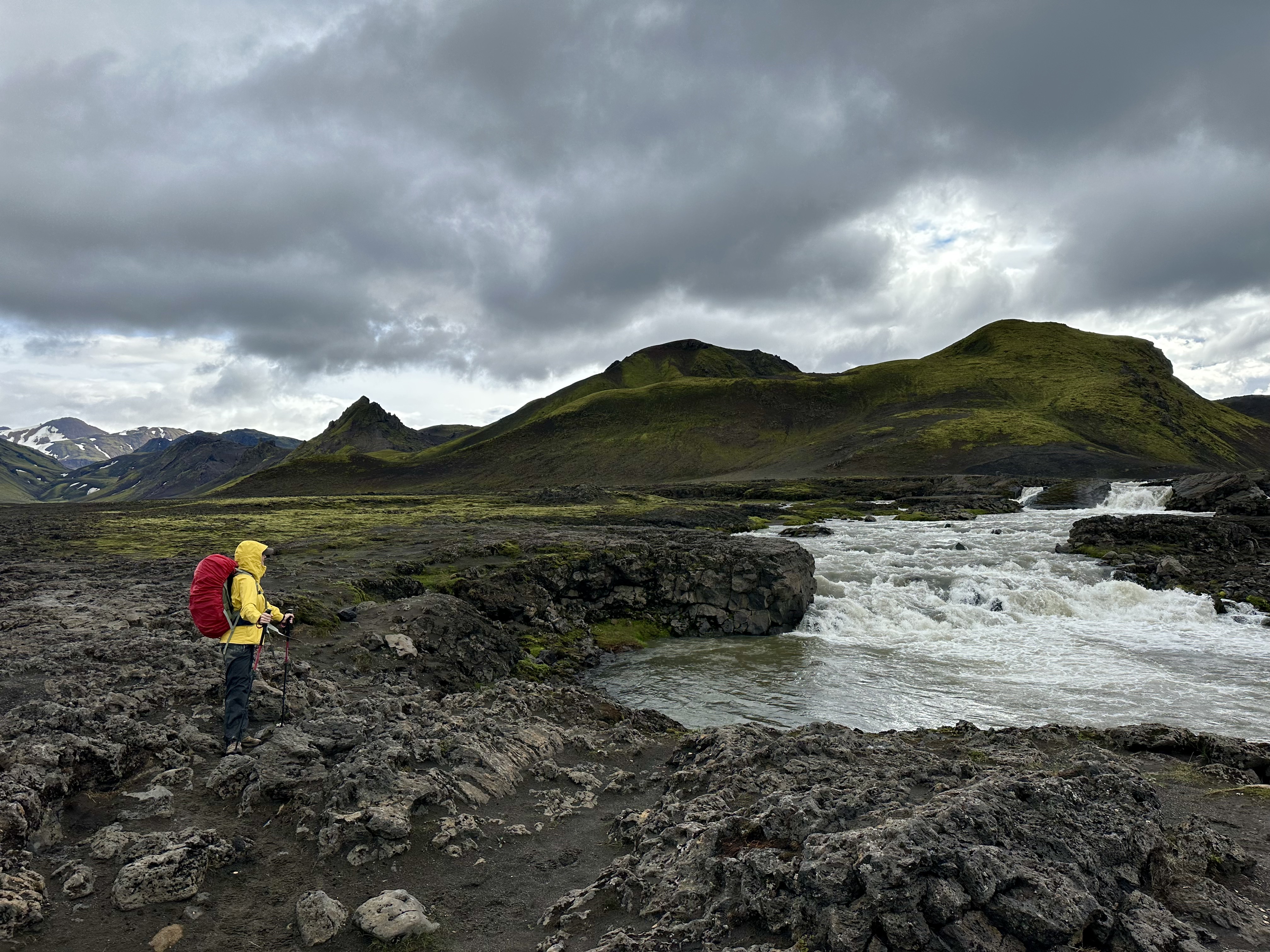
We came over the first hill beyond our hut and down it to our first string-free river crossing. I think this was the Bratthálskvisl. We had to figure out where to cross, but the Dutch men had gone on ahead and pointed to us from across the river.
This river, I learned, was a braided river, meaning the water flow is braided with gravel bars. If you can find gravel bars and shallow areas, you can cross the river pretty easily.
This was the river that the woman the day before had assured us would come up to our hips. We set our packs down and perched on large rocks. I unlaced my boots, pulled my river shoes (Velcro Tevas) from a side pouch on my backpack, strapped them on, and then tied my boots around a clasp on the side of my backpack. Unlike yesterday’s crossing, where we packed in our poles and relied on the string, we kept our poles out for this one. The river may have been shallow, but the current is still pretty strong.
It seemed like the woman from yesterday had perhaps crossed at the wrong spot. Instead of being waist-deep in glacier-cold Icelandic river water, we crossed easily, shin-deep on the first one, knee-deep on the second.
In a manner of efficiency I was proud of, I’d packed my camping towel at the very top of my bag. Once across the river, I opened my backpack, easily pulled out the towel, toweled off, and was back in my boots and ready to go in no time.
Under the sun of a new day, we both felt confident and joyful. My book had described an “unreasonably photogenic volcano, Stórasúla”, which we kept our eyes peeled for, but never really found because every single mountain, hill, volcano, or pile of ash or boulder rising from the ground was, to our eyes, “unreasonably photogenic.”
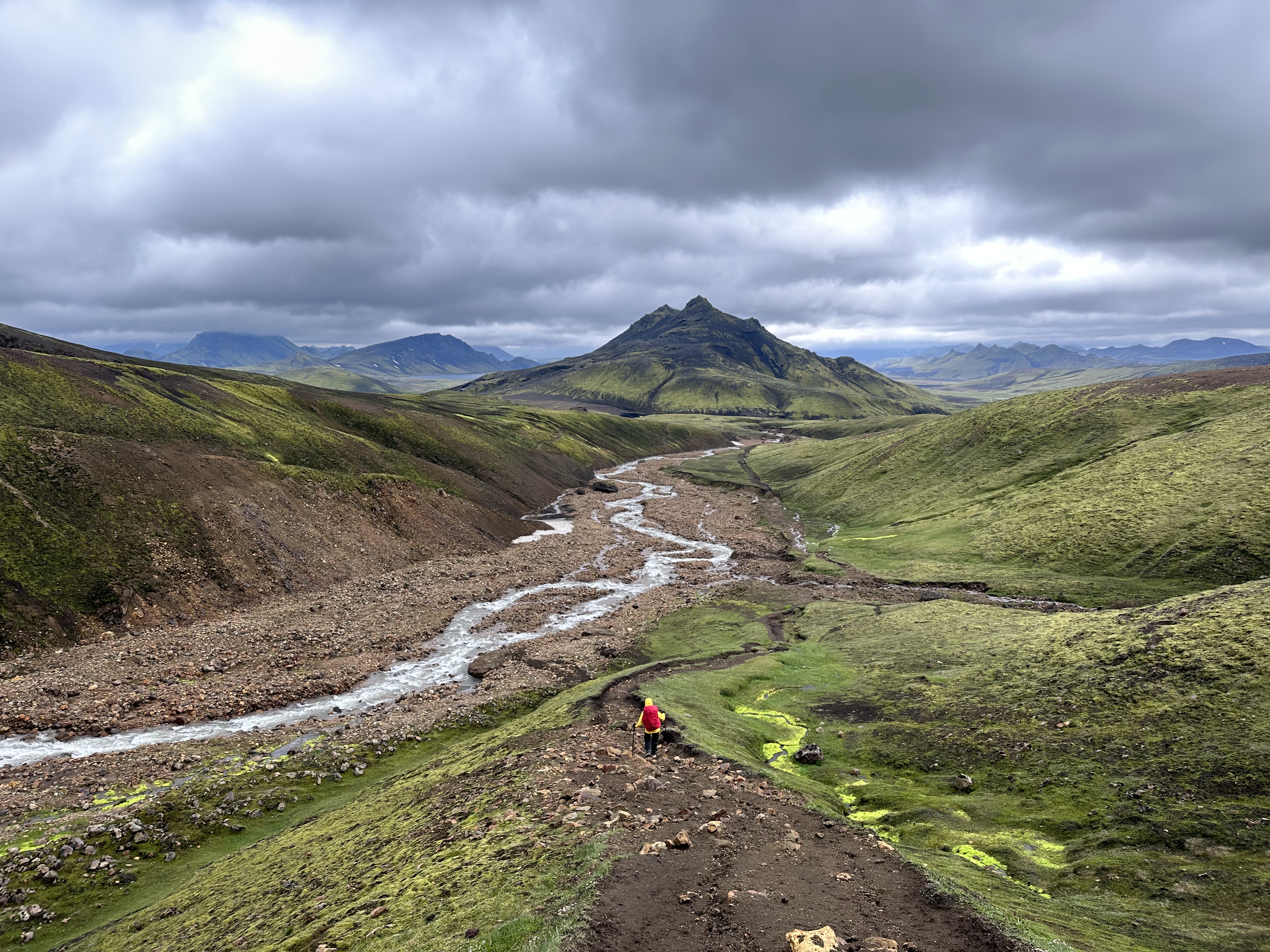
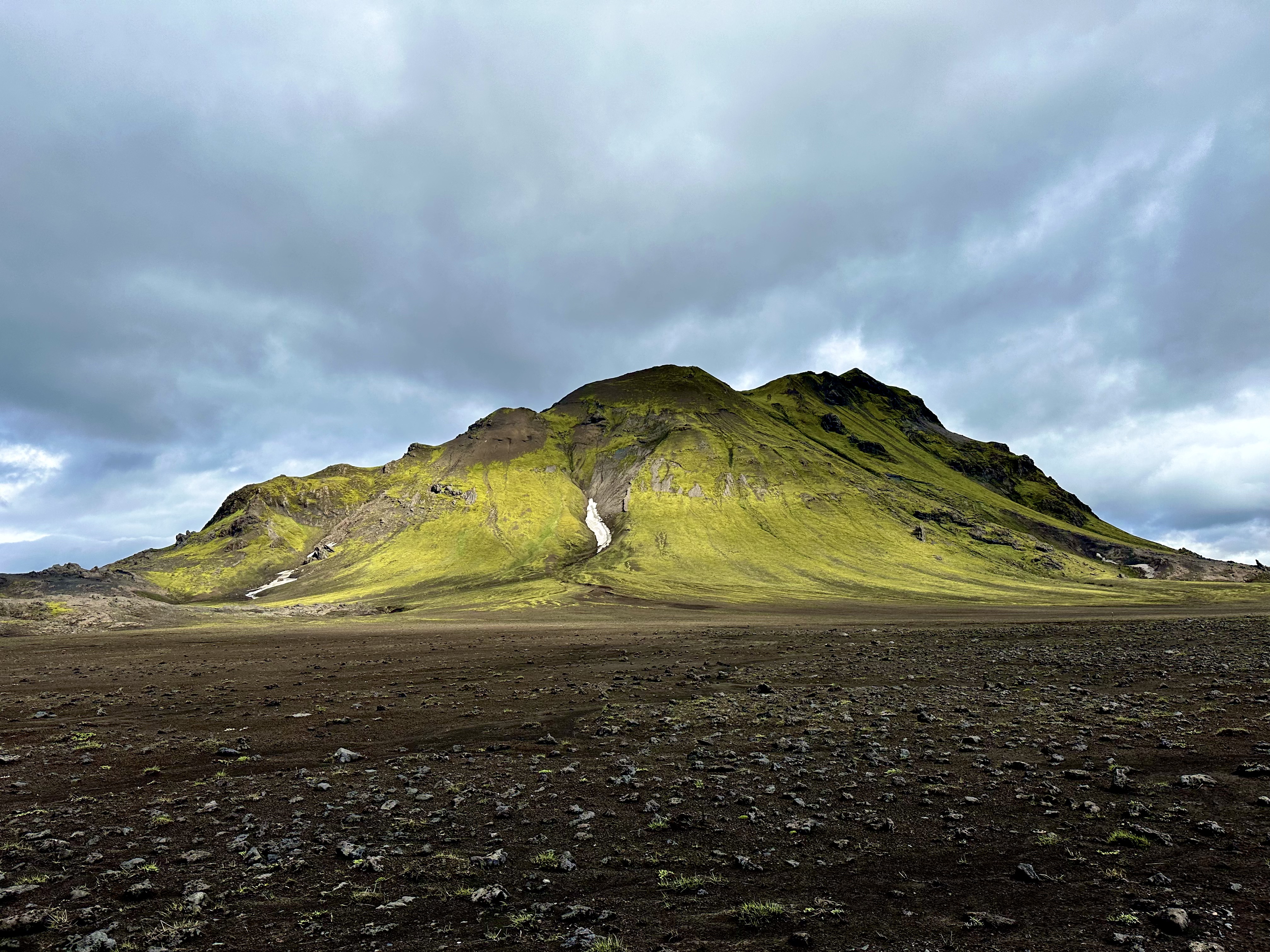
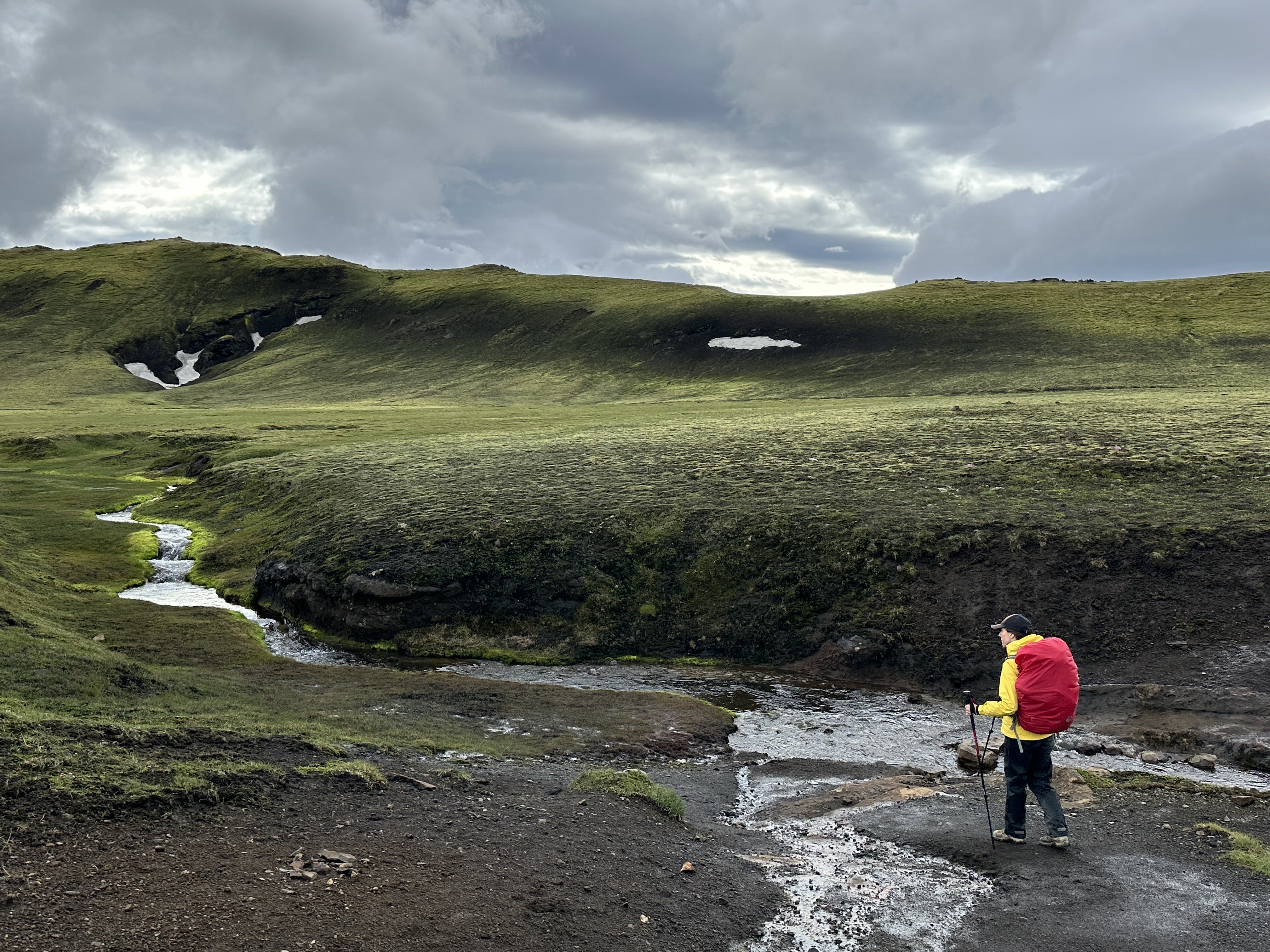
Our 16km hike took us through a verdant valley, before we reached our next river crossing, the Bláfjallakvisl. (Did you think that was a typo, and that I wrote the same river twice? Nope. Very different.)
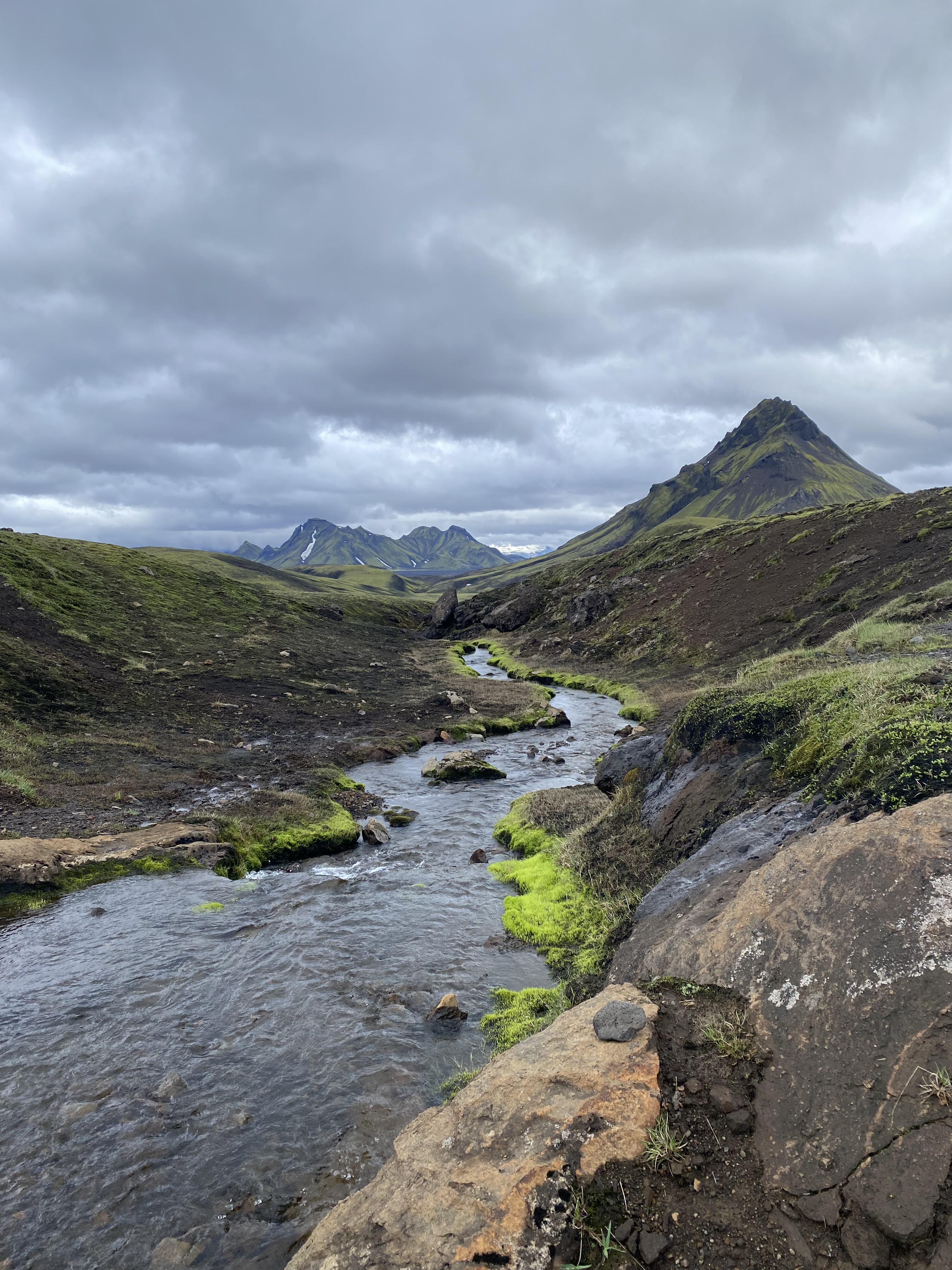
Another cold dip in the river, knee-deep this time but still refreshing beneath the cheer of a sunny sky.
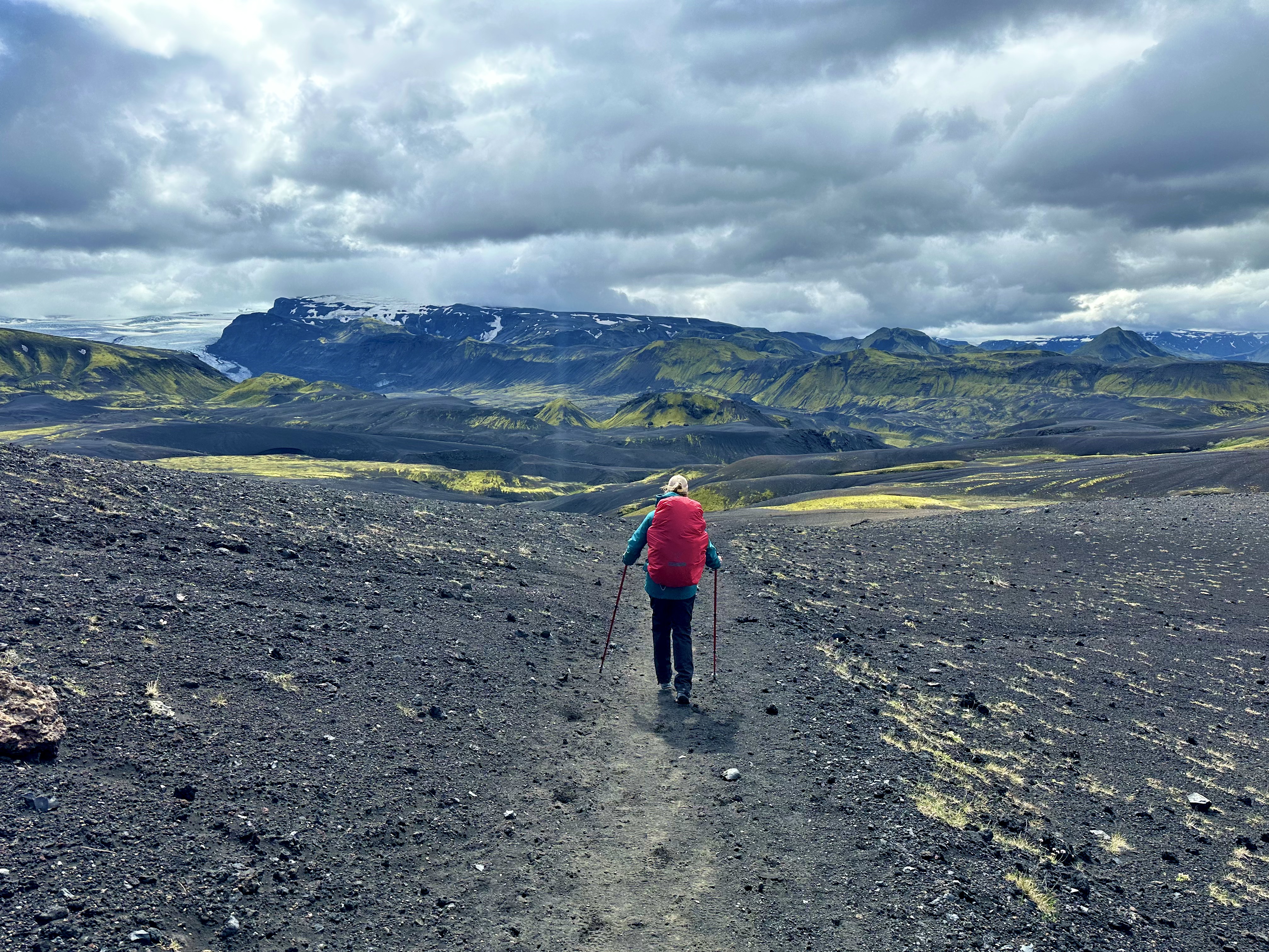
From there, we left the velvety green mountains behind (mostly) and entered a “lava desert”, strewn with lava bombs. My book defines lava bombs as “blocks of rock formed when gobs of molten lava were shot out of a volcanic vent. As the gobs flew on their ballistic path, they cooled somewhat before slamming into the ground.” The author describes four of the common shapes that lava bombs take, and Mel and I searched arduously for the one called the “cowpie bomb”, but to no avail.
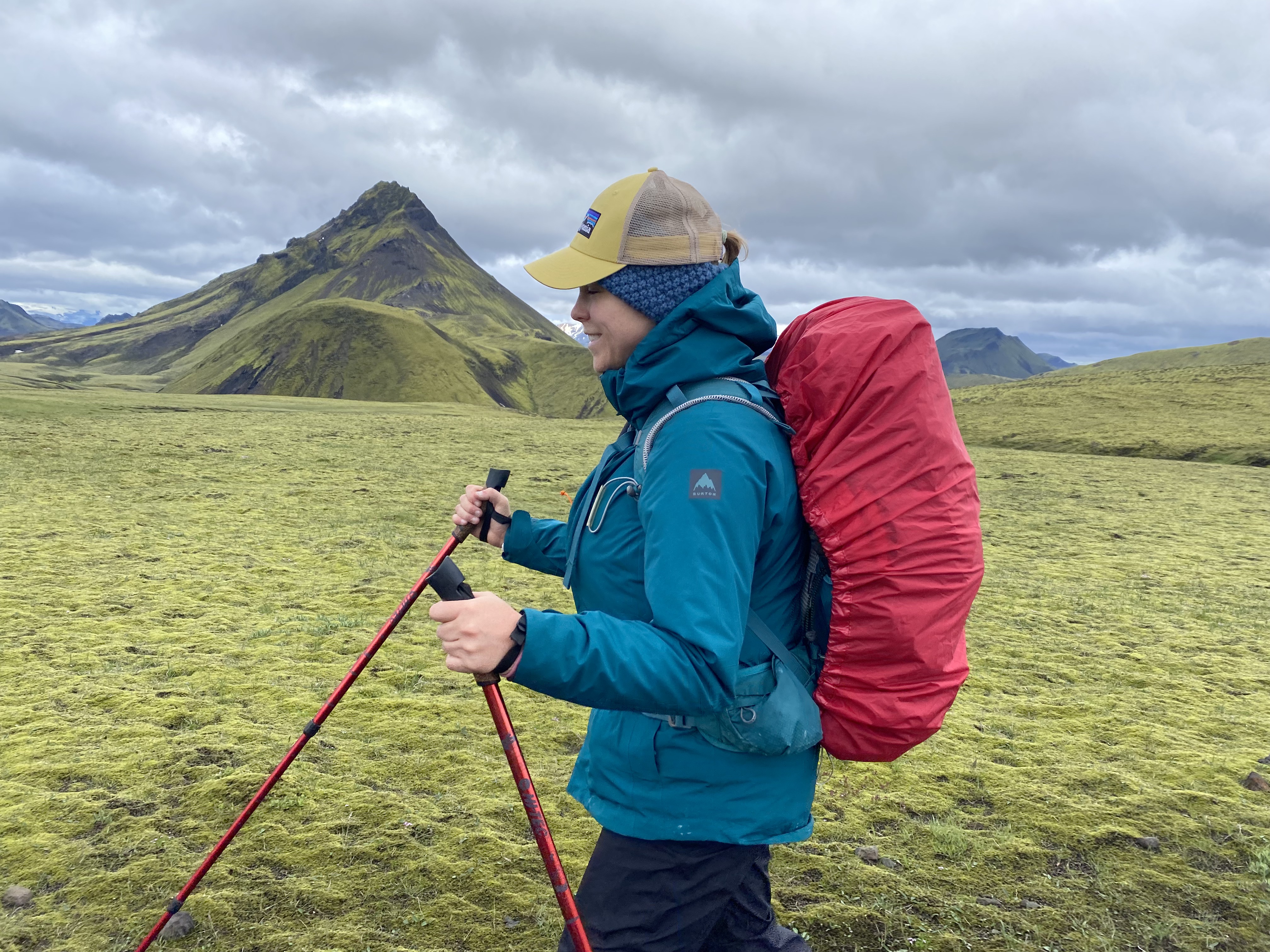
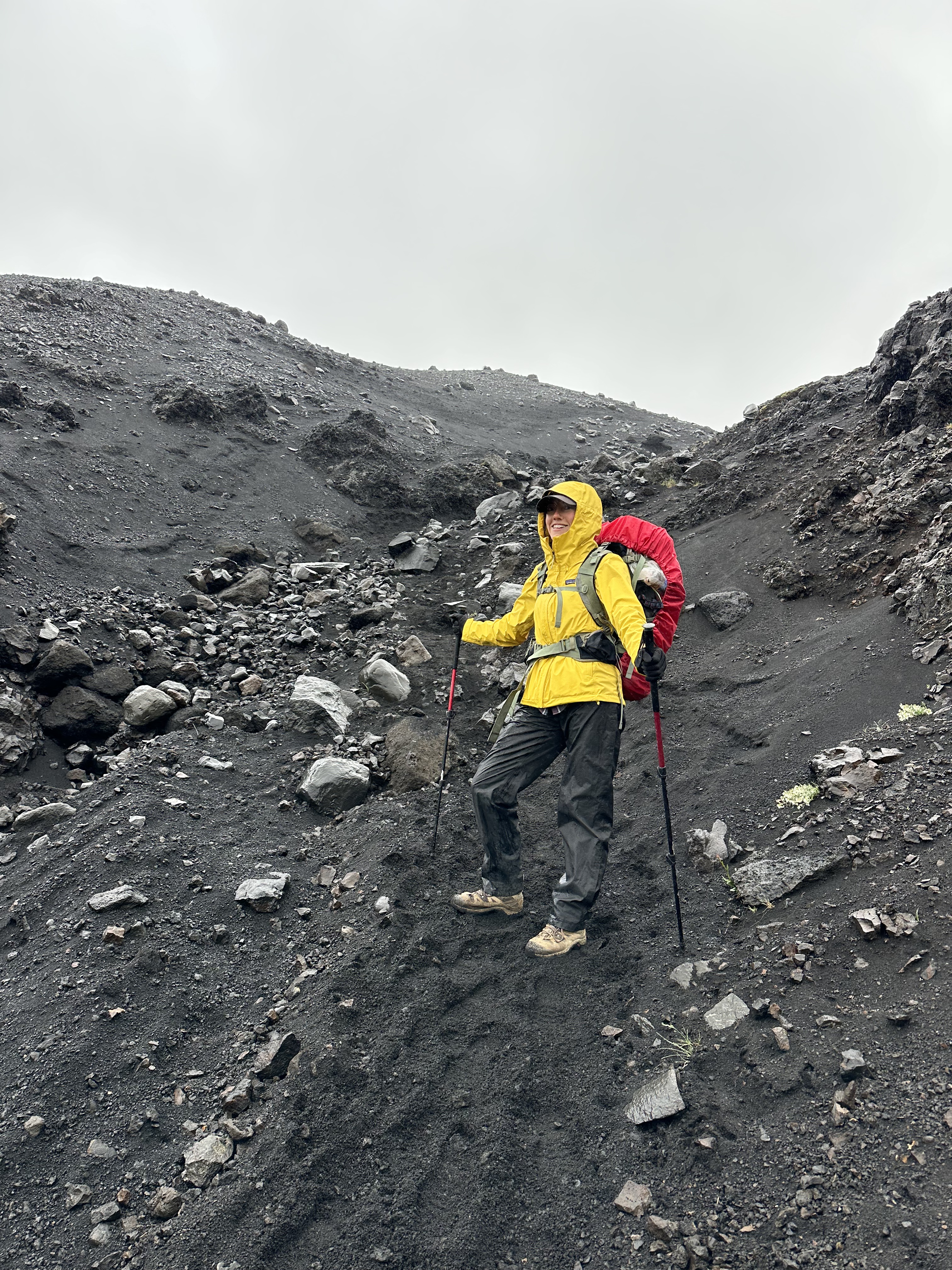
Later, skimming by handy Kindle book, I read about jökulhlaups, which are basically ice cold rivers of volcanic ash unleashed by eruptions. When a volcano erupts, it can melt the glacier or ice cap on it, and the magma and water cascade down into the valley below. Our path took us through the ash and lava bombs left behind by a previous jökulhlaup, and while we were both aware that we were walking among volcanos and in the literal ash of previous eruptions, we were taken a little aback when I read the following out loud, from my book, later that afternoon: “The signs show where jökulhlaups have flowed in the past and the best escape routes should an eruption occur. In such a scenario, the huts have flares and cannon-like firecrackers to warn trekkers to move to high ground.”
We had somehow missed the signs – perhaps we were too distracted by the miraculous sunshine and the Tolkeinian landscape bursting all around us – but we certainly would not have known what to do if flares began erupting in the distance. How high would these flares go? Would we even have seen them?
All of this may sound a bit paranoid, but consider the fact that, during the week of our hike, Iceland was experiencing an earthquake swarm. Checking my vedur.is app, I saw that over the past three weeks, the number of earthquakes hitting Iceland was gradually increasing. And then, on the 4th of July, Fagradalsfjall, a volcano near the capital of Reykjavik and also near where our hike had taken place, had its activity level raised to “high”, with some news sources declaring an eruption imminent.
This is what I love about Iceland: it is danger and beauty, all at once. It is nature in its truest form: destructive, powerful, awesome, and capable of creating breathtaking beauty. It commands awe and respect.
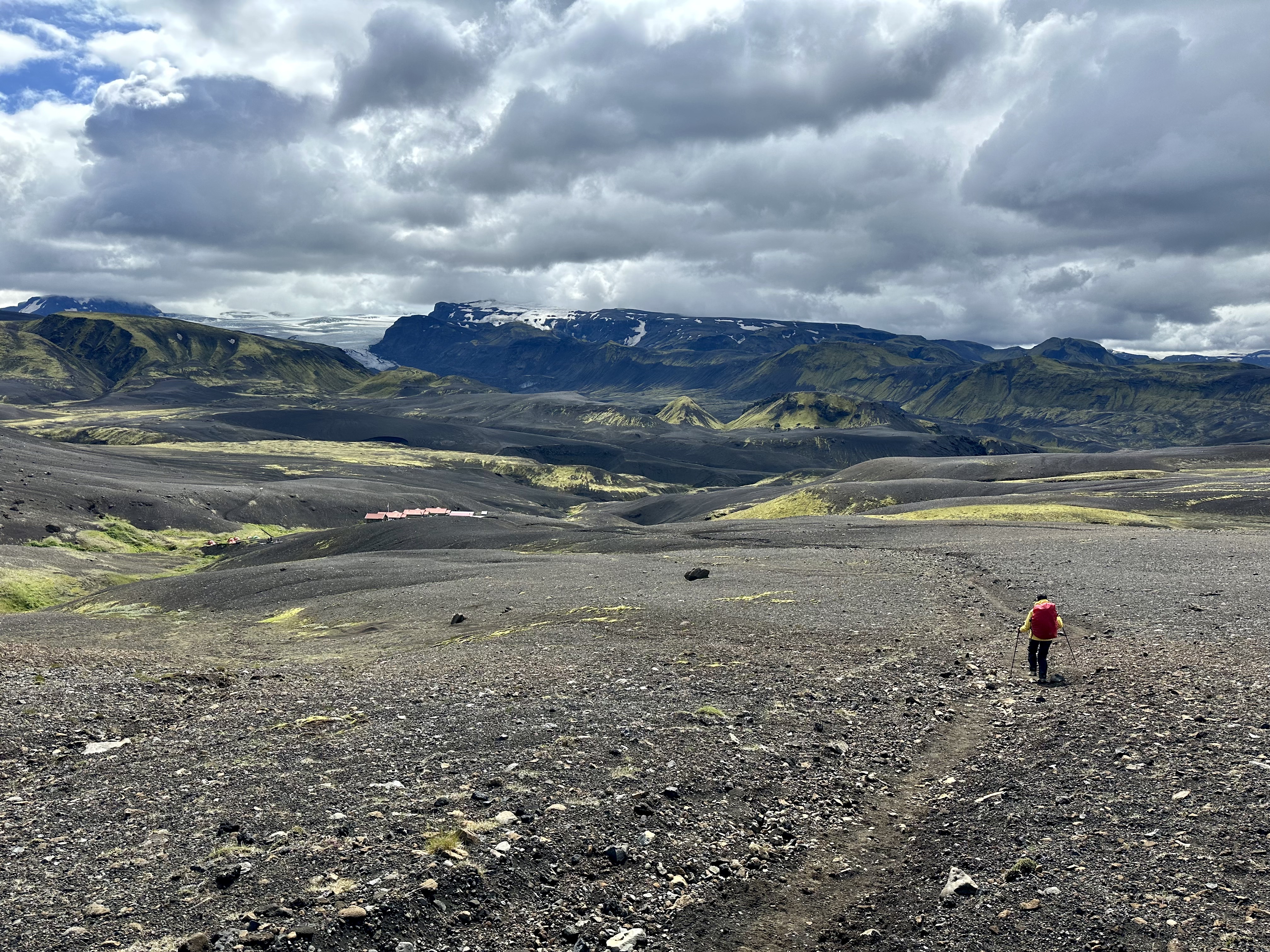
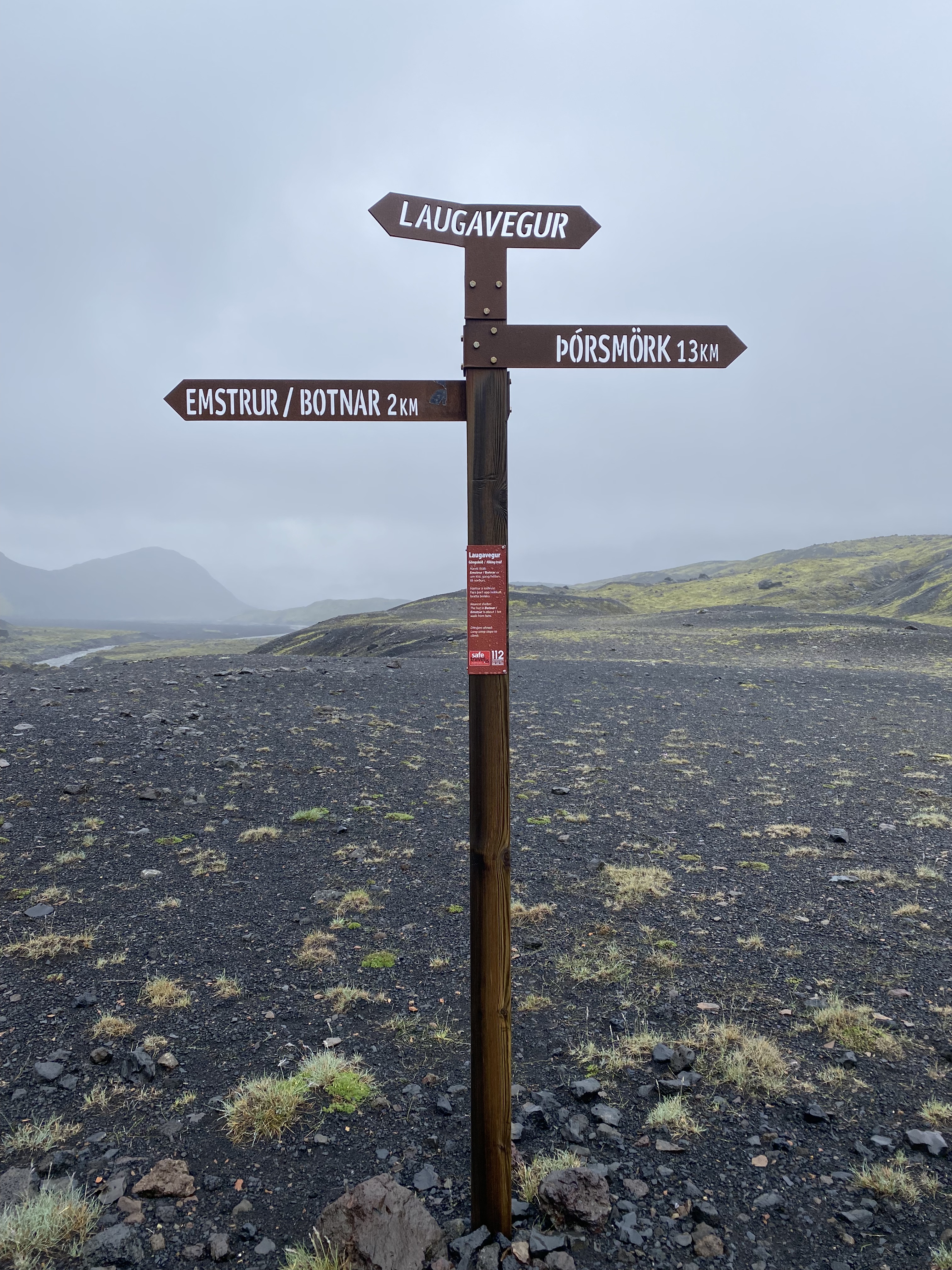
We continued walking through the lava desert, admiring pillars of columnar basalt, the bright pop of sea campion pushing through the black lava sand, and eventually, a view down to our huts for the night.
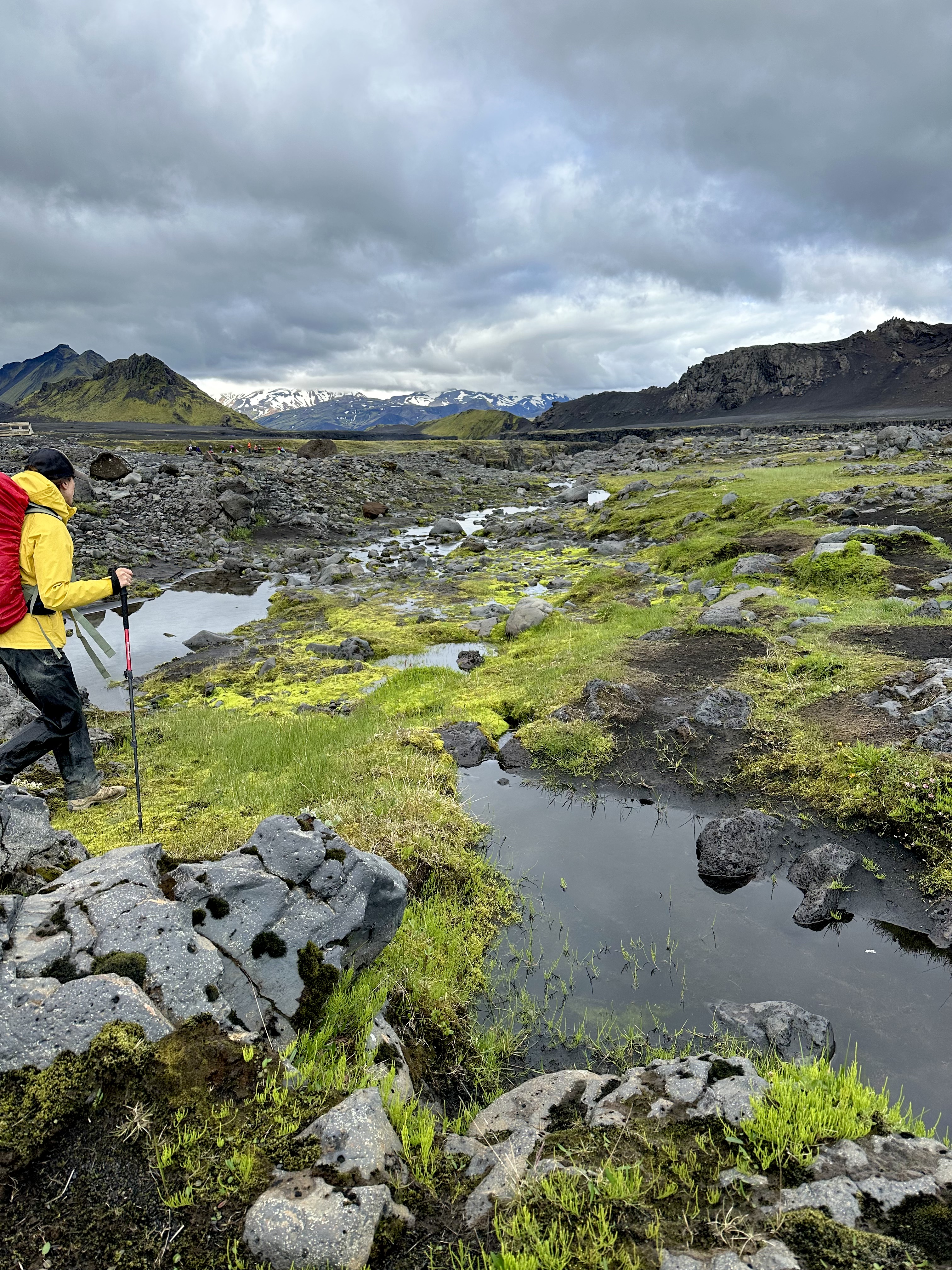
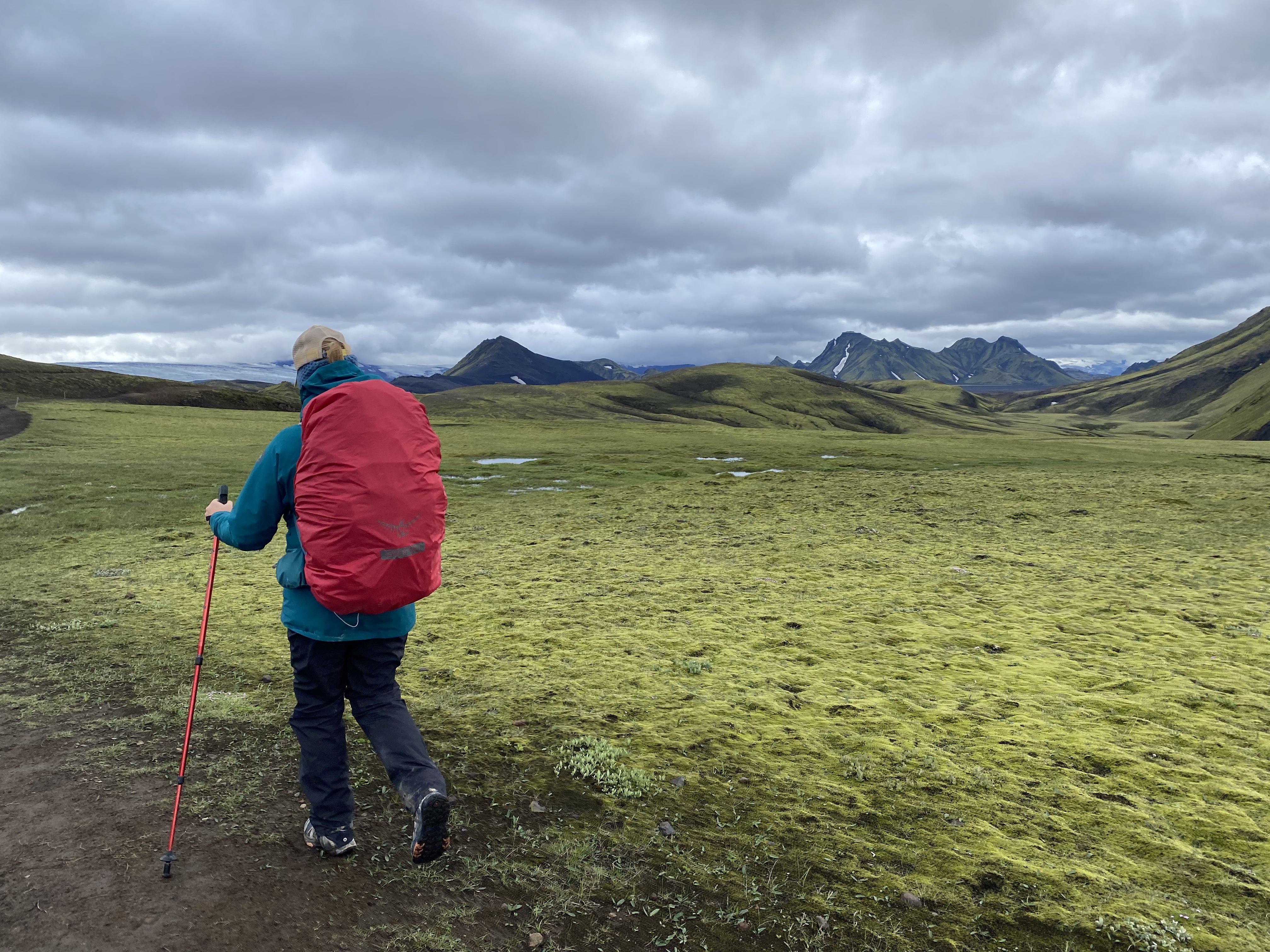
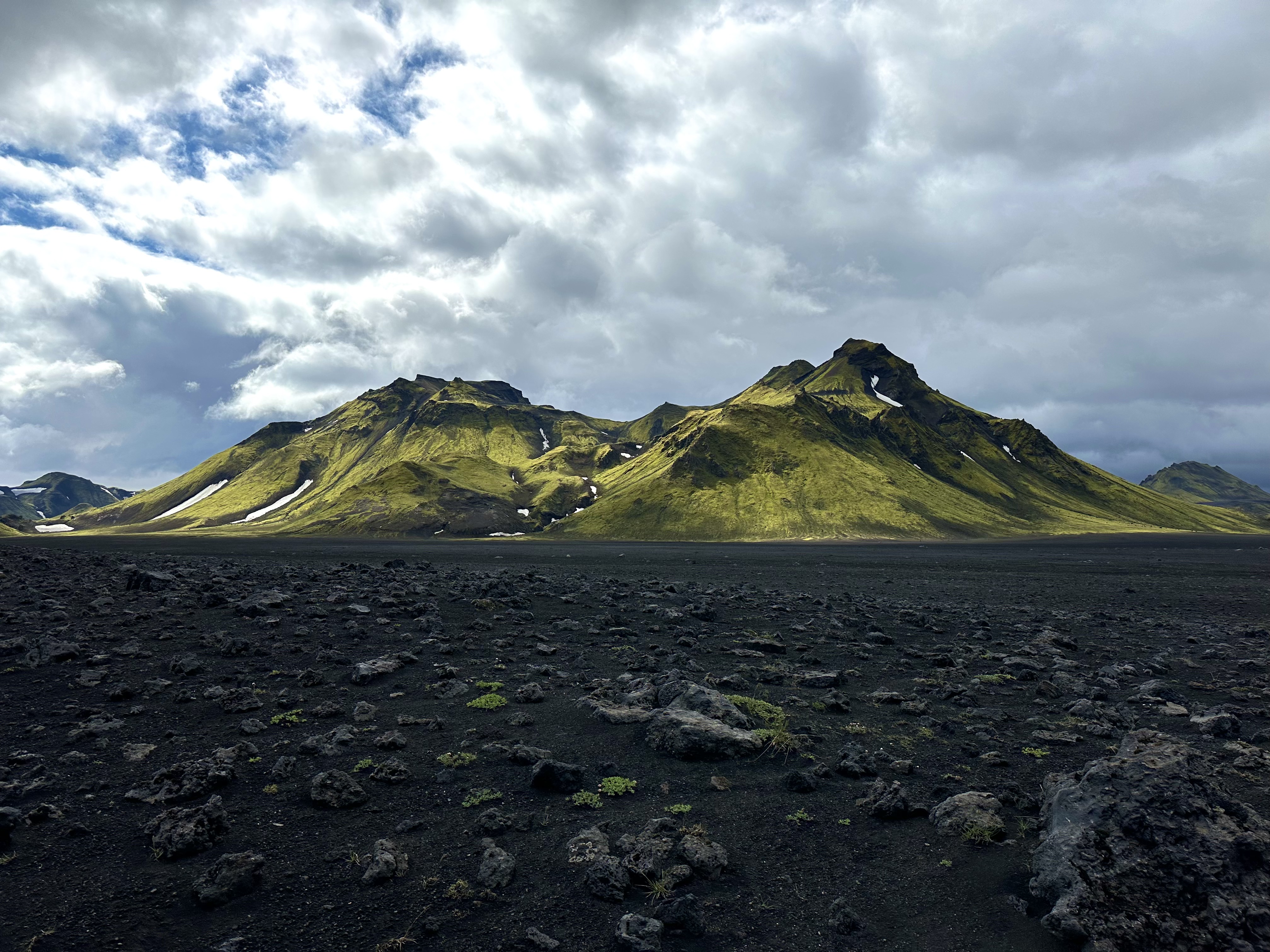
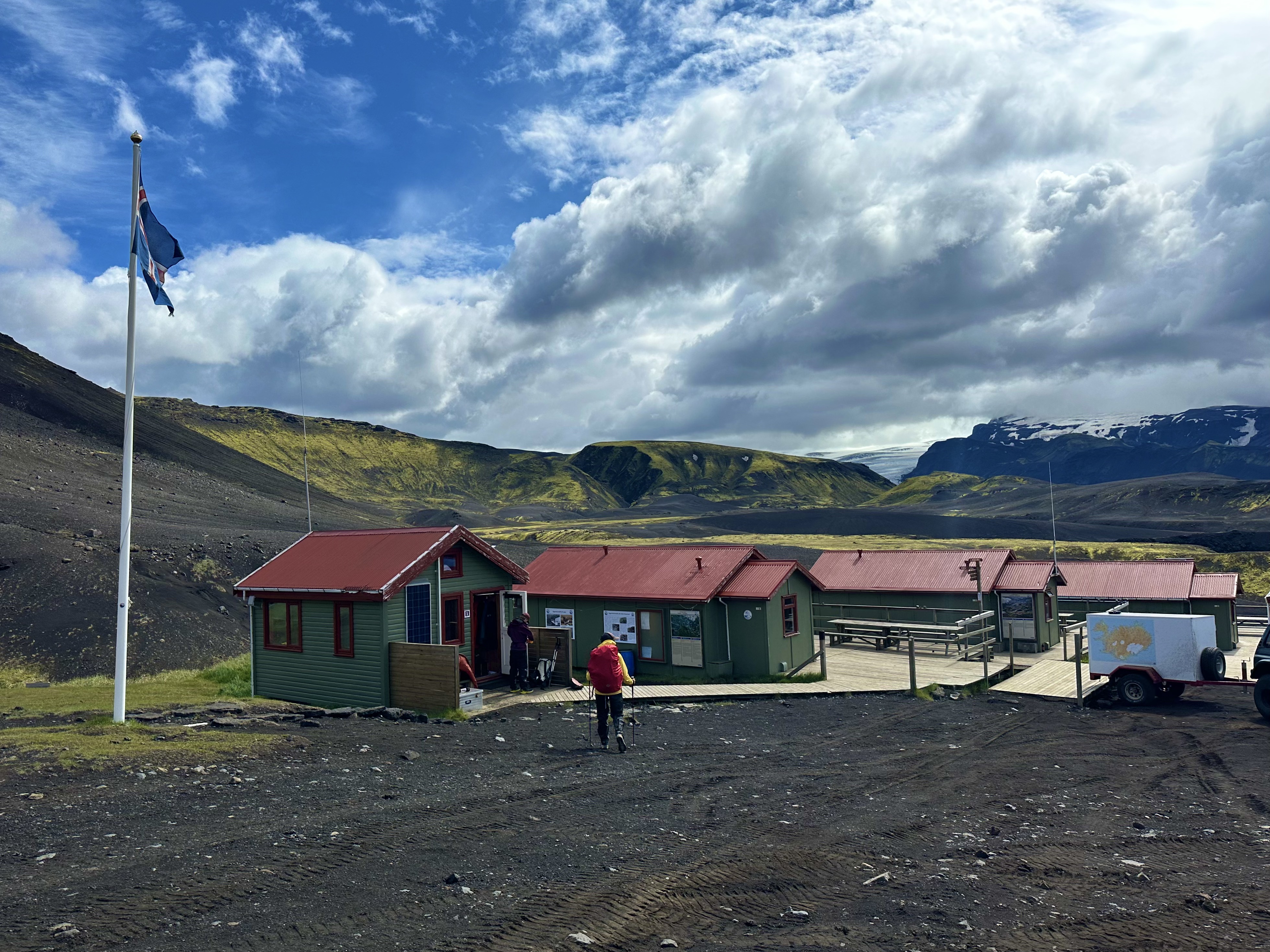
What a joy to catch a view of our huts beneath a sunny sky, the Icelandic flag flapping proudly! Of course, the sky behind us was slowly starting to curdle with dark grey clouds, but there was still enough blue left to be hopeful.
Our hut for the evening had its own deck overlooking the valley. When we checked in, the warden told us we’d be sharing the hut with one of the tour groups. We asked about staying in a hut with the other independent travelers, but the warden had split everyone up. Each of our buddies would be in a different hut with a different tour group.
This hut had its own small kitchen area, and several bunk beds all connected to one another with mattresses side by side. The huts along our journey all seemed to be intent on bringing everybody closer together: from a relatively private room on the first night (shared with other independent travelers) to beds lined up side by side, to now mattresses pressed against each other, Mel and I were getting quite close with the tour groups.
This group was Greta’s group, the slower one, and one of the guides was already there boiling water and preparing coffee and lunch for whenever the group would arrive. As Mel and I claimed our bottom bunks to against the far wall, she introduced herself as Andrea and we learned that she was on the hike to figure out what kind of equipment the tours really required.
“What are you learning?” I asked her.
“It’s food. The biggest thing we need is food – for people with different diets, having enough. It’s important to get that right,” she told me.
Mel had some coffee outside while I boiled water for my lunch for the day, a dehydrated jambalaya. Outside, Andrea told us she was moving to Tokyo to study international relations. I listened to her in between spoonfuls of what was basically salt with some rice thrown in. I had to force it down, since this hut site didn’t have trash disposal; it was pack-in, pack-out.
This was all fine until I went to dump some of the jambalaya in the toilet and realized, with some alarm, that my period had arrived an entire week early. Not a few days, but an entire week. Had I packed any sanitary products? Of course not.
Luckily, Mel had some backup tampons. I went to climb the hill to call my mom and check in – the huts didn’t have signal, either – and encountered the other groups heading down to the huts. Everyone was in good spirits and pointing out a nearby gorge we could perhaps explore later.
When I came back down, Mel had thrown her dehydrated meal down the toilet, and then announced to me, with disbelief, that she had also gotten her period an entire week early.
“But how?” I lamented.
“Stress. We’re not stressed anymore,” Mel said wisely. I took a moment to reflect on the fact that the stress of my job is so subconsciously overwhelming that it changes the physical ways that our bodies function. That is wild to me.
In any case, I write this because the hut did sell pads, but not tampons, and they were not cheap. Later that afternoon, I bought cans of beer for a group of us and a few more pads for Mel and me. A can of beer was 900 Icelandic Kronor; a pad was 800.
In addition to that update, Mel had other news.
“The tour group has asked if we would give up our bottom bunk, because some of them don’t want to sleep on the top. I told them about your fear of heights and said I’d check with you first,” she told me.
“But I don’t have a fear of heights,” I said, before I got the hint.
“We got there first,” Mel said, “I don’t think we should have to switch if we don’t want to.”
“I might have an idea,” I told her, anticipating with some misery the snore-filled night that awaited us.
Before I’d come down to see Mel, I had passed by our Australian friends, who were reasonably upset. They’d booked these huts six months ago, and upon arrival, the warden told them their hut had been overbooked: there was only room for four of them, not five.
“So I’m getting to sleep in a tent!” said Alex, their oldest son. He explained that there were already tents pitched down below, and that they had mattresses, to boot.
“Would you sleep in a tent?” I asked Mel.
“If one’s available, sure.”
I found Greta and said, “If you’d like, we’ll leave the hut, if there’s a tent we could stay in. With mattresses.”
“The tents are normally for the guides,” Greta told us, “but that would be really helpful. I’ll check with the warden.”
Minutes later, Mel and I were unclaiming our beds, to the delight of many of the tour group members.
“They’re leaving because they don’t want to be inside with us snorers!” exclaimed one. Several others watched with expressions that made me feel like Mel and I were cockroaches they’d found beneath a mattress that were scuttling out before a broom was needed. Others thanked us.
If I hadn’t been dreading another sleepless night and the grating sound of snoring, and if I didn’t love tent camping to begin with, I might have felt some anger at the fact that I had also paid for this hut. I’d paid money for a kitchen where I could boil water, a bed, warmth, etc. But because the tent was clearly the better option, I couldn’t complain.
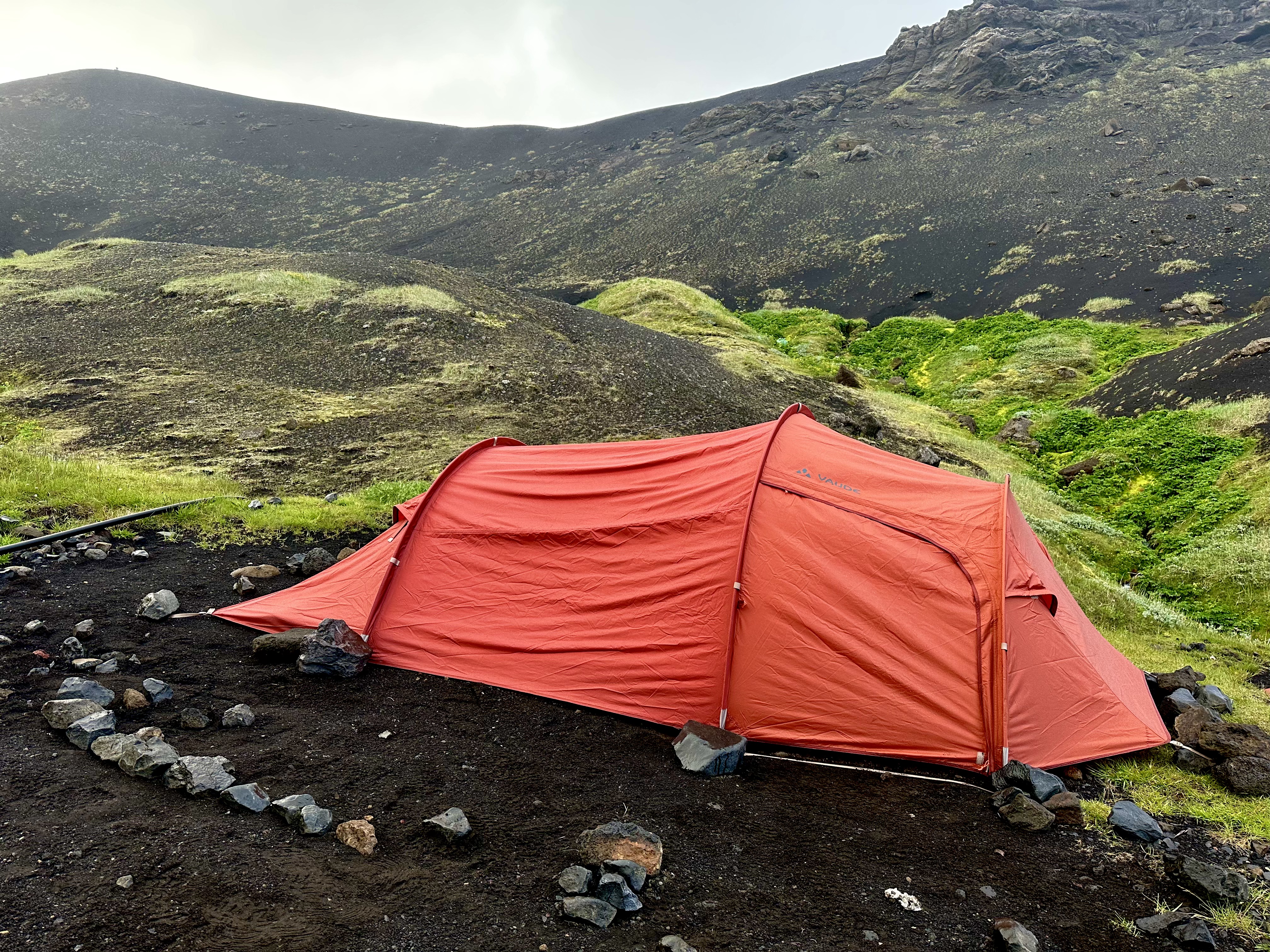
Mel and I helped the wardens move mattresses into our tent, threw our bags in, and then joined our friends and some folks from the other tour group on a hike to the gorge.
“A no-backpack hike!” Mel exclaimed joyfully. On the edge of the gorge, she did a handstand to celebrate.
The gorge was unreal. Layers of iron, green, and black basalt streaked the canyon walls. (The red iron, I learned from my book, is actually “vent areas from preexisting volcanos.”)
Edith, the guide with the other group, pointed out ahead of us.
“That is your hike tomorrow, through a lava field.” She explained that the ash in the field was from a volcano that had erupted in 1918.
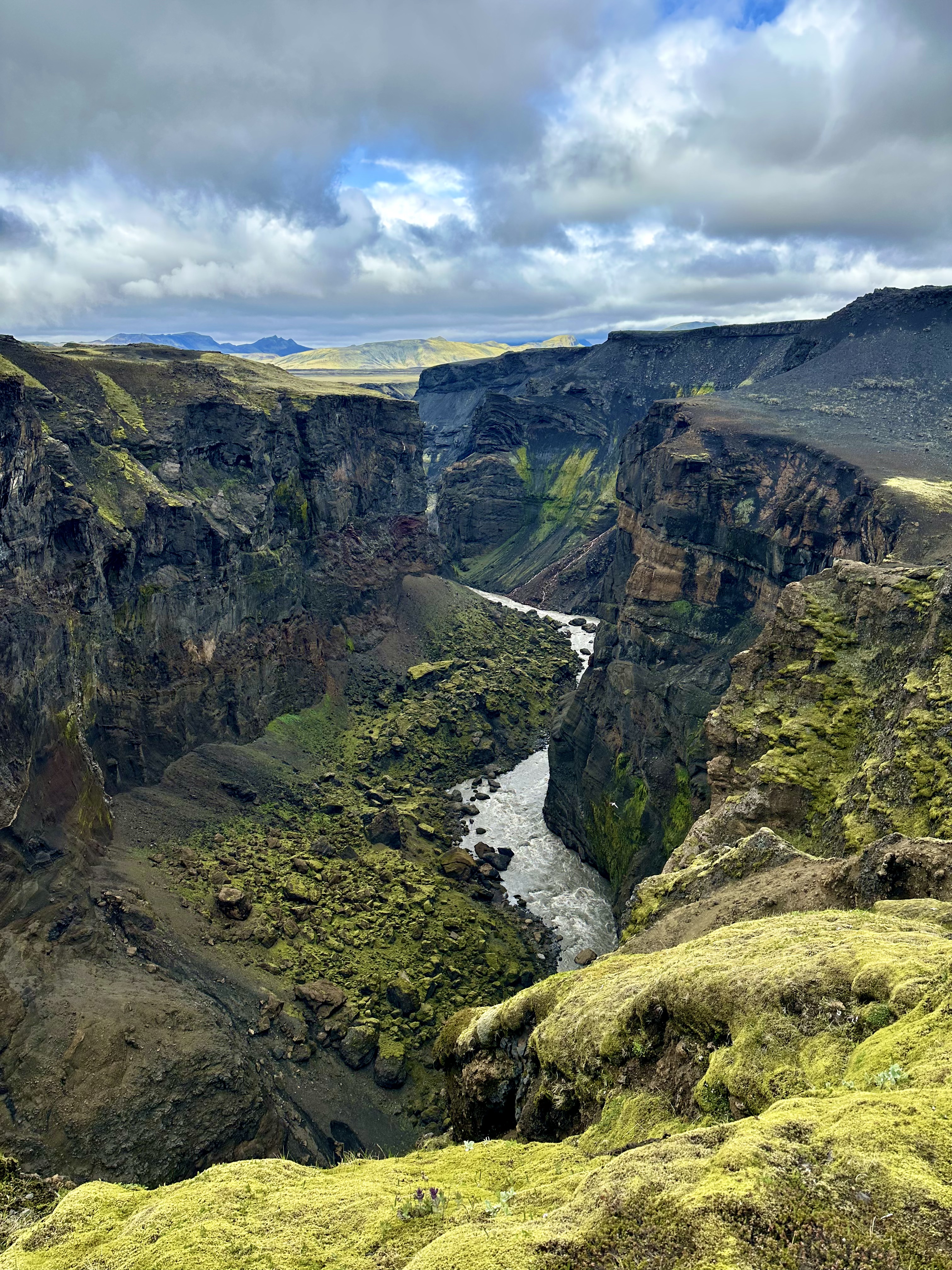
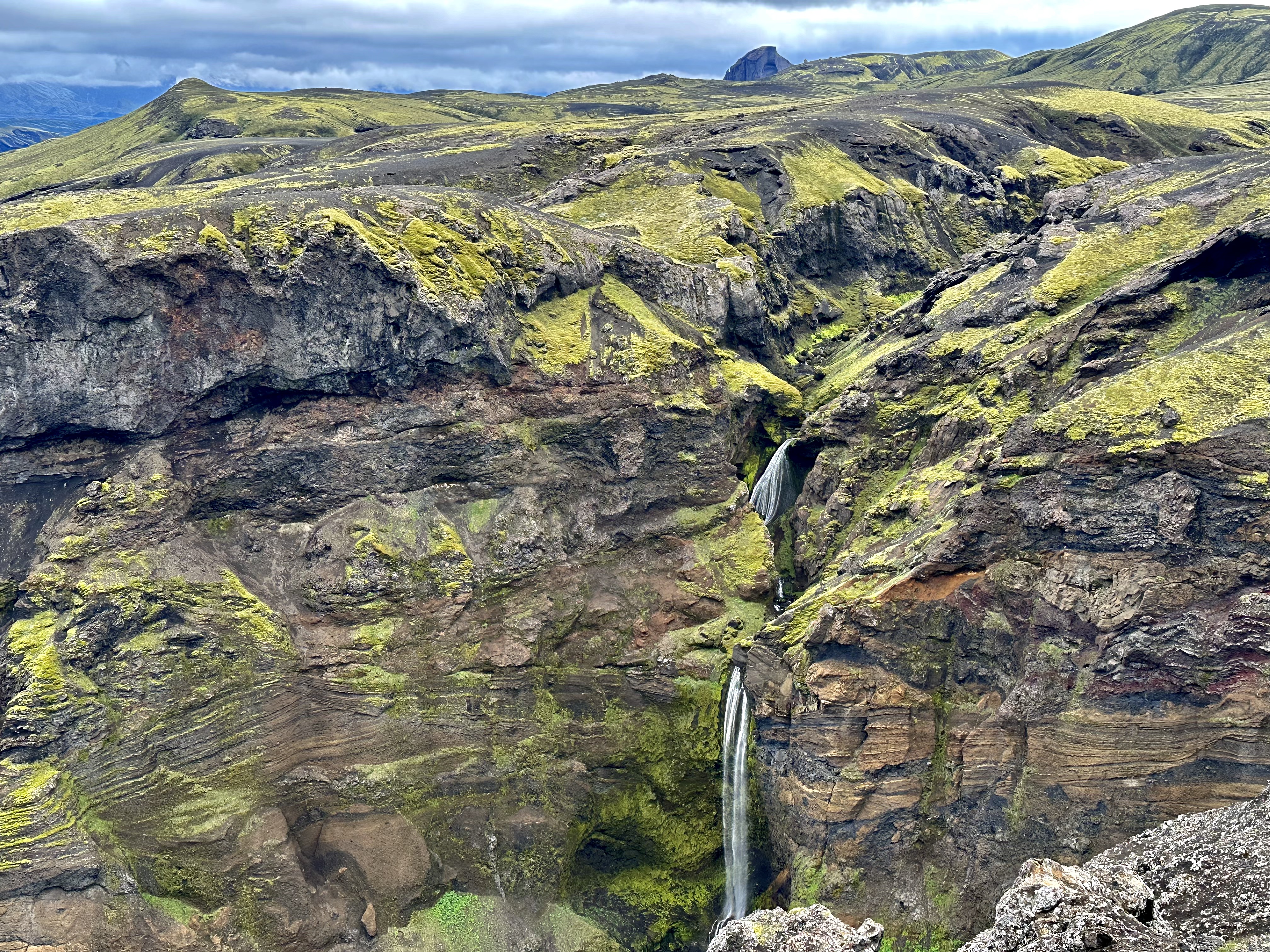
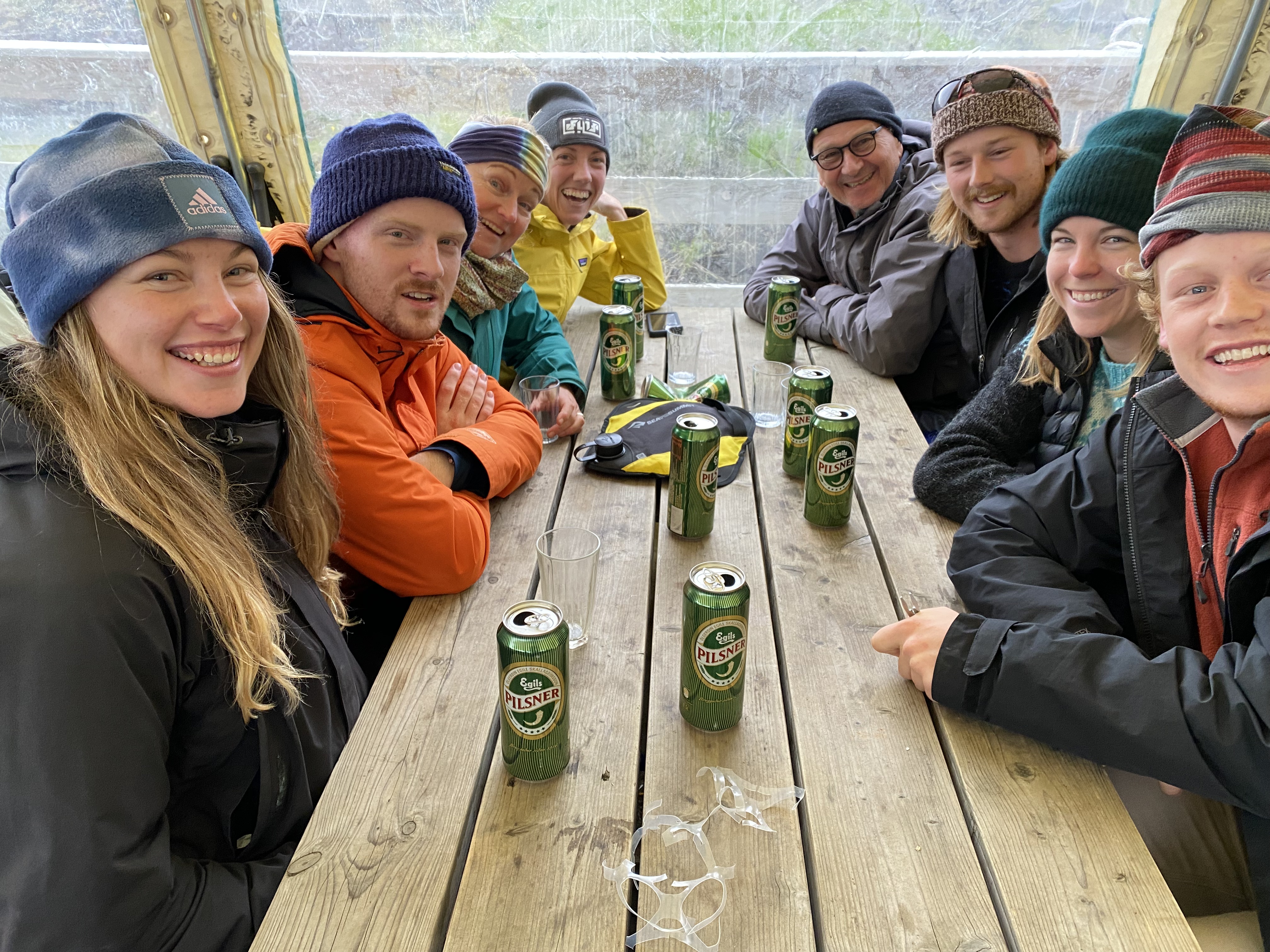
We marveled at the scenery and eventually headed back to the huts, where we gathered with other tent campers in the shared picnic tent, a covered space with picnic tables where tent campers could set up their trangias and make dinner. We played our card game, drank beers, and were about to grab our dehydrated dinners (with some dread), when Andrea came out to see us.
“Greta has invited you to have some salmon, as a thank you,” she said. “Are you interested?”
Salmon or hot salt in a bag? Not a tough choice.
“Is there enough for Holly? If so, we’re in,” Mel said, gesturing to Holly, a solo traveler we’d been hanging out with. Holly had begun the hike with a friend who had turned back after the first night in Hrafntinnusker. She’d continued on her own, sometimes hiking with the Australian family, but always hanging out with us in the evenings when we played cards. The Australian family had gone back to their hut to make dinner – they were getting similar intruder vibes from their group and wanted to eat quickly and get out – and we figured Holly could eat something.
Andrea went back to Greta, then returned, saying it was okay. We followed Andrea back to the hut, kicked off our shoes in the entryway, and entered to an atmosphere that felt uncomfortably awkward.
Greta was at the counter, and everyone else had pushed the dining tables together and were sitting around it, Thanksgiving style. The three of us stood awkwardly on the edge. Everyone looked up at us as we walked in. The man who had saved my sandwich on the bus greeted us cheerily, but two older women who were sitting at the edge of the table looked Holly up and down, nudged a friend, and said something that caused the friend to look her up and down.
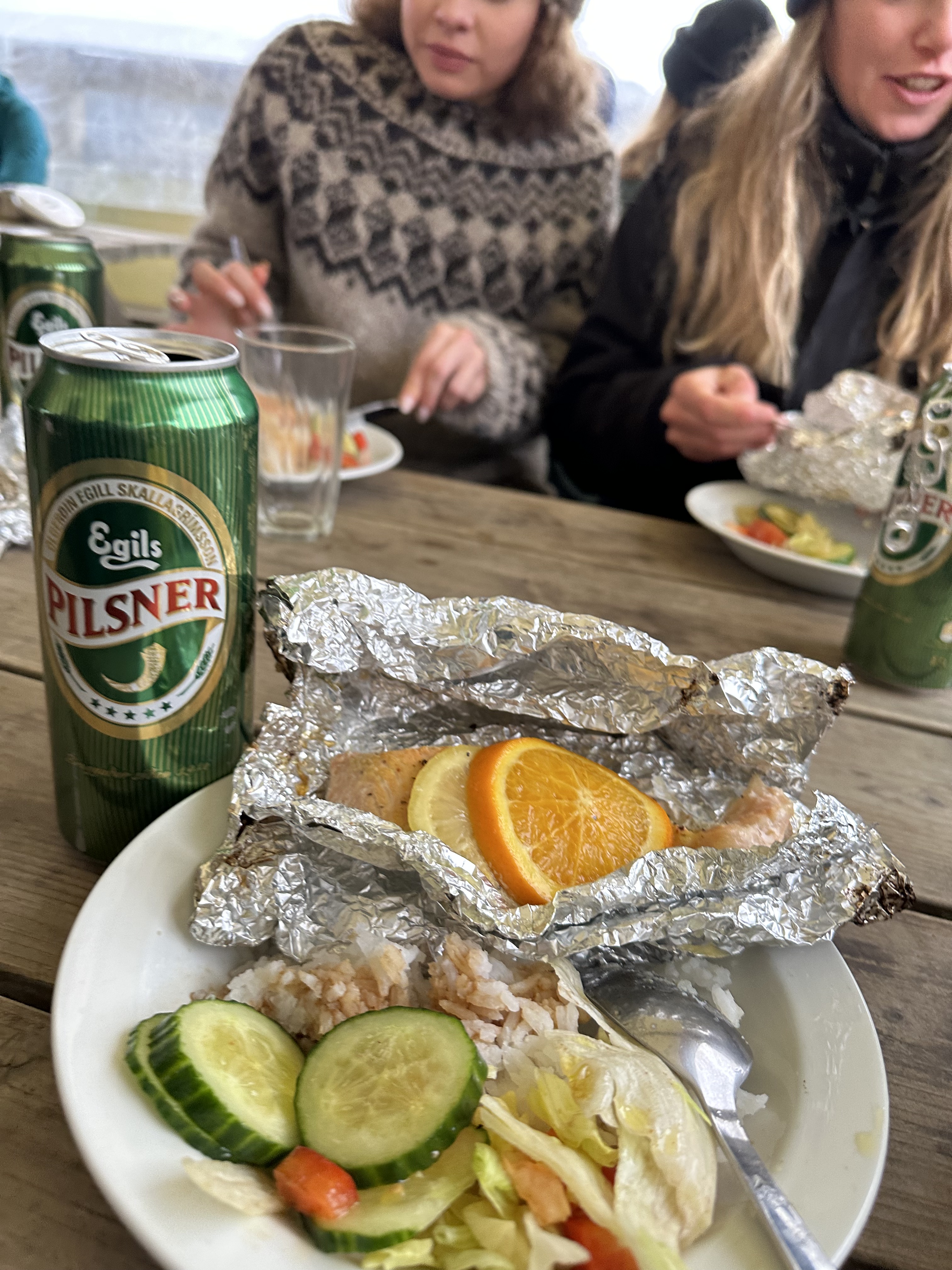
We entered and were given a plate with salmon on it. Mel told me later that the man at the head of the table, who was serving rice, was told by someone sitting next to him: “Wait until we’ve all had some rice before you give them any.”
A woman piped up and said to Holly, “I’ve seen you. You’re with the Australian family.”
“Actually, I’m alone,” she replied kindly.
There was some confusion among other members about who we were and why we were allowed to eat their salmon.
“They were supposed to stay here, but they left, because we snore,” said one of them.
A woman lifted up a bowl of salad and asked if I wanted any. At first I said no, but she held it up and said, “It might be nice to have some fresh veggies. Come on, we have plenty.”
She took my plate and piled some on, and did the same for Holly and Mel. I know this is a basic kindness, but in the face of the weird looks we were getting, it was magnanimous. We thanked everybody, including Greta, who kept thanking us.
“Come in for breakfast tomorrow,” she told us. “We’ll have porridge. You can boil water on the stove.”
Once outside, we were able to breathe a sigh of relief.
I get it. The tours aren’t cheap. For four days of hiking, three nights of huts, meals provided, and a car to bring your backpacks from hut to hut, you’re paying anywhere from $1,790 (Arctic Adventures) to $2,050 (Icelandic Mountain Guides). This includes the bus from Reykjavik and back.
In comparison, Mel and I had paid about $997 total, or $498 each ($427 for the huts for two people, less than $200 for our food, and $370 for buses out of and back to Reykjavik, divided by the two of us).
So I get feeling a little irked that you paid a substantial amount for meals and some people who paid nothing are eating some of your food. But at the same time, I booked this hike years ago, and I paid for the huts and volunteered to leave the hut not because there wasn’t enough space, but so that people had more choice over where they slept. So we’re both making sacrifices here.
Rant over (and most people on that group were absolutely lovely and friendly and kind!).
We ate our salmon, finished our beers, and then retreated to our tent. The forecast for the evening had been light rain. As you can guess, it rained all night long, and the wind blew, and the midnight sun (or the lack of darkness) kept our tent light all evening. (Eye masks for the win!) Apart from dreams of our boots and bags – which we’d left outside the tent itself but beneath the rain fly in a little entry area, propped up against each other with rain covers on – getting soaked, I slept well.
After sleeping in what felt like a garage with running, heavy machinery, the soundtrack of wind and rain on the tent canvas was practically a lullaby.
Categories: Iceland
 Lost Among Latitudes