We had no set plans for Day 2 in Lisbon, save for a sunset boat cruise from 5pm-7pm. Over a decent breakfast at the Empire Hotel, we decided we would wander the city until the boat cruise.
“It says to pack light-soled shoes,” Rebecca read to us from the booking.
“Why?” I wondered.
“It’s a sail boat – it’s so you don’t scuff the deck,” she explained. Rebecca grew up sailing and while I haven’t seen her in action, I imagine she’s amazing at it. I understood we were not going to be sailing the boat ourselves, but my limited knowledge of sailboats was that they are small, have lots of jibs and other poles that can hit you in the face, and it’s easy to fall off of them. Add wine to the equation and…
It was 11:00am when we departed our hotel under gauzy morning clouds. Emerging from the Rossio metro station, the sky was bright and sunny – so much so that Dan and I popped into a kiosk to buy cheap sunglasses (I’d left my good ones at the hotel).
We wandered the plaza, snapping photos of the architecture. I don’t know much about architecture, but Lisbon has a lot of cool building designs. As the world’s second-oldest capital, it’s been around for long enough to boast some variety. According to my Lonely Planet, everyone was in Lisbon at some point: Phoenicians, Greeks, Carthaginians, Romans, North African Moors, Christians. The buildings, churches, plazas, statues, and archways reflect this.

Another cool thing I learned is that Portugal’s downtown is the world’s first grid system. After a massive earthquake in 1755, the city was rebuilt by Marquês de Pombal in a style my LP describes as “simple, cheap, earthquake-proof” (that last detail gave me some comfort) – and in a grid system.
Beneath the warm morning sun, the cobblestones gleamed smooth and shiny, and we made our way up a back street away from the plaza towards Fabrica Coffee Roasters, a journey which required us to pass what looked like an entire elementary school sitting loud and cross-legged outside Lisbon’s version of Broadway.
The moment we ducked into the chic coffee shop, it began to rain. The coffee was delicious, and the vibe was hip. As the rain fell outside, I wouldn’t have minded curling up inside with a book and cup after cup of coffee, but there was so much more to see.
Our next stop was back the way we came, to Confeitaria Nacional, a place Rebecca had pinned as the oldest patel de nata bakery in Lisbon. Founded in 1829, the interior was all brass and plush red upholstery. There was a modest line, which grew a bit more winding by the time we’d ordered. There was seating somewhere in the building, but we opted to stand at a countertop and people watch. For 4 delicious pastries and 2 bottles of water, the bill came to 9 euros.

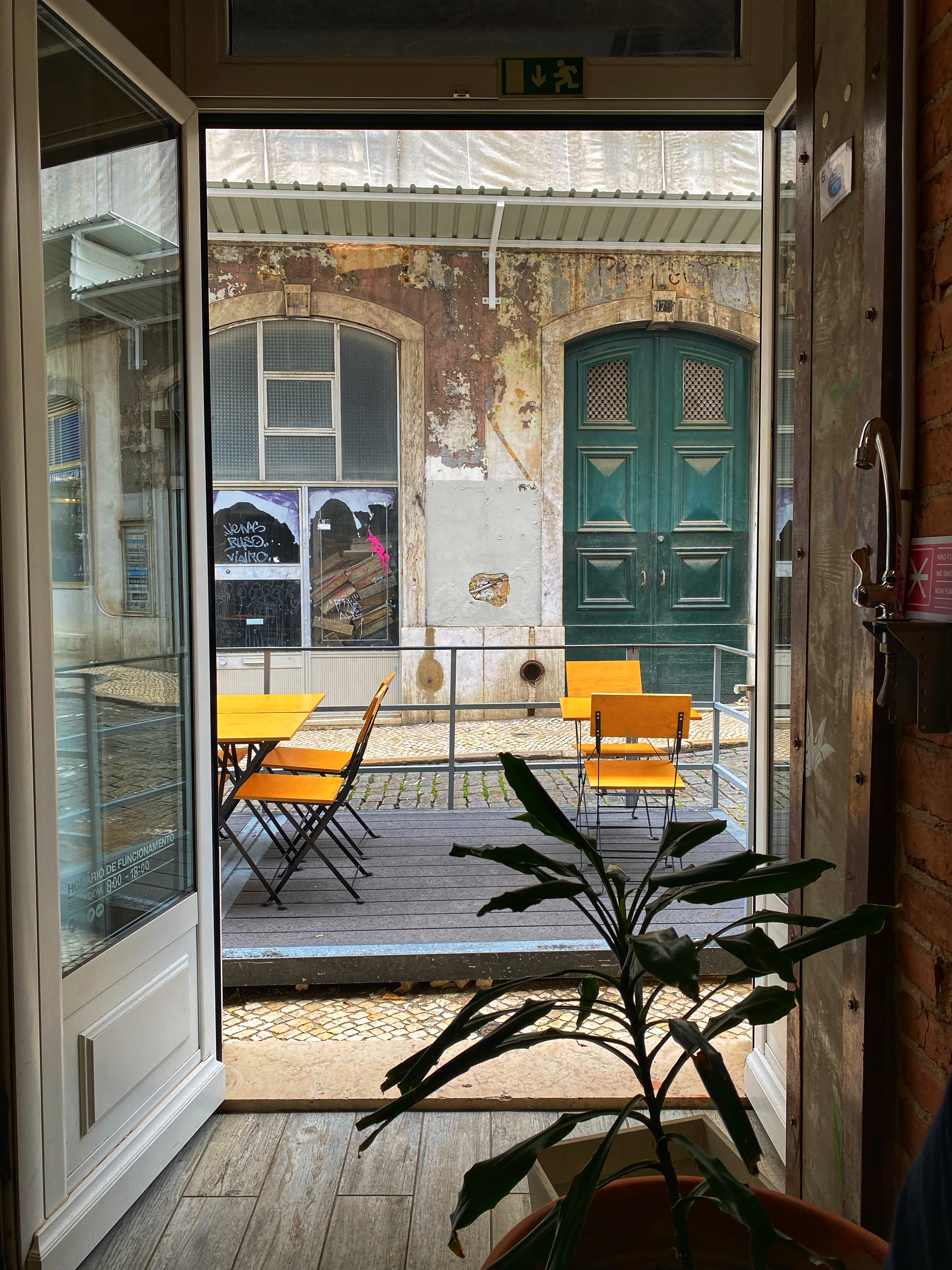
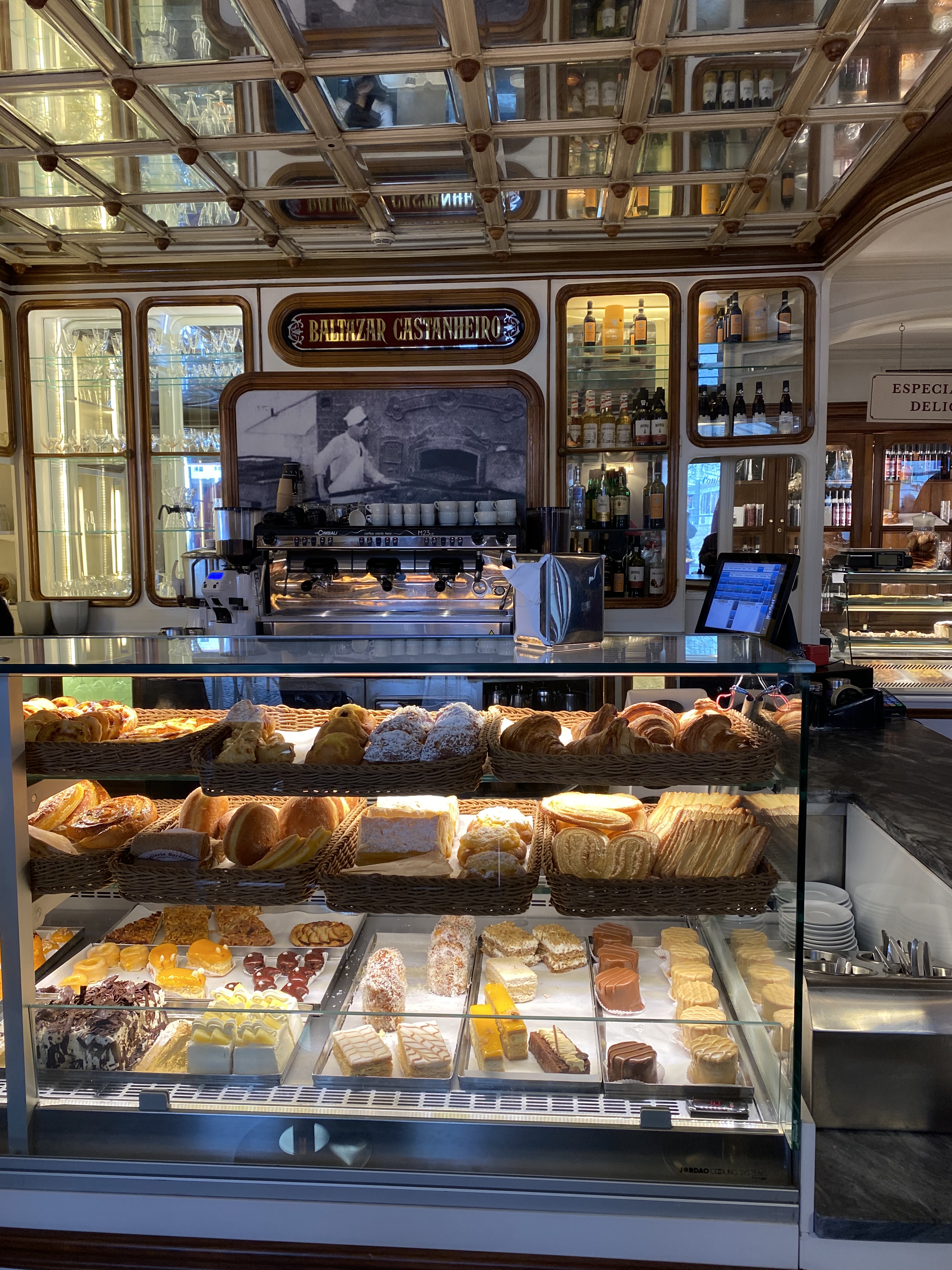
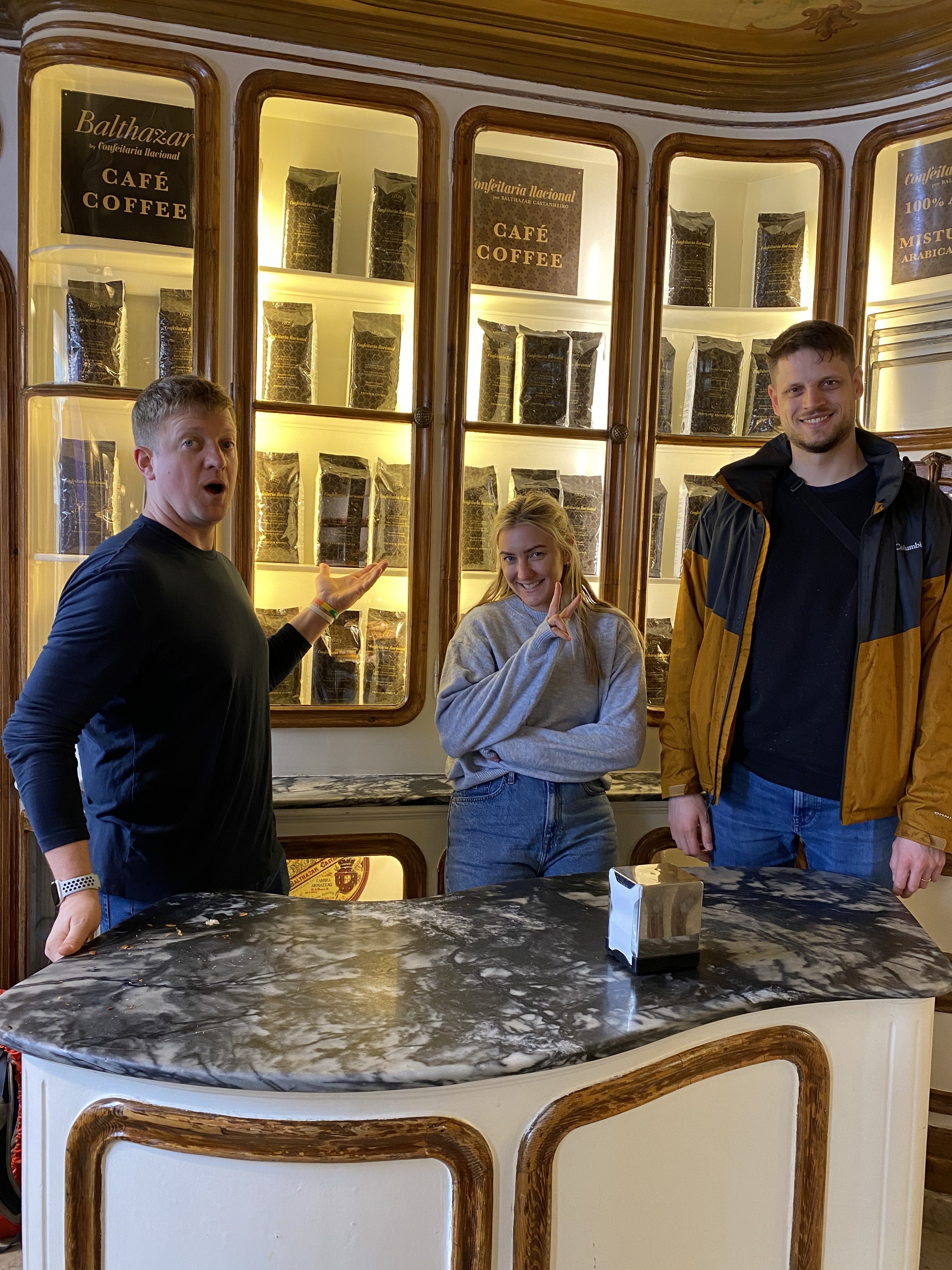
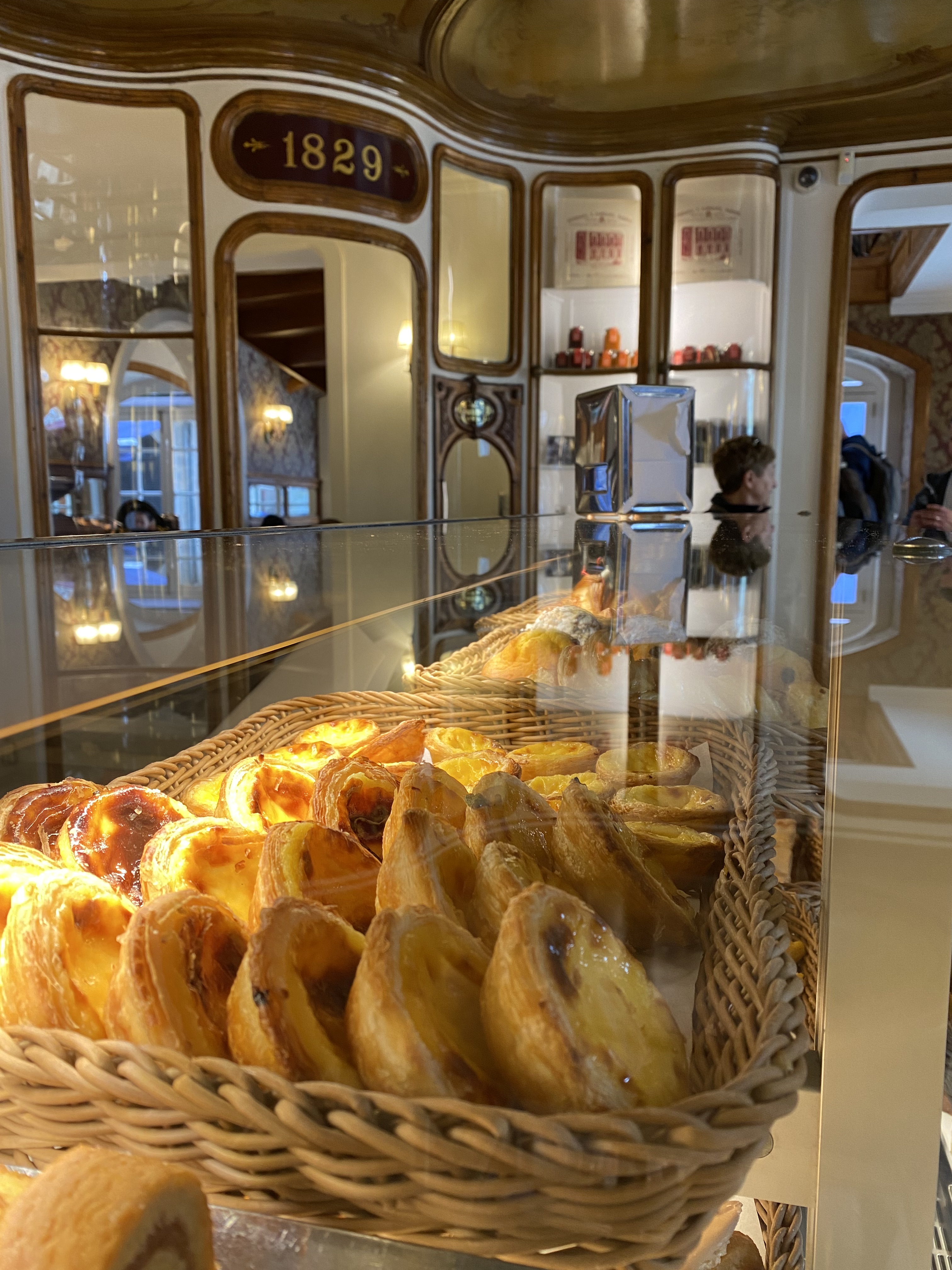

By now, the rain had really picked up. Customers walking through the door now were drenched, but at least they were wearing appropriate footwear. J had on hiking boots, and Rebecca had some GoreTex trail shoes on, while Dan and I wore only our mesh sneakers.
We pulled up our hoods and stepped out into the pouring rain. Our next stop, according to my Lonely Planet, was the pickup point of the 28E tram, the historic one that rattles up and down Lisbon’s rolling hills. The people packed into it yesterday looked like sardines, but with the downpour, I didn’t think I’d care anymore.
We knew we’d arrived at the tram stop because there was already a line of people standing under umbrellas. The rain was falling in aggressive sheets at this point. My socks were soaked through, my feet sopping. Every step was like squishing my foot down into its own personal puddle.
“I don’t want to actually ride the tram,” Rebecca said. “I just want to see it.”
“There is an hour wait,” said a woman standing next to us, smiling, “I don’t mean to interrupt. I just overheard you talking.”
The woman pointed out a tuk-tuk across the street, shielded from the weather by a plastic cover. Only then did we realize she was holding laminated maps in her hand.
“One hour, tour of Lisbon,” she offered us, pointing at the sights she’d drive us by. She named her price, a steep 20 euro per person.
“We’ll confer,” said Rebecca, drawing us into a huddle.
“Look, J and I were just talking,” Dan said, “and it’s not going to stop raining. This tour goes to all the places we want to see, it’s private, it’s covered. For 20 euros, to be out of the rain for an hour – let’s do it.”
So we did. She led us away from the long line for the tram and into a spacious tuk-tuk. Never have I been so grateful to be out of the rain. I tied Dan’s backpack to a post on the seat. Rebecca and I pulled our seatbelts on, and we were off. It was a bumpy ride over the cobbles, but our driver was energetic and explained a lot about where we were. We bounced past the Monastery of São Vicente de Fora, then Sé de Lisboa (a church constructed in 1150 on top of a mosque, which you can still glimpse through the floor).
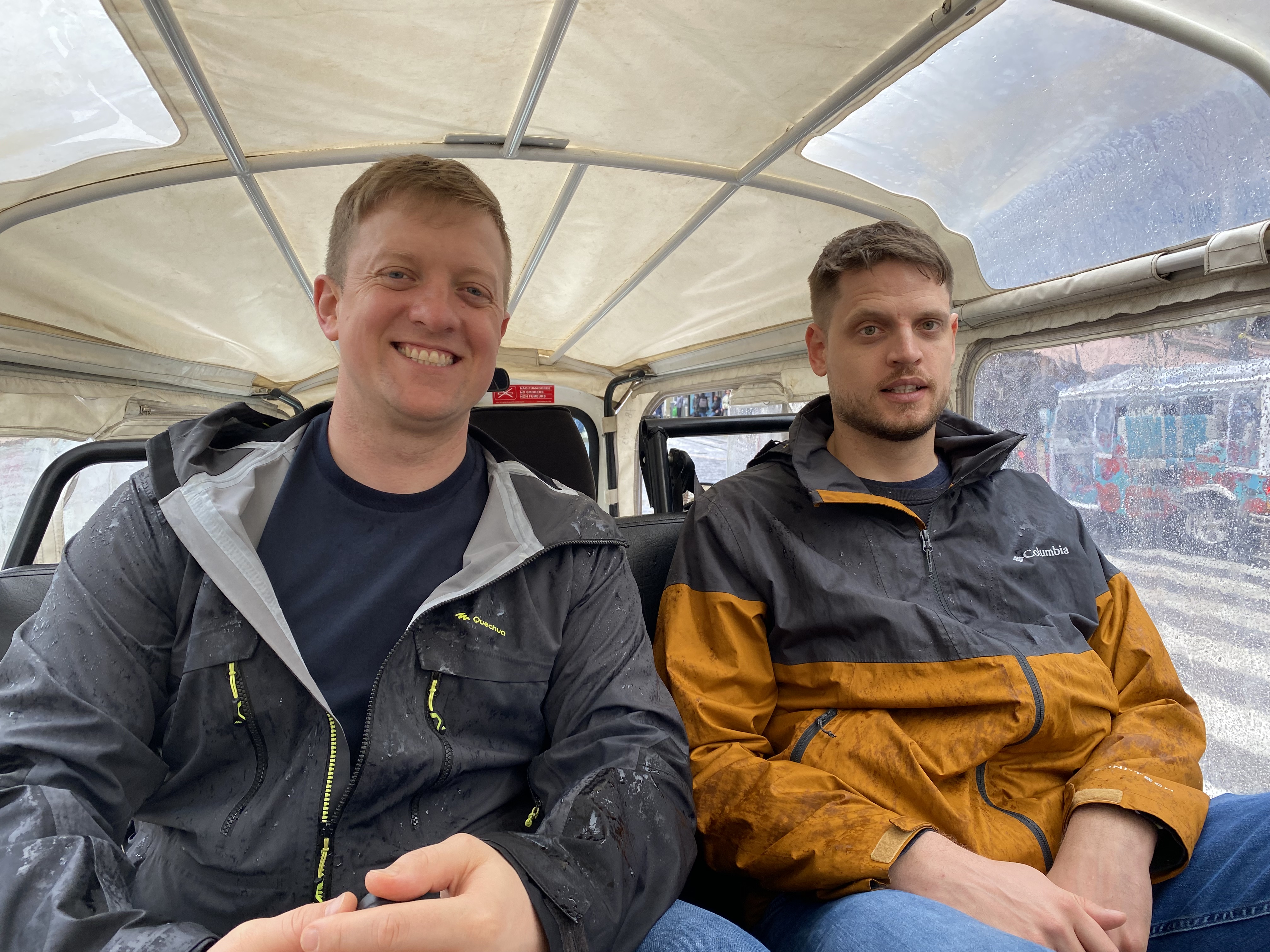
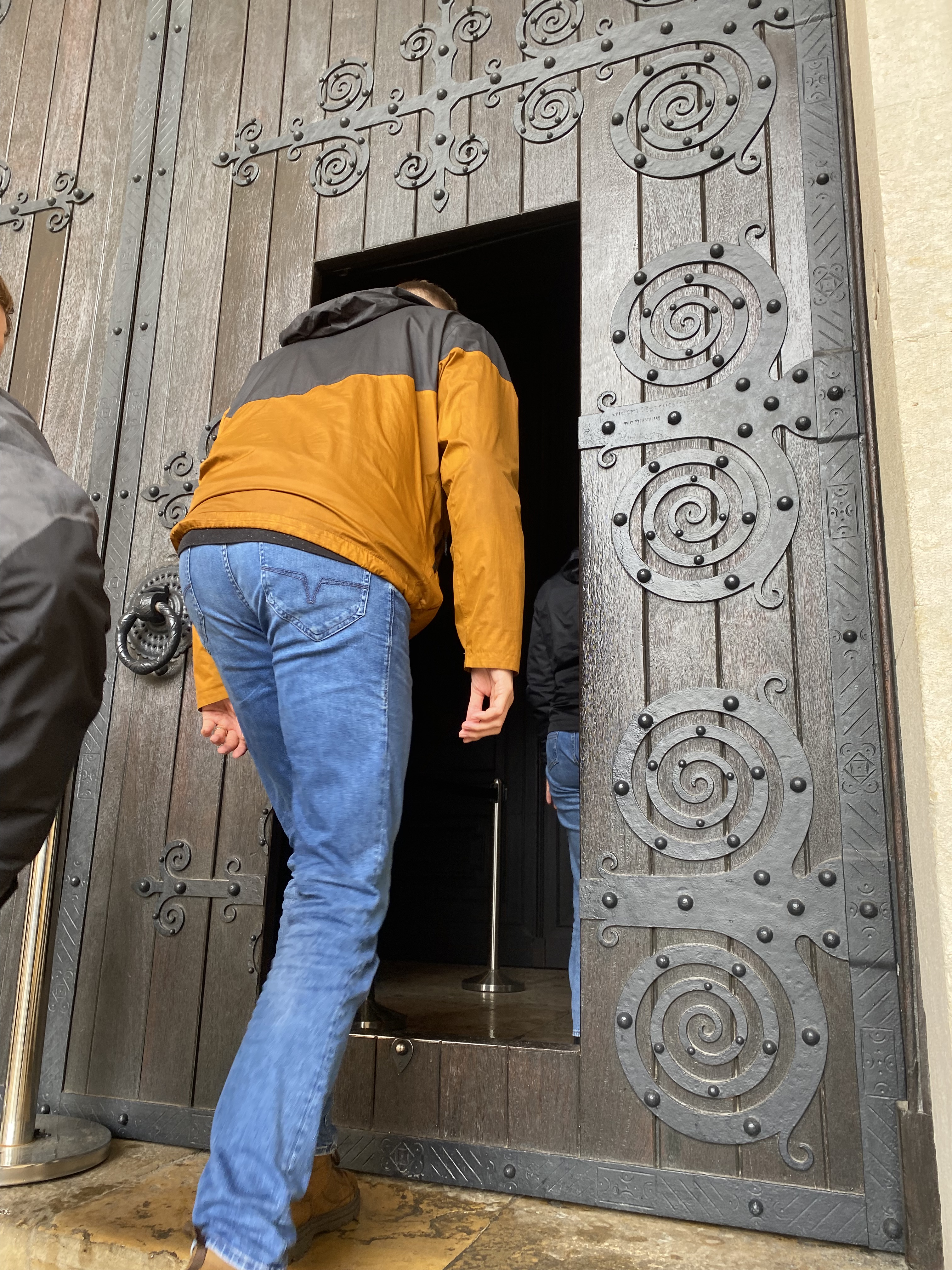

Over the clatter, I called to the front, “Is the weather typically like this in April?”
“Well it’s still March,” she shouted back to me, “but yes. In fact, in Portugal, we have a saying – Em Abril, águas mil. It means, in April, one thousand waters. Portugal actually gets as much rain as Scotland, but in a shorter period of time.”
J fact-checked this later: “Lisbon gets more rain than east Scotland,” he told us.
The rest of the Portuguese phrase goes “que caibam todas num barril“, meaning something about all of the rain fitting in a barrel. It must be a pretty huge barrel, because the rain was aggressive.
“But Lisbon is right on the Atlantic,” J said later. “It makes sense it gets all the weather.”
“It takes the brunt of the weather for Europe,” Dan added.
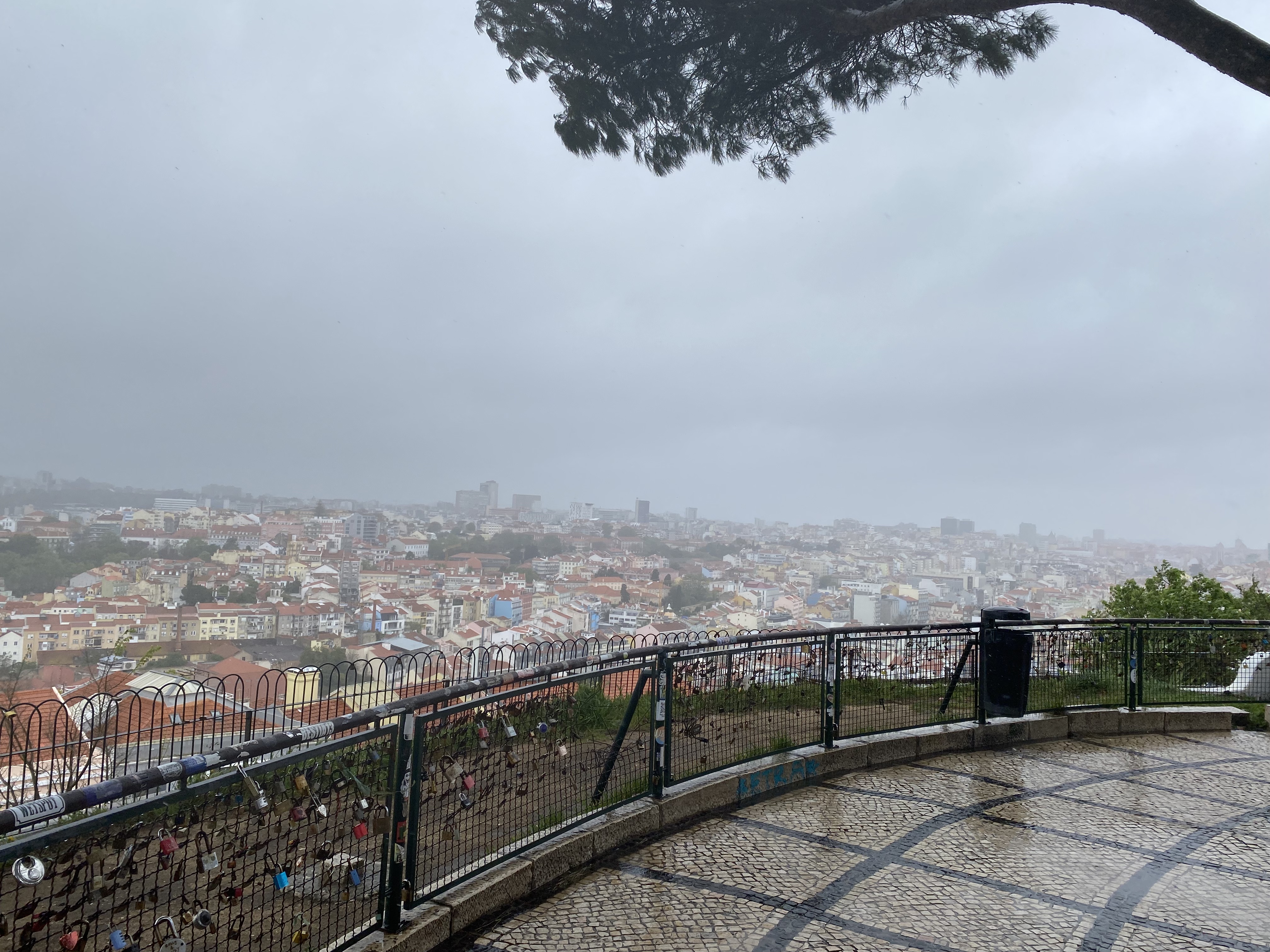
Eager to see firsthand exactly how Lisbon takes the brunt of the weather, we journeyed to the top of a hill to the highest lookout point in Lisbon, the Miradouro da Senhora do Monte. If you Google it, you’ll find magical photos of twilight glimmering softly over the ocean, lights twinkling out at sea beyond the stacked rooftops. We parked the tuktuk and spilled out of it into a wild wind that sounded like a rogue locomotive. This wind rivaled Iceland wind, the kind where you have to buy insurance in case it rips your car door off.
We fought against it and arrived at the lookout point, beside a poor palm tree being smashed by the wind. From where we stood to the horizon was – nothing. Just a big white cloud of rain and wind. My shoes squelched as I ran to the railing, absorbing higher volumes of rain.
Once back in the tuktuk, our tour was over. Our driver offered to drop us back in Baixa, where she promised lots of restaurants. We clambered out of the plastic shelter and onto the street, where Rebecca pulled out Google Maps and found a restaurant around the corner called Manjerica. We darted out of the rain and into the doorway, where we were ushered to a back table in the corner.
The place was cute, and the menu was a small novel. It is not often I feel overwhelmed with choice, and it felt good.
Rebecca and J are vegetarians, I typically don’t eat a lot of meat but will try it, and Dan is the carnivore of our group. I had read that Portugal doesn’t have much to offer vegetarians – even our tuktuk driver commented: “I was vegetarian when I moved here, and then I had to give that up.”
But there are some restaurants where you can find creative, fresh, delicious veggie dishes, and this was one of them. By the time we ordered drinks, the restaurant was packed and there were no tables remaining.
“We’re so lucky,” said J. “Just like last night – we got the last table.”
“J! You can’t say that,” Rebecca admonished him. She and I knocked on the table.
We ordered a ton of food. It was all amazing. We had lemonade with shots of ginger, protein power bowls, sandwiches, wraps. Outside, it was still raining. How was there that much water in the sky?
“If it’s going to rain like this, we need an indoor plan,” said Rebecca. In retrospect, looking through my Lonely Planet, Lisbon offered a wide array of museums. Housed in stunning buildings, they featured everything from fado music to carriages to azulejos.
“Do they have escape rooms here?” I wondered.
“Yes, but they also have mini-golf,” Dan answered, scrolling through his phone. “We just need to figure out the timing of the boat tour so we can see where we need to be and when.”
Right. The boat cruise. At that moment, we turned to the doorway, which was now crowded with people coming in off the street. J stood up to go investigate and returned wide-eyed.
“The street is underwater. It’s like a river,” he said. I stood up to go look myself, and sure enough, the water was nearly as high as the porch to the restaurant. Servers were grabbing wooden plywood from the basement. A waiter stood by, shaking his head.
“Does it usually get this high?” I asked him.
“No, not usually. But now we’re a waterfront restaurant, so our prices are higher,” he joked.
Back at our table, we ordered espressos with milk. There was no way we could cross the street or leave the restaurant now.
“This is like Thailand,” said Rebecca. And it was. I hadn’t seen rain like this since I lived in Manila. The idea of boarding a sailboat in this weather seemed absolutely ludicrous. Rebecca dialed the boat company. A few seconds into the conversation, it was clear there was no boat trip. Surprisingly, though, it looked like we’d be getting a refund.
“I asked him if he spoke English, and his English was really good,” she told us, hanging up. “Then I said, I’m calling about the boat trip, and he just said, ‘Nope.'”
So…mini golf it was!
As quickly as the street had become a river, the water receded and the cobblestones were visible again. People emerged from the doorways and set out on their way. We paid the bill and darted across the street in hopes of finding waterproof shoes for me and Dan. My search was fruitless, but Dan got some waterproof boots, and the sound of relief he made when putting them on made me jealous.
We clambered into a taxi, which careened wildly up the stone streets and to the mini-golf place. We gratefully emerged from the car and entered the mini-golf. There were 18 holes to be played, 9 of which were cosmic UV-light style. Dan and Rebecca emerged victorious, with J and I coming in last. This would be the theme throughout the trip, but I didn’t mind. There was a lot of laughter, and while my shoes squelched as I puddled from hole to hole, the rest of me was dry, and we weren’t getting rained on. For a short while, Rebecca and I both forgot about our jeans, and how they had gotten so soaked through that our legs were wet. I did not forget about my socks, because they were still wet.

Our mini-golf experience came with a bar option, but the drinks looked too blue and sugary to be good, so Dan found us a little watering hole nearby called Trobadores, which billed itself as a medieval tavern.
It was a short walk around the corner. The rain had not stopped, but it seemed more resigned, like a child losing energy after a full-blown tantrum.
At first, we walked past it, because the door was practically hidden in a wall. Nothing suggested food or drink apart from a small board on the wall beside the door, which had some writing on it in faded chalk. Over the door was a bunch of dried flowers. We entered, and descended stone steps into a dimly-lit tavern that made me feel I’d suddenly been transported into a D&D campaign. Lute music played over the speakers. Waitresses swished around in laced tunics. The place was sort of empty and the menu was beautifully hand-drawn, offering specialties like rabbit, duck, or a sausage you grilled yourself.
We ordered a bottle of white wine and wished we had a board game. We raised our glasses – clay goblets – and said “Prost!” to staying dry and slaying dragons. Dan ordered a sausage that came on a little metal grill, which our waitress lit on fire and Dan turned a few times. I ordered a bowl of mashed chestnuts, which I have never had and which were absolutely delicious, even if they looked like baby food. Rebecca and J ordered veggies with polenta and dipped bread in the chestnuts. Of course we ordered a cheese board, which was rolled over to us on a rickety wooden cart.
I don’t know how it came up, but as our waitress returned with the bill, she mentioned that they would have live music in about an hour. With no real plans, we decided to reserve the same table and come back in an hour to see what kind of music a medieval place would host.

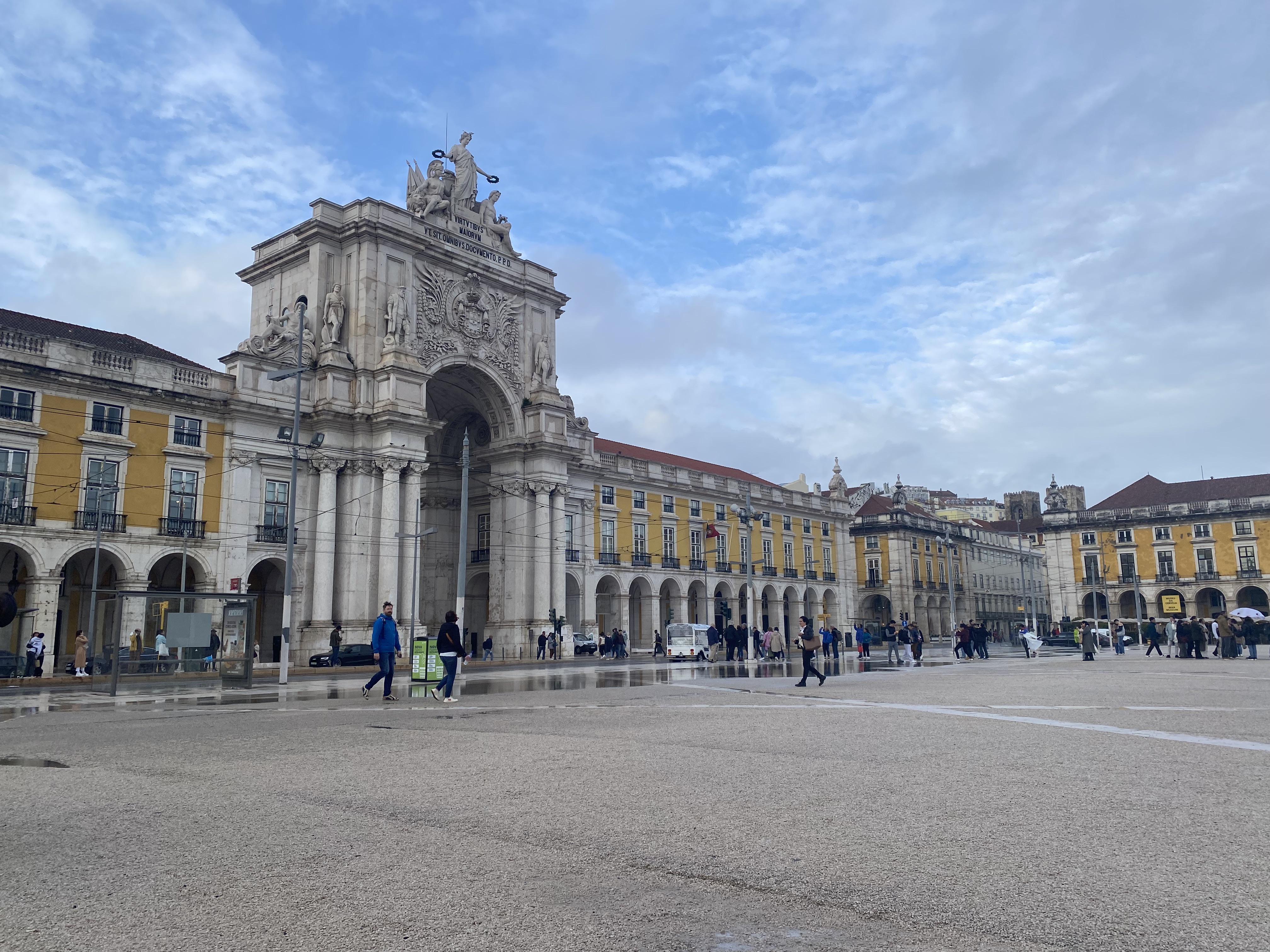
Outside, the rain had reduced to a drizzle, and dare I say the sun was beginning to peek out from the afternoon clouds. Determined to see the sea, and what Rebecca kept calling the Golden Gate bridge, we journeyed out and found ourselves in the sprawling Praça do Comércio, a riverfront square where, my Lonely Planet explains, “Everyone arriving by boat used to disembark here, and it still feels like the gateway to Lisbon.” It had the opposite effect to us, having spent a day and a half in Lisbon already, but you could see the appeal.
The world was awash in pearly post-rain light, seagulls cawing and diving over the sloshing waves that had clearly spewed up a lot of flotsam from the storm. A waiter had told J earlier that the sewers had flooded, which was why the streets were awash with water. I stepped down off the cobblestones and onto the sand, bypassing a large dead rat. In the distance, Rebecca pointed out the Ponte 25 de Abril, the bridge that looks like the Golden Gate Bridge. It’s named for the date of a revolution in 1974 called the Carnation Revolution, where people overthrew the last remnants of a dictatorship established by Salazar called the Estado Novo.
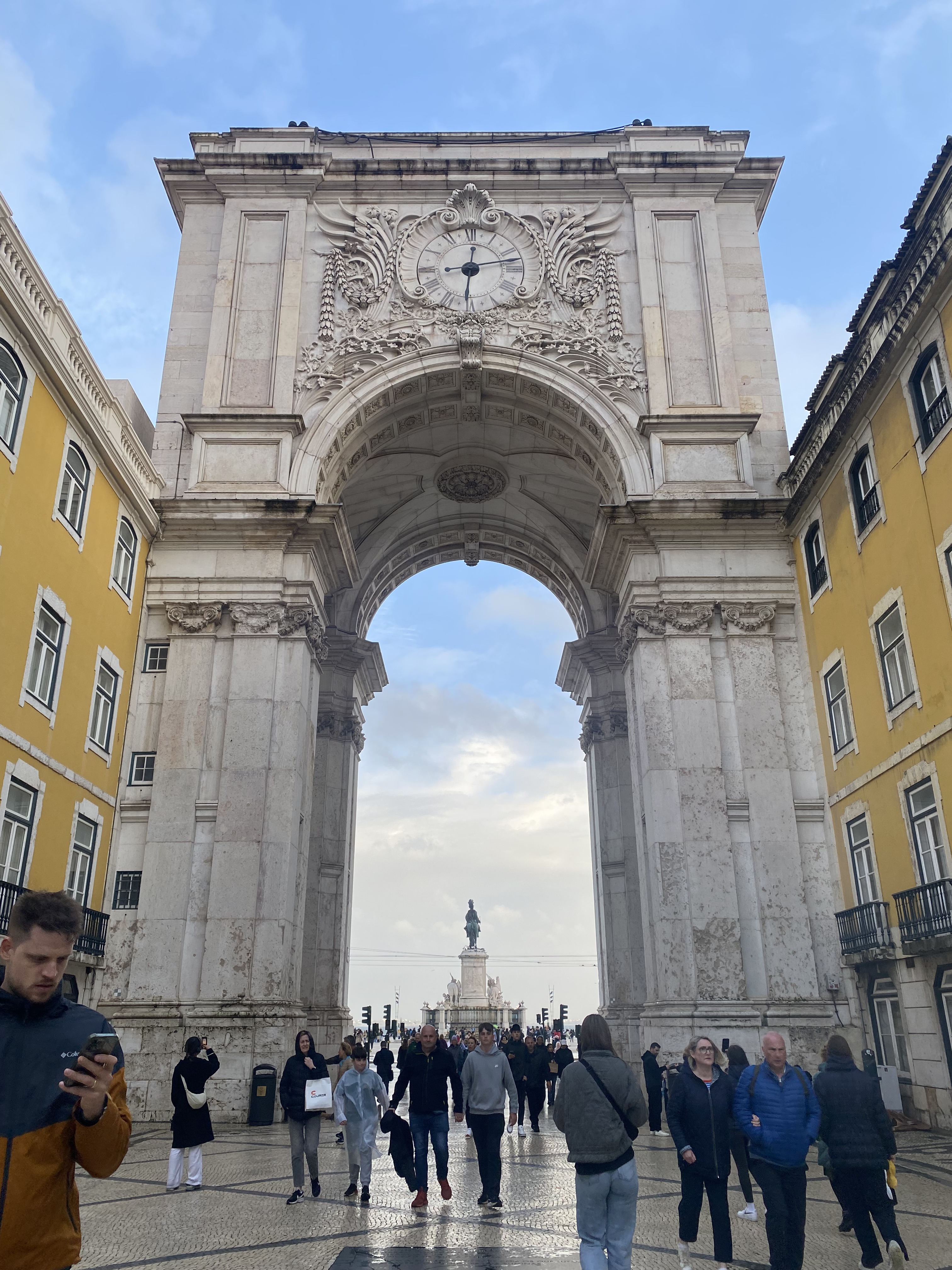
We passed underneath the ornate and imposing Arco da Rua Augusta, the gateway to the city, and wandered back up around Rossio in search of waterproof shoes. (I have to say, I’m very grateful for Rebecca and J’s patience. As the Germans say, there’s no such thing as bad weather, just bad clothing, and I have committed the massive error of bad clothing.)


At 7, we returned to our medieval tavern to the same table as before, which was right beside a larger table situated in front of a non-functioning fireplace where 4 musicians were plucking out renaissance music on a fiddle, a lute, a tabor, and some kind of medieval accordion (maybe a concertina?).
They played Norwegian sea shanties, Scottish reels, and everything else that goes with mead and mashed chestnuts (I may have ordered another bowl). We ended up ordering two more bottles of wine, partly because our tuk-tuk driver had encouraged us to order a Portuguese green wine called “vinho verde”, and we wanted to try one.
Young wine that tastes bright, crisp, and a little vegetal, the vinho verdes did not disappoint. Dan and I taught Rebecca and J our wine game, where I tag a bottle on my Vivino app and I add in our notes, then I see what other commenters have identified the same notes.
“But I thought they’re called nodes,” Rebecca said, and we all laughed a haughty 2-bottle wine laugh at that. She managed to prove that there are things called nodes associated with wine, and so from then on, when we shared a bottle of wine on the trip (which was every night), we “did our nodes” (pronounced with a Yorkshire accent on the ‘o’).
We were leaving Lisbon the next day, without having seen it basking in the sun or heard its fado music or tasted its meaty delicacies. But we’d survived the monsoon rain and as we headed back to the metro, I felt a delicious buzz, not just from the white wine but from the fact that we still had over a week in this new country with two old friends (well, 4 years old) whose company is so brilliant and so fun I would gladly walk another day in rain-logged socks to enjoy more of it.
Categories: Portugal
 Lost Among Latitudes