I’ll admit I wasn’t too disappointed to leave Lisbon on Thursday morning. I’m sure in the sunshine, Lisbon is a vibrant place to be, but it’s all a bit sprawling and sort of overwhelming, so I was excited to pick up our rental car and head for Sintra on the coast.
At breakfast, we deduced that we only needed to be outside for the two minutes it took to get from our hotel to the metro, so we should theoretically be okay in terms of the rain. Overhead, the sun was shining, a cruel departing gift. We took the metro to Baixa and then switched over to the blue line for Santa Apolonia train station, where our rental car awaited.

The car was a brand new Nissan Quashqai with only 20 kilometers on it. The EuropCar agent explained that the tires might feel a little sticky, being brand new and all. For that reason, we opted for the insurance policy that, at 20-ish euros per day, guaranteed us “no responsibilities.” We packed the trunk and then assumed our car roles: Dan navigated the manual transmission as our driver; J sat shotgun as co-pilot, plugging our destination into the car’s sat nav; Rebecca double-checked the destinations on her phone’s Google maps, DJ-ing between rounds of Sudoku; I sat backseat and tried not to throw up. We pressed a few buttons, revealing a massive moon roof, and we were off!
Our destination was the Sintra Arribas Hotel, whose website offered enticing photos of spacious rooms overlooking an infinity pool on the ocean. The infinity pool looked especially stunning at sunset, glassy and calm and empty apart from a woman in a bathing suit, resting on the edge and overlooking the foamy waves of the sea.
“I hope the pool is open,” Rebecca said in the car. “I e-mailed them to see.”
The weather was cooperative as we set off from Lisbon. The sky was a slurry of white and grey clouds shifting to occasionally tease a bright patch of blue sky. No raindrops fell on the moon roof.
After a mere 30 minutes or so, we arrived in Sintra Vila, a tangle of narrow cobblestone streets just wide enough to accommodate our Quashqai as Dan looked out for a parking lot. According to my Lonely Planet, Sintra Vila is a Unesco World Heritage center. Its cute cobblestone parking lot, shaded by wispy trees, already made it a cut above the rest in my book. We parked the car and grabbed our rain jackets – the clouds were gathering overhead – and headed up to Palácio Nacional de Sintra, described in my book as “a mix of Moorish and Manueline styles.”
Moorish architecture I was somewhat familiar with, but I’ve Googled anyway. Its features include horseshoe arches, minarets, and geometric motifs. Manueline was new to me.
Manueline is named for King Manuel I (1495-1521), who was on the throne at the age of “discovery” and the peak of sea travel, both of which mark the Manueline style. Architecture features maritime motifs like ropes, seashells, and elements of the wooden world of ships. It also included motifs associated with Christianity at the time, like symbols of the Knights Templar. (Later, we roamed a beautiful park decorated in the style of Neo-Manueline, which I thought was a totally different style, but is actually just a revival of the same style but in the 1800s.)
The palace was cool to explore, though we opted not to go inside. Instead, we hiked up a hill towards the breathtaking Quinta da Regaleira, a sprawling villa studded with stone towers, wells, and dozens of plant species overgrowing the main path and several quiet, windy side paths leading to hidden fountains.
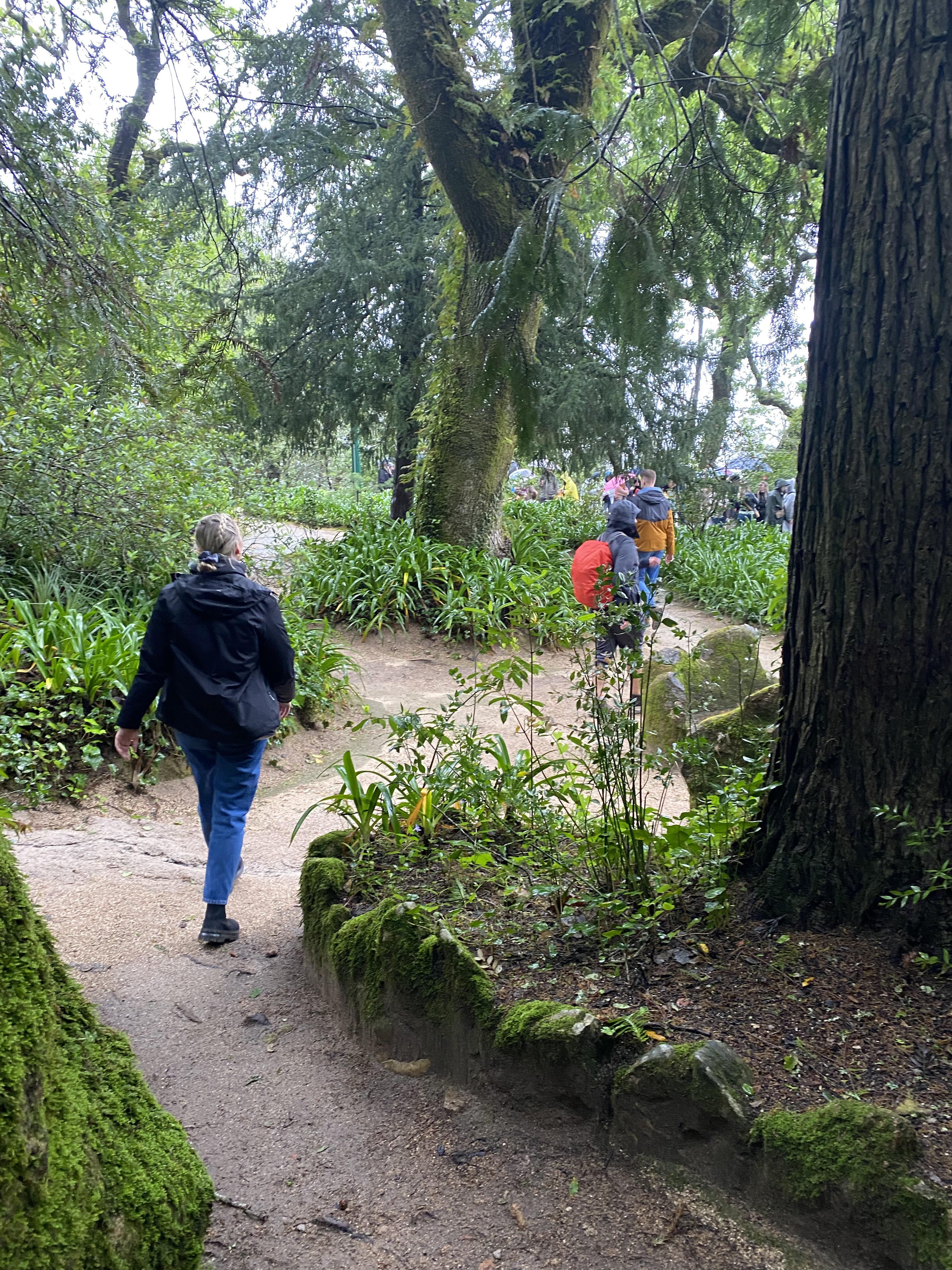

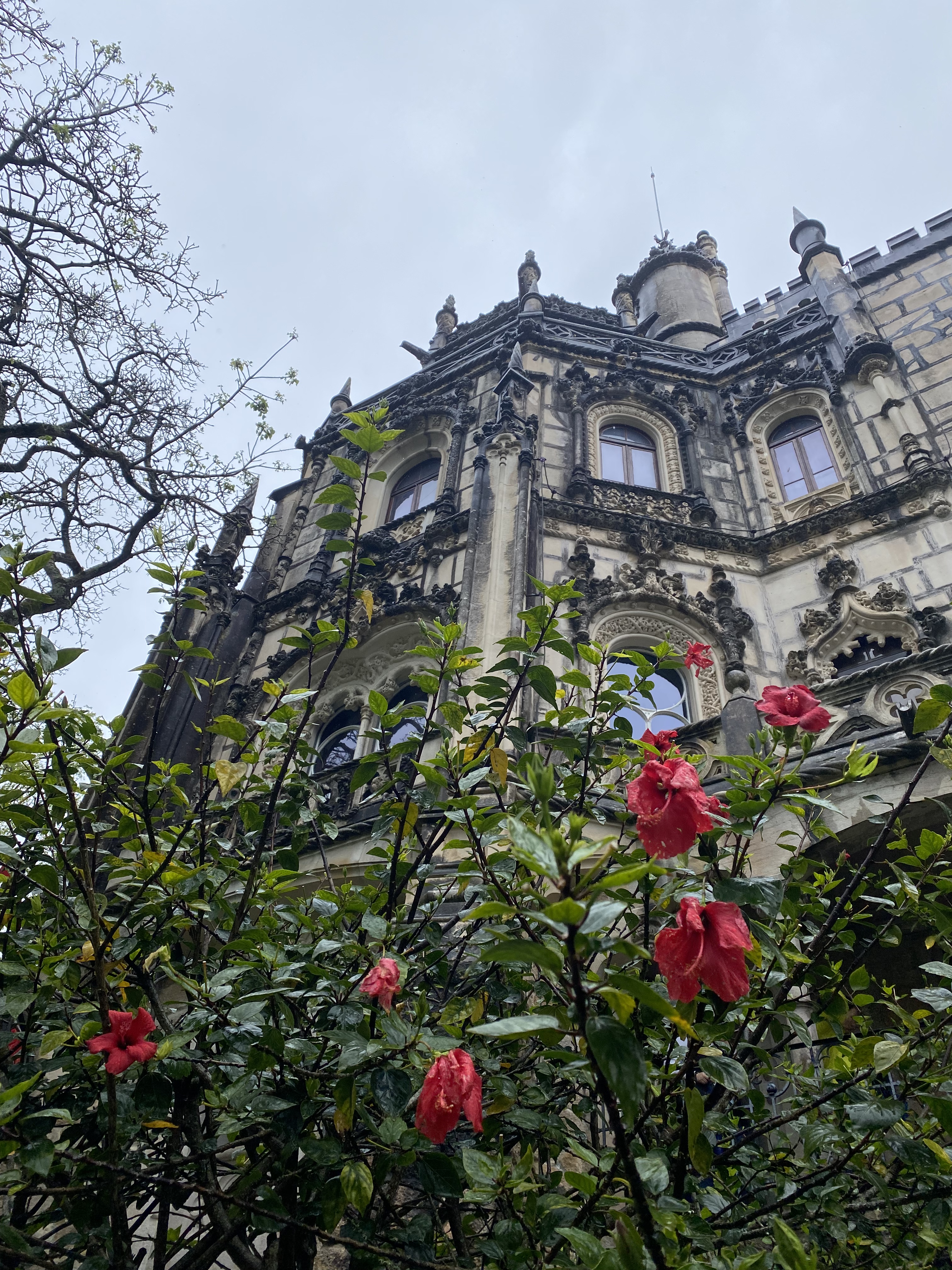
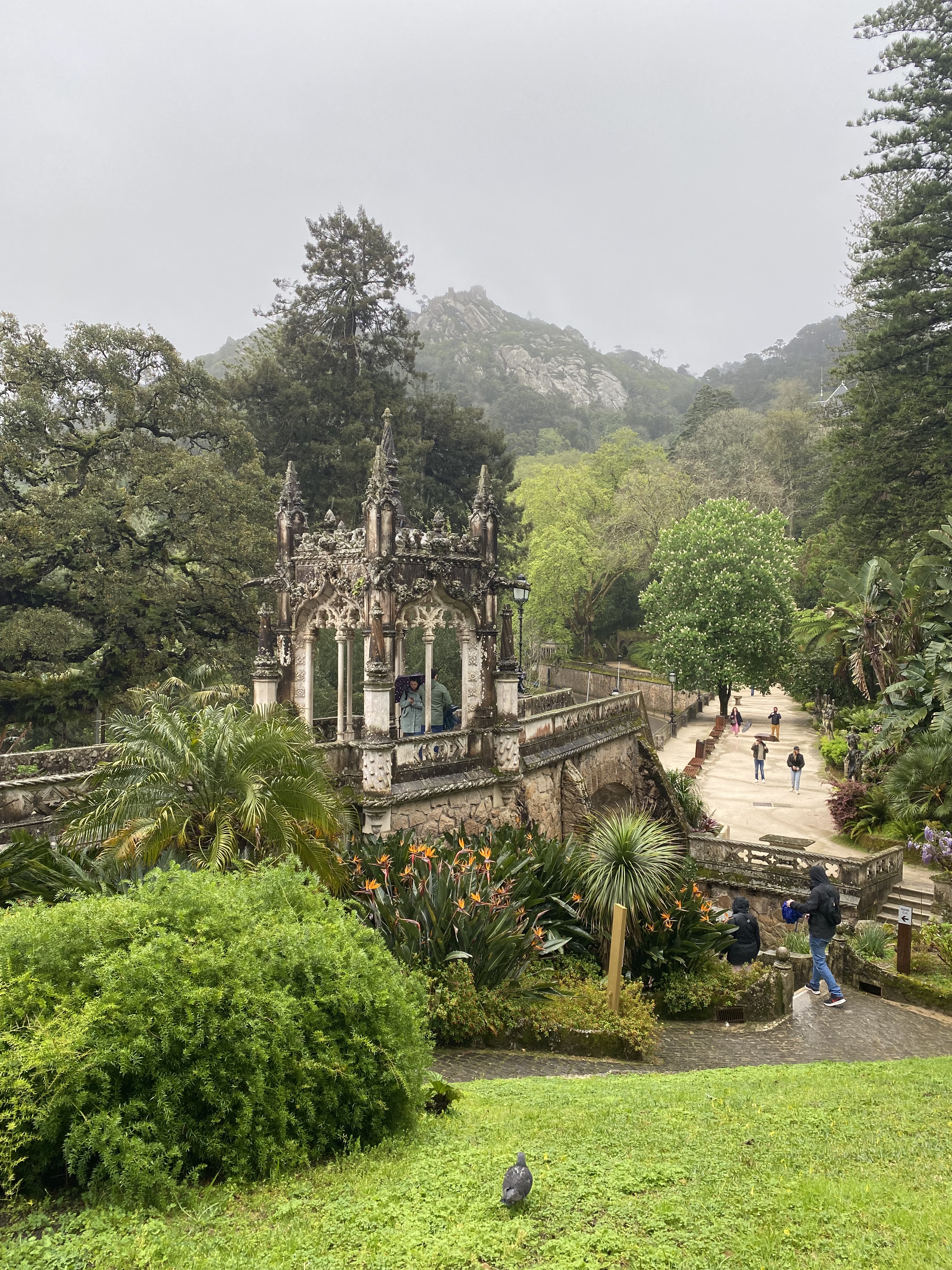
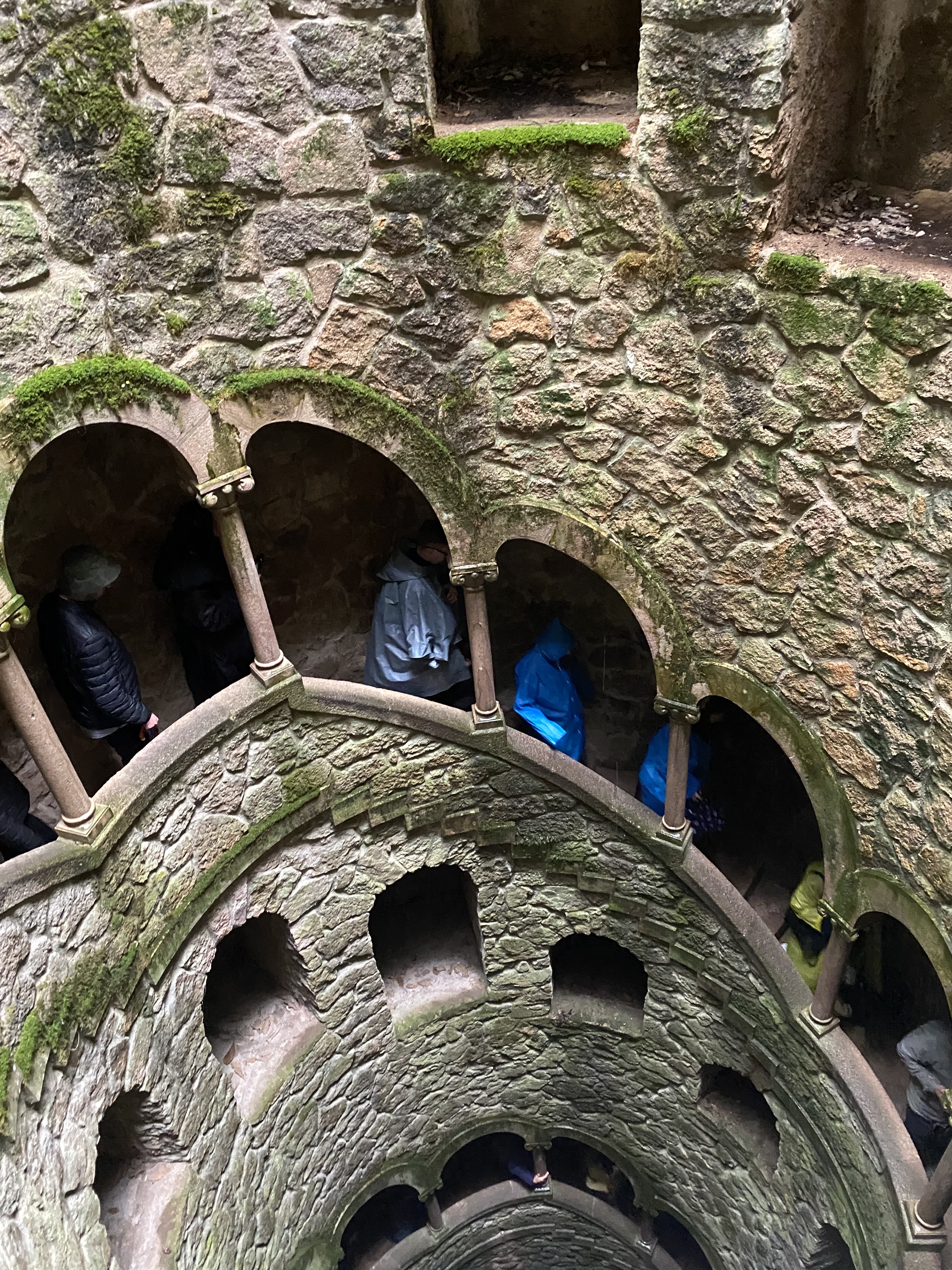
It began to rain while we were in there, albeit half-heartedly, and the thick branches and leaves of the trees overhead provided a little protection. Everything we read in the villa encouraged us to find our way to the Poço Iniciático, or the Initiation Well, a 27m hole in the ground you can access by descending nine tiers of spiral stone staircase.
Entrance to the well was efficient. Two park employees stood at the entryway as visitors trickled through the arch. Every couple of minutes, they would call down into the well at people who had stopped a bit too long for a photo to “keep moving!” This comforted me, because while I enjoy exploring, getting stuck in a well because someone is taking a barrage of selfies did not sound fun, and I kept wondering if Portugal was overdue for another insane earthquake. How many years had it been since 1755?
Also, I was reading something – what? – as we waited, which theorized the purpose of the well. Did the layers of the well represent the layers of hell, a la Dante’s Inferno? Some thought so. But the idea behind initiation was this: knights would descend into the well, blindfolded, with nothing but their sword pressed tightly to their chest. Once in, they had to find their way back out, “into the light.” I guess it was a sign of bravery and good directional skills?
We descended down to the very bottom, where a stone floor depicted the cross symbol of the Knights Templar. From there, we entered a stone grotto lit with twinkling fairy lights, a modern touch the initiated knights missed out on. We followed the grotto to the Unfinished Well. (As we walked toward the Initiation Well earlier, Dan mentioned something about the “unfinished well.” I argued that we were not going there, and it was in the wrong direction, but Dan understood me saying I didn’t believe there was an unfinished well. He went back to the sign to take a photo and send it to our group. When we emerged in the Unfinished Well, he proudly and casually said, “Oh, where’s this? What well are we in now?”)


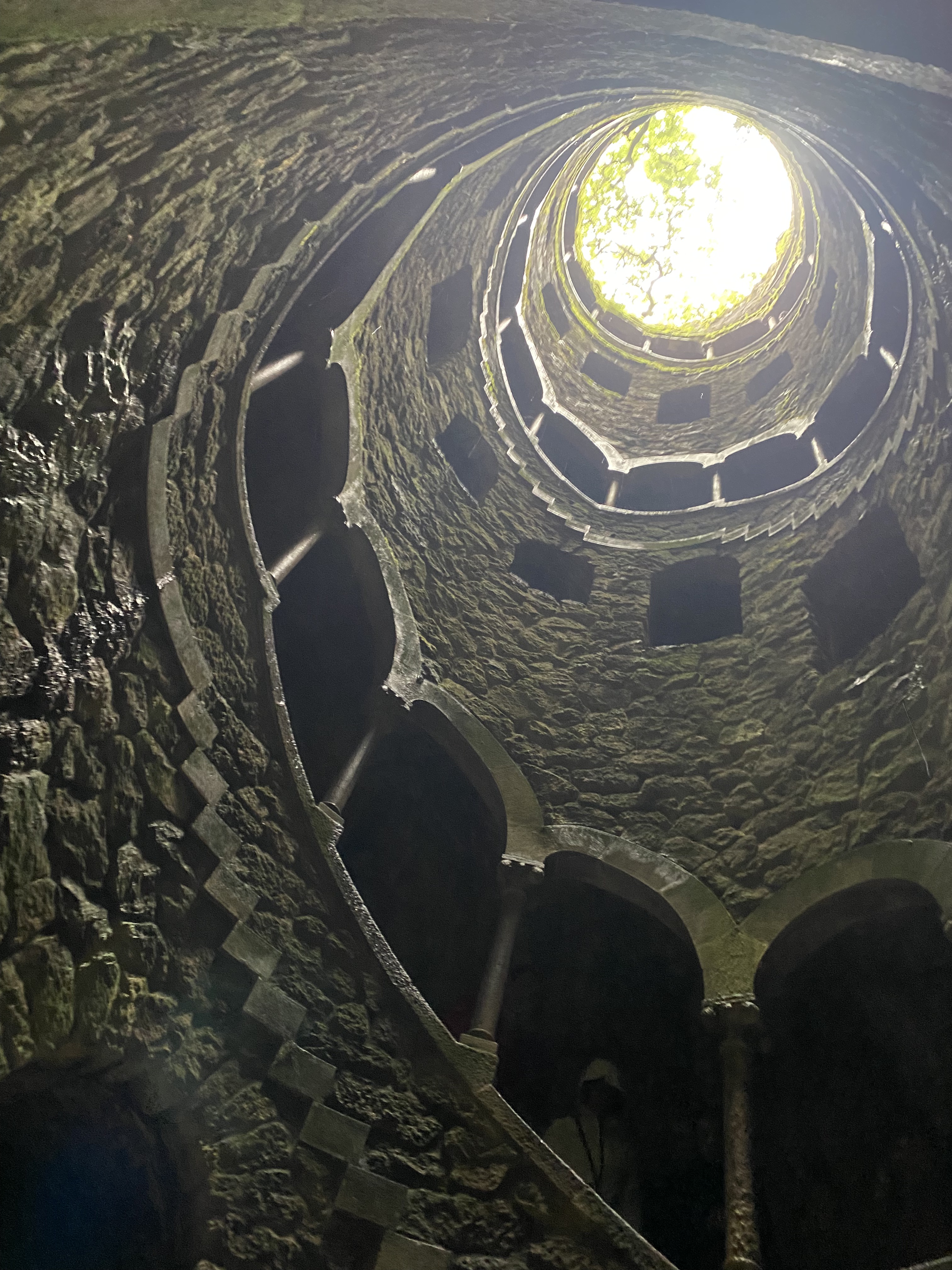


Eventually, we found our way out of the grottos and back into the beautiful, verdant nature of the park. We explored muddy trails off the main path, wondered whether dinosaurs might emerge from extravagantly large ferns, and finally found our way back to the main road, where we returned to town to have lunch in an unremarkable restaurant.
We ordered four espressos after lunch, a beverage choice that was quickly becoming a bit of a post-meal tradition for us. I’m not usually an espresso drinker, preferring coffee with oat milk, but the jolt of energy and warmth was welcome on this trip. Dan and I both asked for ours with milk, and Rebecca and J joined in. A helpful waiter finally explained what we were ordering: um garoto, he said. Espresso with milk. I wrote out the pronunciation in my Notes for later.

By the time we piled back into the car, the rain had started up again. It was a 17 minute drive from the town to our seaside hotel, and when Dan pulled the car under the awning to unload our bags, it was wild and windy outside. We were grateful to spill into the clean hotel lobby, whose windows overlooked the infinity pool and the sea.
The pool was definitely closed.
“It’s empty,” explained the man. “But you can see it’s being filled again.”
We watched in absolute awe as the ocean crashed down larger, louder waves than I had ever seen before, with some crashing so high that waves poured over the edge of the infinity pool, sloshing into the pool itself.
“There’s a big storm right now,” they explained to us, before handing us room keys and sending us off.
Our room had a balcony, and while I was tempted to dry my boots out there, I thought better of it. It was soaked. But the double glass doors provided a clear view onto the pool, where wave after wave thundered over the wall.
“Should we be worried?” Dan wondered. We shrugged it off, changed into dry clothes, and headed to the hotel bar area which also overlooked the sea. The hotel reception and the hotel restaurant were like two totally different places. While reception had been helpful and friendly, the waitstaff seemed irritated if we stood up to ask for a menu, and they struggled to get our order.
Dan ordered a beer and I ordered a glass of white wine and sparkling water. The waiter returned and asked me, “Sparkling water?” I said, “Yes.” He said, “That’s all?” I said, “And a glass of white wine.” He disappeared, then returned a short while later with a sparkling water and a glass of red wine.
Rebecca came down later and ordered a glass of Vinho Verde off the menu, which was the wiser choice – it was springy and delicious – and we spent a good hour poring over dinner options. I wanted to check out a place just down the road on the beach, but our restaurant had said it was fancy. Rebecca had found a place in town. Our hotel reception had cheerfully encouraged us to stay and eat in the hotel restaurant, so we asked the waitstaff if we could see the menu. They said we could, then disappeared and never returned.
In the end, Dan drove us into town and we ate at a quiet restaurant. On the way back to the hotel, through the thick dark night, we spotted a flashing white light in the distance.
“It’s the lighthouse,” said J. “There are ships out there, probably.”
I did not dare imagine what it felt like for a ship at sea in this storm. I’ve never seen a lighthouse in action before – I’ve seen plenty during the day or out of commission at night – and the sweep of this foggy white light flashing through the dark clouds was eerie. What did it look like to ships?
Back at the hotel, Dan and I rented billiards balls from reception and played a game of pool on a too-small table with too-small corner pockets. Miraculously, I won. In between shots, I went over to the windows overlooking the dark sea, pressed my face up to the glass, and watched the lights of a distant cruise ship, feeling grateful for the quiet stability of the hotel games room.
In the morning, I awoke at 7am to another miracle – SUN! It was a different world. As I parted the curtains, I looked out onto an ocean whose waves foamily lapped the shores, not even remotely close to breaking over the wall and into our pool. The sky was pearly blue, like the inside of a clam shell. A few streaky clouds drifted above the ocean, benign. It was the perfect morning for a run.

I pulled out my phone and perused my Lonely Planet. It turned out that our hotel was on Praia Grande, a small beach that was sandwiched between our hotel and massive rocky cliffs we hadn’t seen through the storm when we arrived the afternoon before. On those cliffs were dinosaur fossils. I was in.
I laced up my running shoes and stopped by the front desk on my way out to ask how to get up the cliffs. Google Maps is not helpful for running, often mapping me a route alongside a highway with no sidewalk. He explained that there were two options to get up: a set of stairs across the street on the left, which might be closed, and a set of stairs at the end of the beach that were definitely closed, but I should be able to go up them anyway. He explained that some recent rockfall led to the stairs being closed, with warnings posted about fines for anyone who climbs them.
Off I went, jogging down the beach, pausing to marvel at the shining waves. Ahead of me was the cliff, towering enticingly. The stairs on the left were there, but closed. So I jogged down along the sand – sand! – past a woman with a camera on a tripod, and I found myself at the bottom of the rickety staircase leading up the cliff. It looked fine, but there were warning signs posted, and I hesitated.

My other option was to run the other way, toward Azenhas do Mar, a 2km run that would plant me near a beautiful town that seems to hang over the cliff edge. But I wanted to see dinosaur fossils. I jogged back the way I came, and decided to pause and ask the woman with the camera if I could go up the stairs.
“They’re closed, but at this hour, you should be fine,” she said. “I don’t think anyone will fine you.”
The Swiss in me felt unable to go up the stairs, even if I did want to run them. I asked her if I could run on the road. She said maybe, but then added, “I’m heading up there now to take photos. I can give you a ride.”
She seemed nice enough, and I trust my gut, so I hopped in the car and off we went. Her name was Sandra, and she was originally from Lisbon but now lived the next town over, in Praia das Maçãs, which was having a seafood festival today, selling barnacles and mussels. It was Good Friday. She asked what we’d seen so far, and I told her about the Quinta da Regaleira.
“Of course. That was one of the places that was built to hide the Holy Grail,” she told me. “Back then, Portugal was a place that was considered safe to hide it, so the well was built as a potential hiding place.”
“Is it there?!” I asked her. She shrugged and smiled.
She drove me past the hotel, then pointed out where we would turn.
“You have a car with you? You can bring your friends back here later,” she explained. We continued along a winding road – with zero sidewalk in sight – and eventually parts of the road turned red. “Now you count the curves – one, two, three. On the right – there.”
She slowed down and pointed to a tiny tiled sign advertising strawberry fields, and we turned down an unpaved road.
“There used to be strawberries growing here, but now there’s not,” she told me. She parked the car at the end of the road, then grabbed her camera equipment from the trunk and led me down a path that ended at the top of the wooden stairs I could have illegally climbed from the beach. She walked down a short way, then pointed up at the cliff. “And those are the dinosaur footprints.”
There they were. Unlike the rest of the sharp, straight striations on the cliffside, the footprints were deeper, sort of rounded. It was unreal. I had a lot of questions I didn’t ask.

“There were more, but there was a rockfall recently and the rock collapsed after a storm. That’s why the stairs are off-limits,” she explained. “I’m going to climb up higher for the view.”
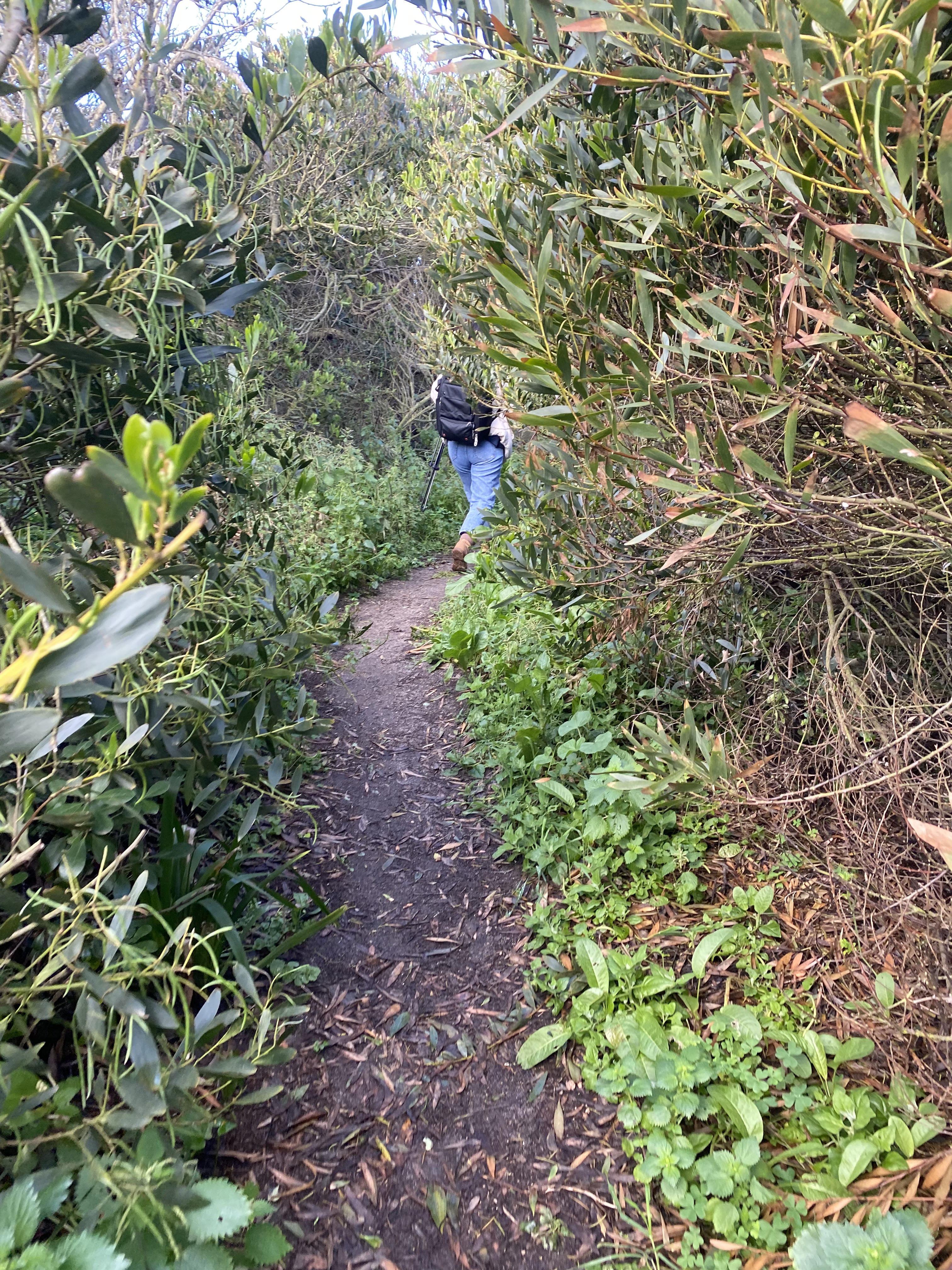
So I followed her up. She explained that I should download OutdoorActive to get the best hiking routes, and pointed out painted hiking blazes on the posts marking our trail. It was a relief to see them, because it really felt we were bushwacking. Making our way along the trail, you had to really stick your arm out to part the overgrowth and for most of the hike, I had to bend over to get through. But emerging on the other side, at the top of the cliff, there was the most marvellous view of the coastline and cliffsides.
We snapped photos, her with her camera and me with my iPhone, before heading back to the car. She was going back to Praia das Maçãs, a kilometer from my hotel. I wanted to get a run in, so I rode back with her and jumped out on an even smaller beach. After following her on Instagram and chatting about poetry and art, we hugged good-bye and she told me to message her if I wanted advice or questions on anything in the area.


I jogged back to the hotel feeling light as a cloud, which was good because the breakfast buffet there was so enormous that I left feeling like a fat raincloud. We made our plans for the day over fruit, eggs, good coffee, and springy bread. Then, we checked out of the hotel and piled back into the car.
We were en route to Sintra to explore a Moorish castle, but as Dan drove, he turned up the road Sandra had taken me before.
“This is how we got to the dinosaur footprints,” I told them.
“We have time – let’s see them,” said J, who loves rocks. I had taken a photo of the strawberry field sign, but we passed it the first time and had to turn around. I led them down the stairs to the fossilized footprints, which make it look like the dinosaur was walking up the cliff vertically toward the sky.
“Imagine the size of the animal that left prints like that,” J was saying.
“You can see how the rock has been pushed up,” Dan added. “That would have been flat, but over time, the rocks got pushed upward until they’re vertical.”
“I want to go down there,” J said, pointing at a cement pilar where I’d stood with Sandra earlier. I was excited to be able to lead the way down the path.
“This is like raptor grass,” said Dan. “Clever girl.”
We hummed the Jurassic Park theme song as we swished our way through the overgrowth. Then Rebecca said, “To think you followed a total stranger down here this morning, Nicole. I don’t know about that.”
We emerged at the cliffside and the views had the same awe-inspiring impact on everyone. A Swiss man and his wife were down by the cement marker, flying a drone, which got J talking (he’d brought along his drone, but had read that you needed to register it to fly it in Portugal). After several minutes admiring the views and snapping photos, we headed back the way we came. We passed more people on the hiking path, and to my dismay, I spotted dozens more climbing up the illegal beach stairs!

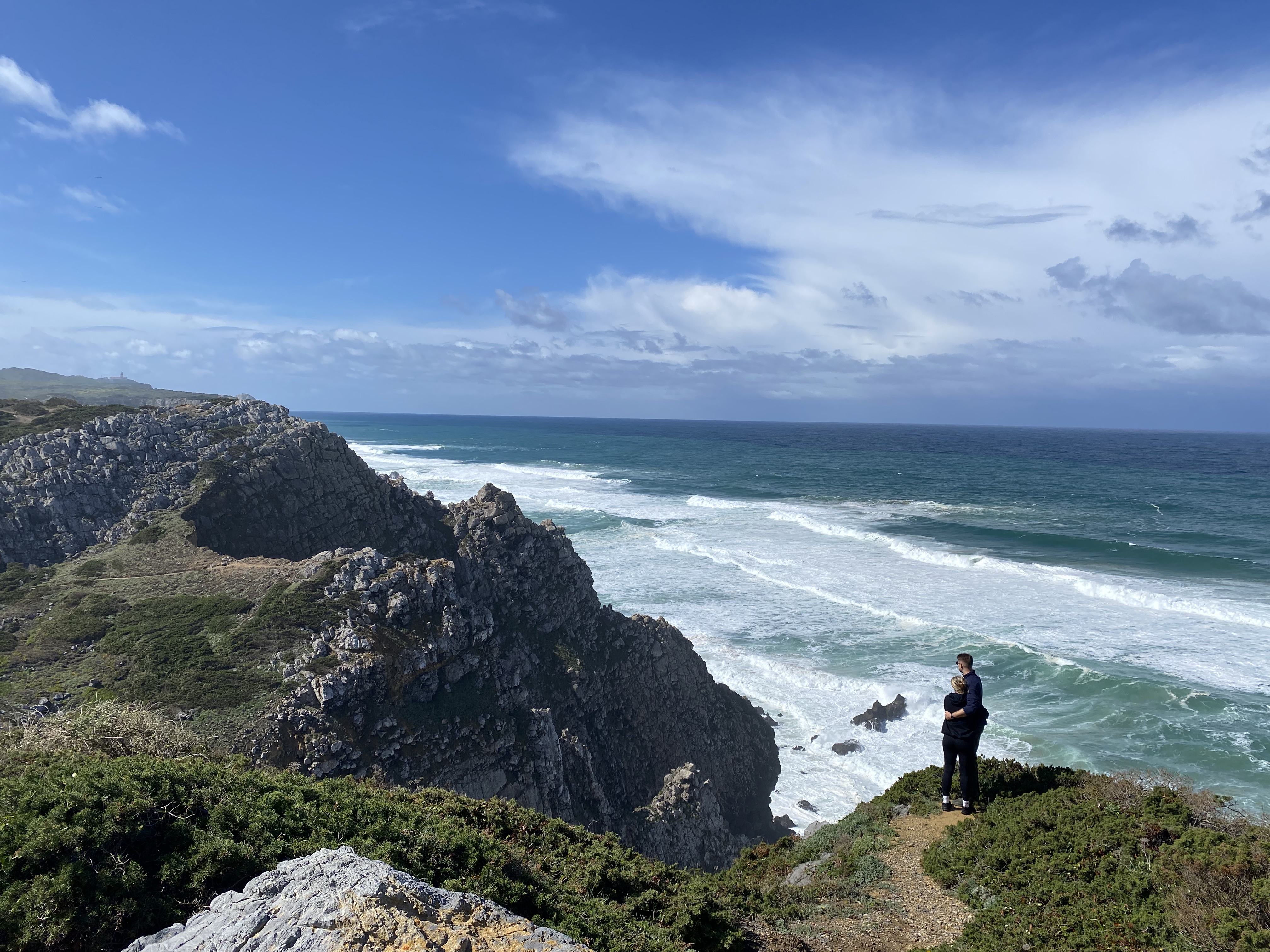
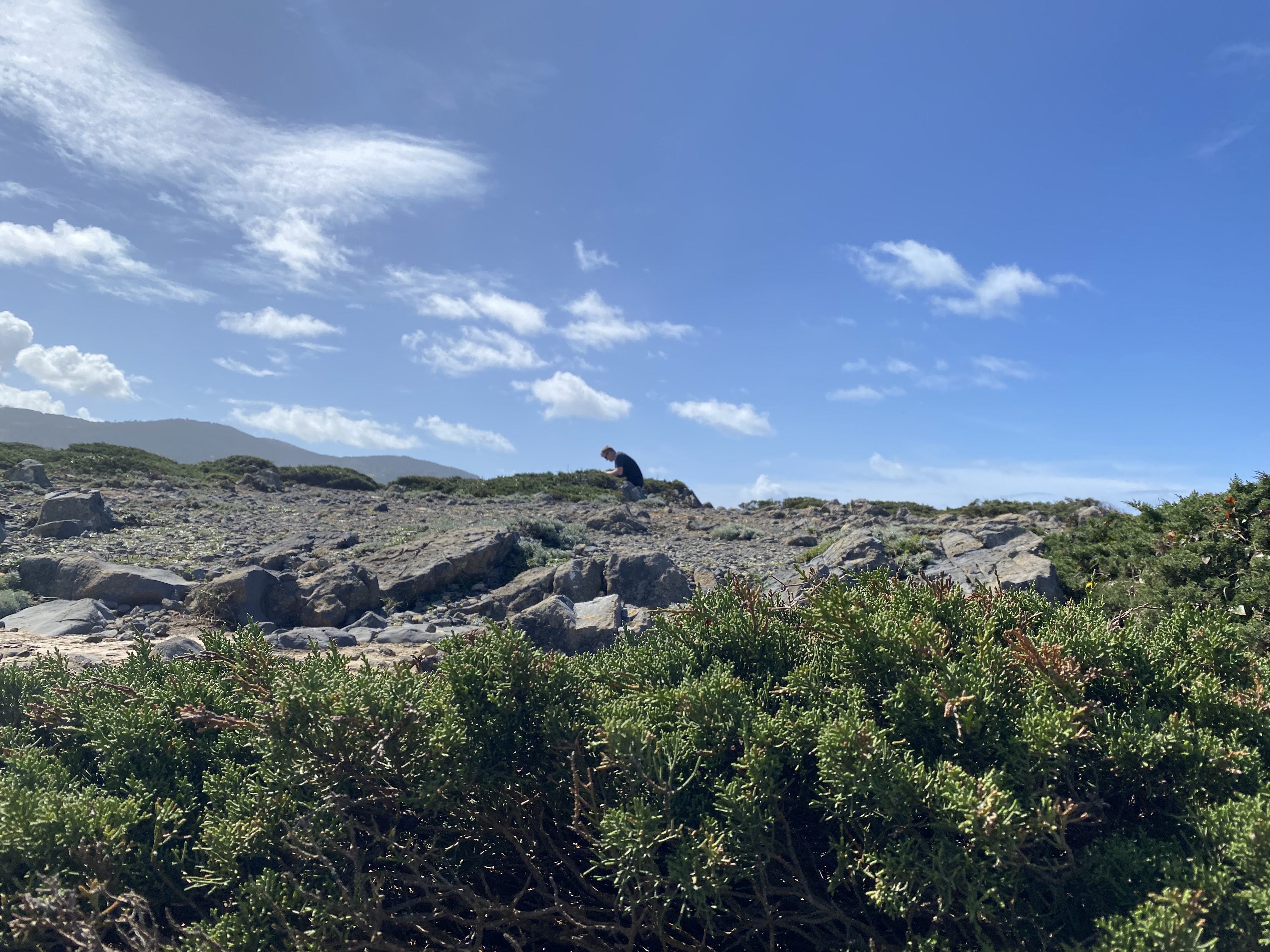


Part of me felt a twang of regret, because I had wanted to run up the steps and see the fossils that way, but another part of me was grateful to have met Sandra, because she’d shown me how to get there by car and showed me the cool viewpoint.
The morning was off to a splendid start that only got better as we arrived in Sintra and began our hike up to Castelo dos Mouros, the Moorish castle. As we hiked under a stone archway, J snapped a photo of a QR code printed beneath a headline reading: “Save time! By your tickets now!”
As we hiked up, J tapped in some information, and then reported back: “There are no open slots until 5:30. It looks like you get tickets for a specific entry time.”
This was disappointing, but we hiked up to the castle entrypoint anyway. There, another touch-screen offered the possibility of buying tickets, so we tried again. It’s worth pausing for a moment, standing there in a 10th century Moorish Castle, tapping your finger on a touch-screen with credit card contactless payment, trying to gain access. Tapping a piece of plastic is a far cry from invaders stampeding over hills with spears.
Again, the only available tickets were at 5:30, so J decided to ask the man who was scanning tickets of people who were entering. We watched J speak to him, saw some head shaking and eventually some nodding, and then J returned.
“He said we can just go in,” he told us. This seemed bizarre. Why were we being allowed to enter, waiving the 8 euro entry fee, at a time slot when tickets were unavailable?
“What did you say to him?” Rebecca asked, as we moved past the line of people and entered. The man pointed at us, then pointed to the left.
“That way,” he told us, pointing toward the cafeteria.
“I said, we just want to see the Moorish castle, and he said, “Okay, but only two of you.” So I said, “There are four of us.” He said, “Only two.” I said, “How about two pairs of two?” And he said, “Okay.”
Turning toward the cafeteria, we realized that perhaps the man had misunderstood J, had thought he was asking if we could use the cafeteria rather than see the castle. Rebecca ventured through first, then waved us on. Apparently you could enter the castle by way of the cafeteria entrance, and so we were up. We felt a little guilty about it, but hey. Maybe he did just feel like giving 4 strangers access to the castle that day.
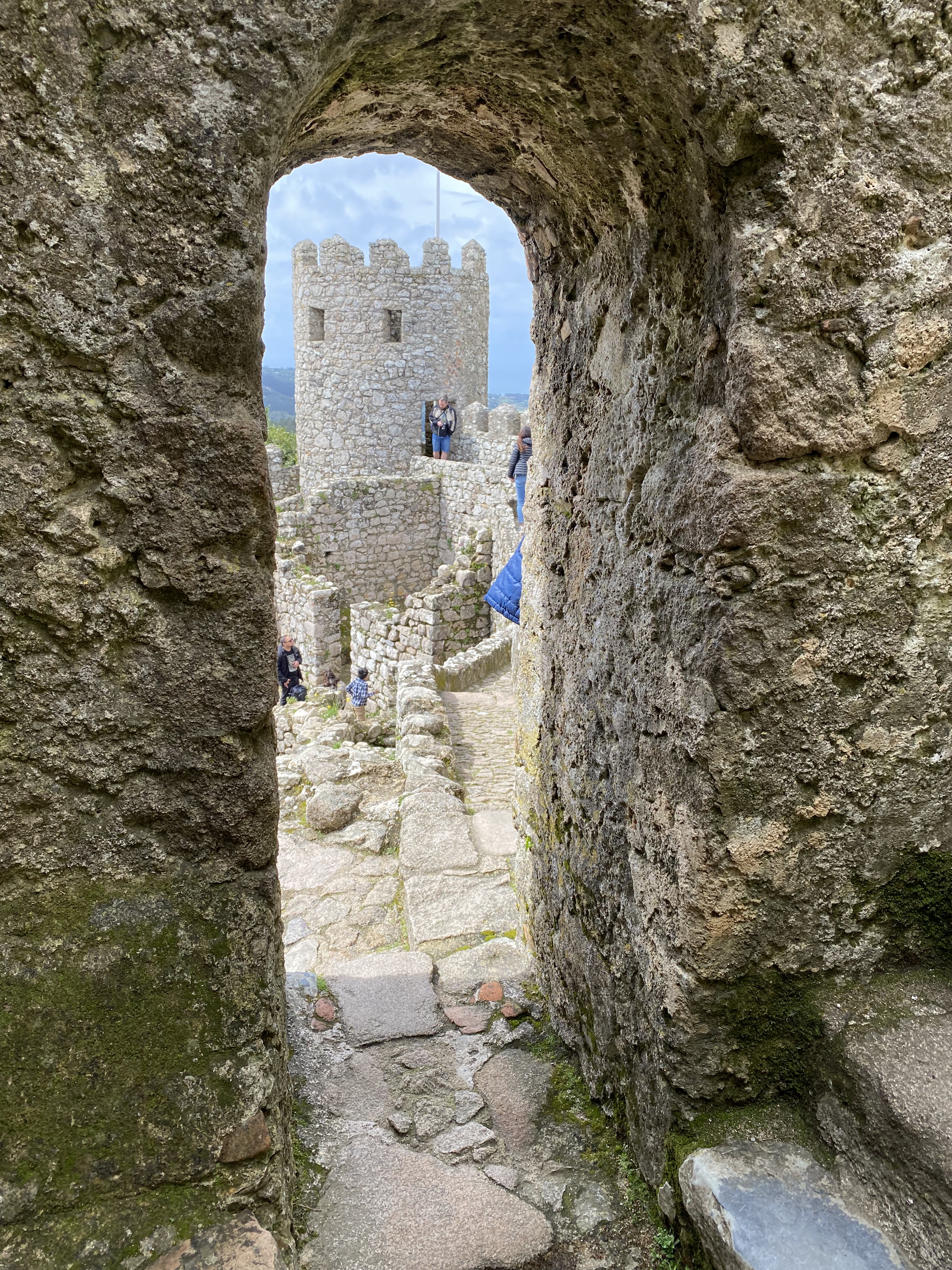
And man, what a castle it is. At 412 meters above sea level, the ramparts offer unrivaled views of Portugal, stretching all the way to the water. The castle walls roll along the hillsides like the spines of slumbering dragons, so all the while you’re walking you have your eyes on the very top tower. We made it up there and paused to take in the view, which included the nearby Palácio Nacional da Pena. Even from the castle, it looked beautiful, a pinkish color popping against the clear blue sky.


This was our next stop, so we made our way back down the castle, past the ticket scanner, and back onto a cobbled road that led through forest and toward the palace. As we walked, we came across a QR code that said “Pena Quest!” and suggested we could solve riddles and collect QR codes along the way.
“Is this a side quest?” J wondered. We’d planned each day with some loose itinerary, and any time one of us suggested a diversion – the medieval tavern, the Pegadas de Dinosauro da Praia Grande – one of us would say, “Side quest!”
I scanned in the QR code as we headed toward the palace gates.
“Anyone see a riding ring? There’s a riding ring somewhere. If we get all the QR codes, we get a prize!”
“Probably a giant pencil.”
We reached the main entrance to the palace and immediately deflated. We’d been walking quietly through the woods only to emerge on a roadside absolutely teeming with people. Two or three coach buses had just unloaded a sea of visitors at the palace gates, adding to the ocean of people who were already standing around, waiting to get in.
The four of us recoiled back into the forest. We would not have been among the throngs trying to get to the ball in Cinderella; we would have been the witch in Hansel and Gretel, baking stuff alone in a hut in the middle of the forest. Crowds, no thank you.
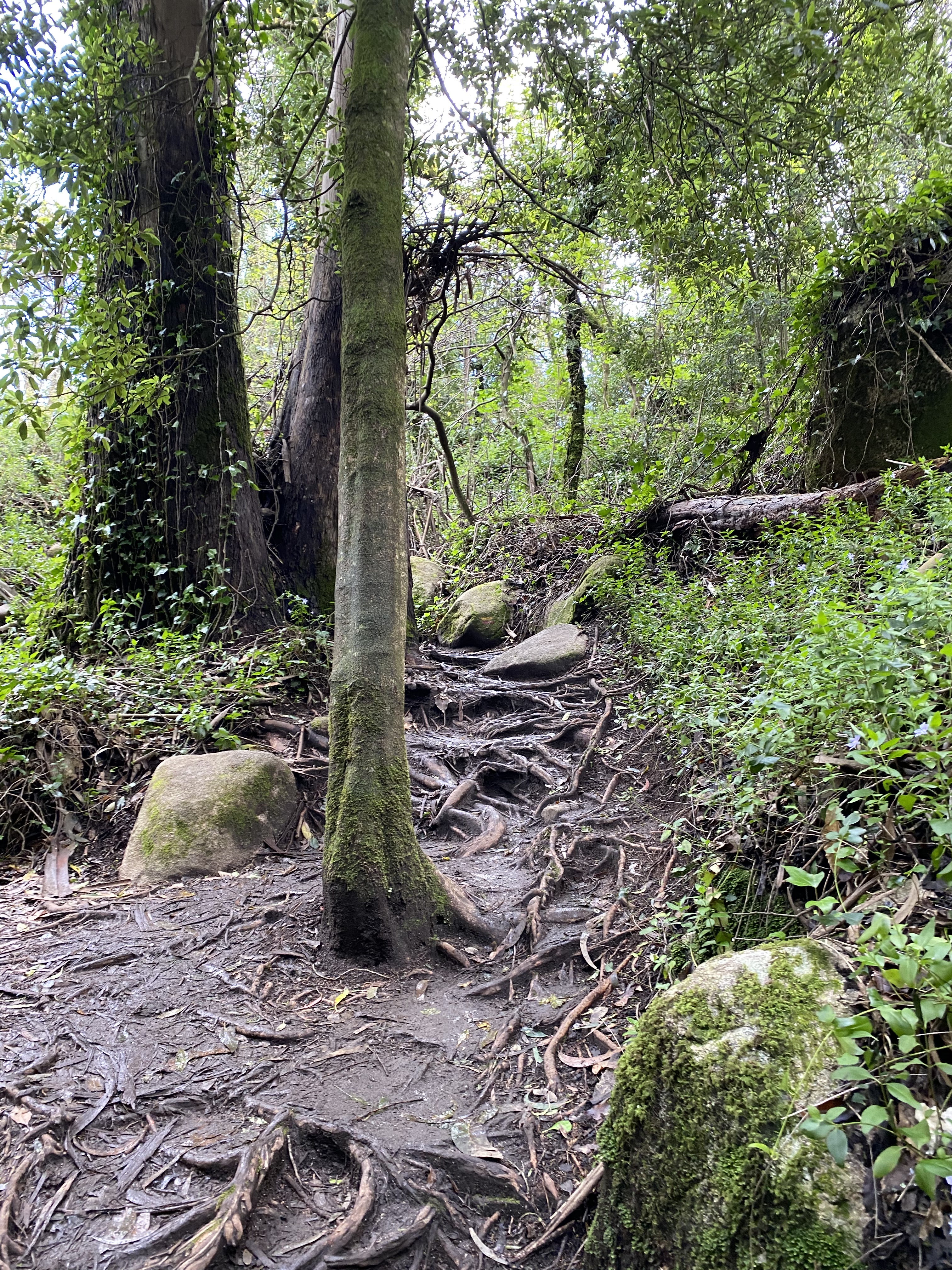
J led us down a cobbled path to the town so we could avoid the main road. We passed old cisterns in the woods, decrepit fountains, fallen trees. It began to rain, but only a passing shower. By the time we emerged in our cobblestone parking lot, the sky was dry, but cloudy.
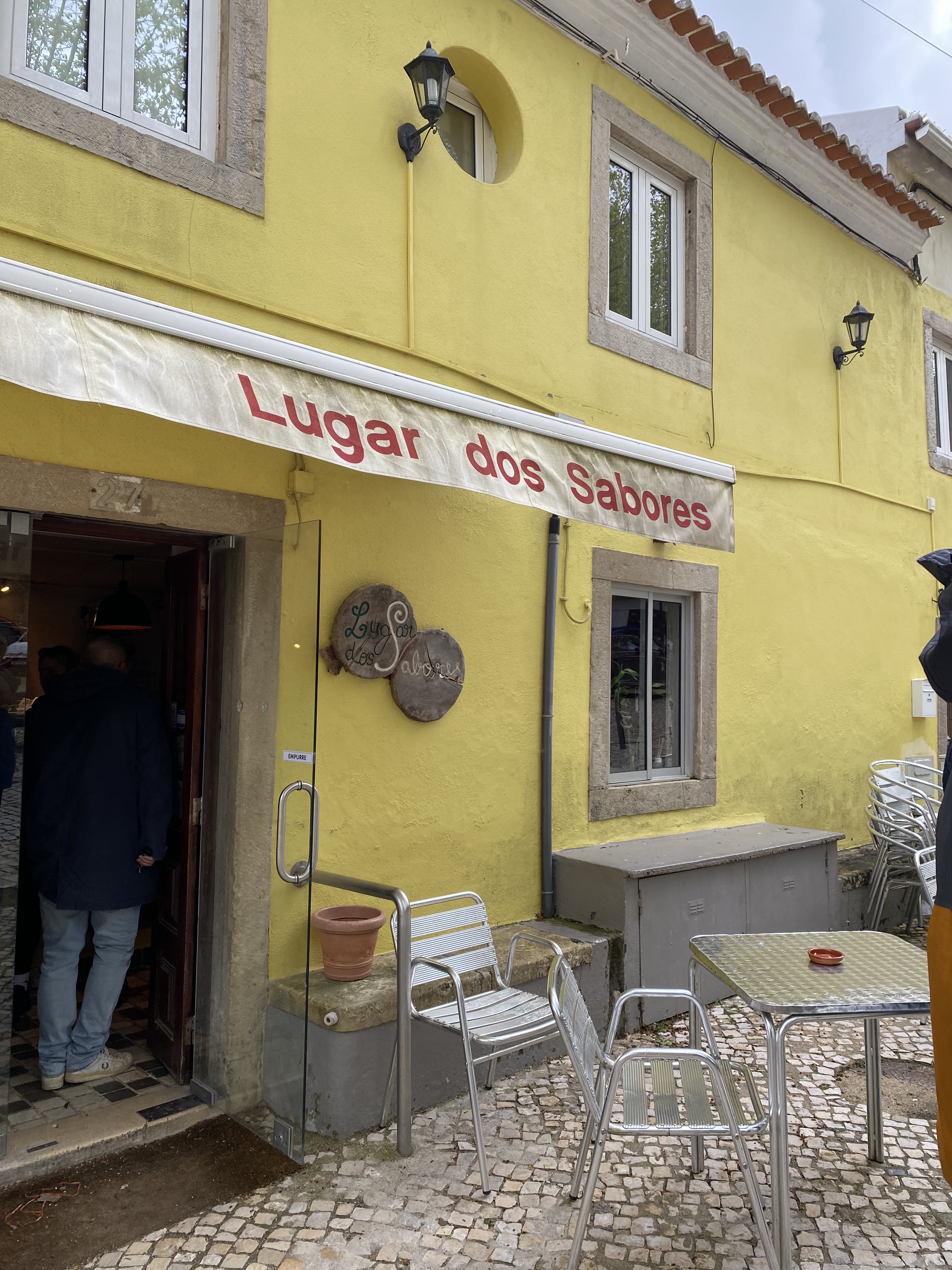
Rebecca scanned her Google Maps for a restaurant and saw that one right there on the square had a 4.5 star rating. Marked with a tiny flapping awning, Lugar dos Sabores didn’t look like much, but inside was cozy and a display case offered freshly baked quiches, spinach pastries, and made-to-order sandwiches. The woman running the place was friendly and smiling, and sat us down in the corner and brought us our food. We also ordered four glasses of lemonade, and man, it was pure, fresh-squeezed lemon and water. Delicious.
We ordered pastel de natas – in three different flavors! – and I did my best to order garota, our favorite espresso with milk. I believe it was here I was complimented on my pronunciation.
Feeling refreshed, we hopped into the car to head to our next hotel, Your Hotel and Spa, but not before a quick stop at Portugal’s most famous wave, Nazaré. The 1 hour 20 minute drive was a beautiful one, with rapidly changing scenery: trees, rolling hills, distant mountains.
As we grew closer to Nazaré, though, the sky began to open up and rain came down. The village was cramped and cobbled, and as we grew closer to our destination, traffic slowed.
“It says on here that the only downside to coming here is that they close the road 1 km away from the lighthouse so you’re forced to do the rest of the journey by tuktuk,” Rebecca read off of Google Maps. I was not happy about this, but we found parking 1.2km away on a side street and stepped out into the rain.
We did well to pull out of the traffic at that point; as we walked down to the archway, we passed cars at a standstill. We came to a giant archway where the road sloped downhill toward the famous Farol da Nazaré lighthouse, the one you’ve probably seen in those crazy photos of surfers riding enormous waves that seem like they’re going to crash over the lighthouse.
The waves were big, but not as big as the photos make them seem, and they definitely sounded huge. We watched a few of them roll in, gathering strength and rising up, and then they’d slowly start to barrel in on themselves with a tremendous roar. These are not the waves I grew up with.
I wish I had photos or videos, but it was raining so hard, so incessantly, that I was completely soaked through everything. My hiking pants were plastered to my skin, my hiking boots were soaked, my socks were squelching, and I was quite cold. It was a long walk back up to the car. While the walk down had the fronts of my legs facing the rain, the walk back up the hill ensured that the backs of my legs were soaked as well.
When we climbed back into the dry car, I sat in my sopping clothes as Dan drove us to Your Hotel and Spa, our hotel for the next two nights. Located past some remote vineyards and well off the main road, the hotel offered laundry service and, hopefully, some relaxation. As I stood waiting to check in, Rebecca poured each of us a glass of fruit water and said some magic words to me: “I think we need to reevaluate our hiking plans for tomorrow.”
Revitalized by the water and the promise of maybe having a day of dryness, I lugged our things up to the room and we all decided we’d meet downstairs at the spa. However, Johannes got down there first and messaged the group: the spa was booked for the evening. We could book for the next day, though. Should we meet in the game room to decide?
We made a plan. The weather tomorrow forecast rain again, so we’d spend the day in the spa. For now, we’d book in our massages and spa circuit, reserve dinner in the hotel restaurant, and pass the time playing pool in the games room.
What a 180 dry clothes, good company, and a plan can be. We played pool for over an hour, Rebecca and I sharing a small bottle of white wine, Dan and J drinking beer. We made it down for dinner at 7:45, where we ordered a cheese board and two bottles of wine from the manager who looked like a mix between McDreamy and Willem Dafoe. His recommendations were on point and offered with a good sense of humor.
We were there until 9:45, eating our way through mains and desserts, and we left full and a little achy from laughing so hard and so much over the two hours we were together. (At one point, Rebecca looked around at the quiet diners and said, “No one in here is having as much fun as we are.”)
I think that’s a good moral for the trip: you can shake off bad weather if you’re in good company.

Categories: Portugal
 Lost Among Latitudes