J had planned a nice 10k hike for us on the Saturday we were at Your Hotel and Spa, but the weather forecast was the same as it had been for the past few days: rain. So on Friday, we decided we’d spend Saturday in the spa instead.
Of course, apart from a brief morning shower, Saturday was the first sunny day we had the entire trip.
We woke up and enjoyed a good breakfast at the hotel before booking the tennis court for 10:30-11:45. Dan and I sent a bag of smelly, soaking wet laundry away to get washed, which meant I had nothing to wear for tennis (all of my clothes were soaking and smelly) so I borrowed a pair of Dan’s basketball shorts. The game was fun, with lots of laughter, some good rallies, and good weather. Rebecca and Dan played well, and Johannes was a close second. I haven’t played since Manila, so I was not as good, and several times brought the racket down directly over my head to return a shot, a move the others labeled “the templar.”
It began to rain a little, so we went inside. J and Dan drove to town to pick up lunch – salads and kombucha from some restaurant – and I showered and relaxed.
At 1pm, we put on our robes and headed down to the spa. We all had to purchase a swim cap in order to use the spa, and for a 1-hour spa circuit, as hotel guests, we received a discount rate of 15 euros. The spa was okay: a steam room, a sauna, a massage pool (not really hot, though) and a larger pool (also rather cool). Then they had a shower that was a bucket of cold water, a rain walk, and a rock walk, where you walked barefoot over lots of pebbles while cold water sprayed you. The first 15 minutes, we tried out everything, then settled on the sauna, as it was the warmest place we could find.
“But it’s still not hot enough to be a sauna,” said J. “This isn’t a sauna.”
It also didn’t have the bucket of water to throw on the stones. Oh well. We were only there until 2pm, when J, Rebecca, and I had massages until 3:15pm. This was quite relaxing and great. I’m always nervous about getting massages out somewhere, but it was a good one. We decided to cancel our second spa circuit, and we met in the games room after my foot massage was over for more pool until dinner.
Since Easter was the next day, the hotel had hidden eggs around the building and people were out looking for them. It was quite cute.
At dinner, we ordered our standard fare: white wine and a cheese board. Our pal from the night before was there, and he suggested a nice bottle of sparkling wine that was actually very good. A woman came and served us our cheese board.
“All of these cheeses are regional, from Portugal,” she told us, setting it down. We dug in, and of the four or five cheeses, there was a clear favorite. This was big for us cheese-lovers, especially Johannes, our Swiss-German companion. We called the man over.
“What cheese was this?” we asked him. “It was so good.”
“We want to buy it,” said Johannes. The man dashed back into the kitchen and returned with a block of it, since we’d eaten all of the cheese on the board.
“Was it this one?” he asked, and we all nodded. “I’ll be right back. I think we have the wrapper.”
We were on the trail to good cheese! Excitement abounded! And then he returned – with a crumpled up wrapper proudly stamped: GRUYERE.
“This is the one!” he said triumphantly. It was reason to chuckle. No wonder we loved it so much. As we finished our dinner, we decided we needed to give him a tip, something extra in addition to the bill. Rebecca practiced transferring money by handshake, which had us all in stitches, and when he came over, she ditched the gesture and went for a more refined, Yorkshire approach. She thanked him for his service and his recommendations, and just handed him the money subtly.
He then thanked us, and asked where we were headed. When we mentioned our last stop was Porto, he said he’d be there as well: he was going “undercover” to scope out a hotel. He suggested that we eat dinner at a restaurant there called Flow, which Rebecca typed down in her phone. For the next few days, we joked that we’d see him around Porto wearing a fake mustache and a monocle.
In the morning, we sat in the same spot for breakfast, and filled up on good food before hitting the road. As breakfast ended, we ordered our espressos with milk.
“Go on, Nicole. You have the pronunciation,” J said. With pride, I asked for four “garotas.” The waitress stared at me blankly.
“What?”
I tried again. “Garota.” I pulled up the Note on my phone where I’d typed out the phonetic spelling. Again, nothing. She made the universal face of “I have no idea what you’re saying”, where she scrunched up her nose and stared at me like I’d found a mouldy peach in a dumpster and was slowly eating it in front of her.
Rebecca jumped in helpfully. “Espresso, with milk.”
“Ah!” she said. “Espresso with one drop of milk. Yes, that’s called pingado. Espresso with one drop of milk. Or, if you want a bigger one, espresso with more milk, you can order meia de Leite.”
We thanked her and ordered our coffees. We were baffled. What had we been ordering? A quick search of coffee in Portugal on catavino.net yielded the following: um pingado is espresso with, literally, 1-2 drops of milk. Like, drops. That’s not what we were after. Uma Meia de Leite is described as “a shot of espresso in a heap of milk”, served in a 6 oz coffee cup. This is what I should have been ordering the whole time.
Above them both, though, was the one we’d been ordering: um garoto. The definition read “um garoto (little boy) is a weak, milky espresso that’s commonly given to children.”
Whoops. As she served our coffees, I wondered why she didn’t know the word. Either my pronunciation was godawful, or the idea of serving kids’ coffee to adults was so unthinkable that she couldn’t make the connection. We gave our obrigados and she left smiling.
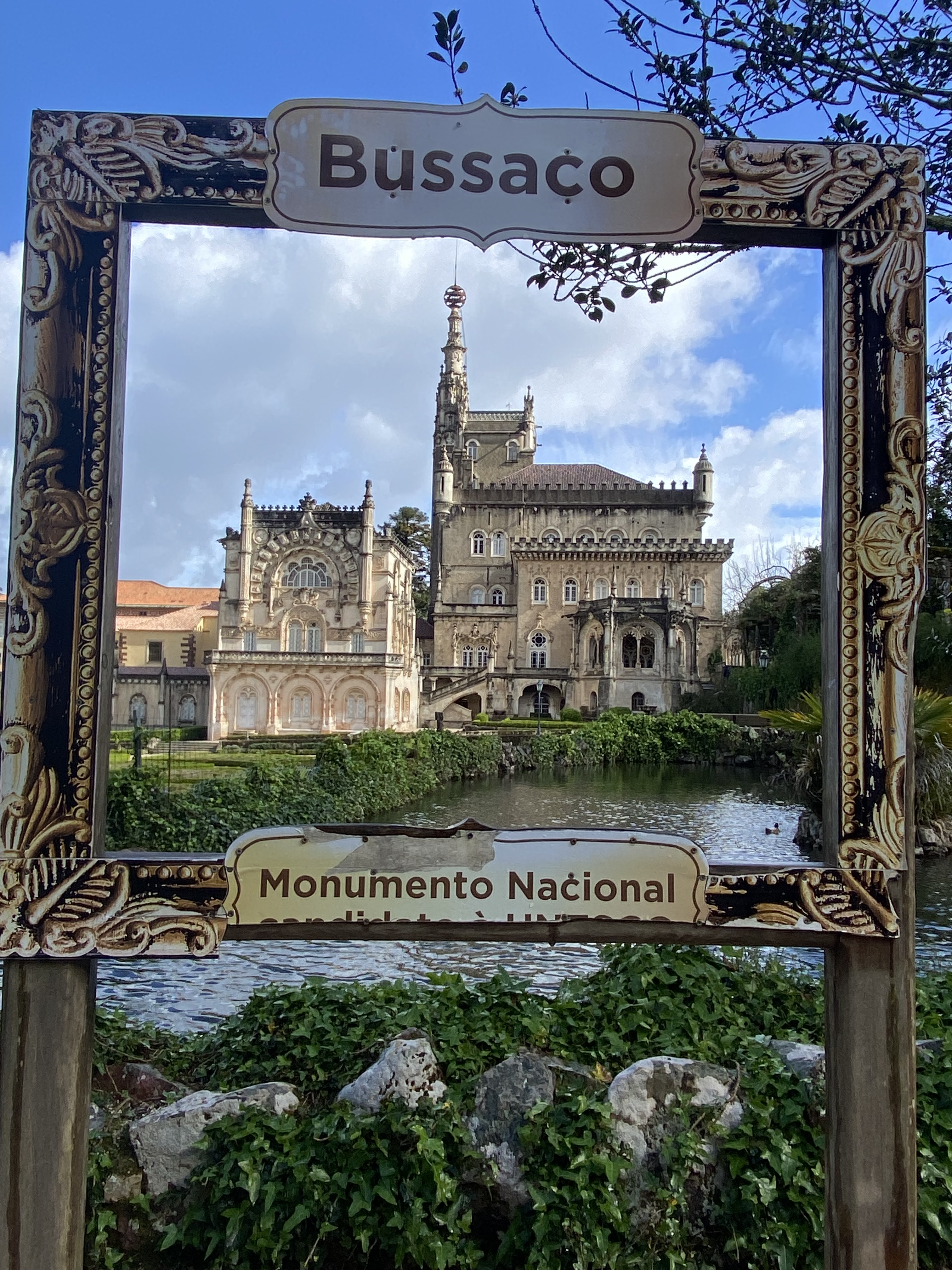
We loaded the car with our clean laundry and cases, and we were off. Our next stop was an hour and a half drive north to Bussaco Palace, where we’d spend the night in an old palace tucked away in a national forest. Be still my heart.
We decided to try Nazaré one more time under clear skies, but of course as soon as we pulled into the town, clouds began to gather. We started to joke about it.
“They’re pulling up! They’re about to get out of the car! ASSEMBLE!” we imagined the rain clouds saying, each time we found a parking spot.
A man directed us to a small cobblestone parking lot behind the main square, a few hundred meters closer than we’d gotten last time. He wanted some coins in exchange. We walked through the square just as church was letting out for Easter Sunday. Bells were tolling. Clouds were lingering. I walked briskly back toward the archway leading down to the lighthouse. I was determined to not get wet.
Dan was with me, and as we went down, we realized that J and Rebecca had stayed back by the car. By the time this made sense to us, we were already at the lighthouse. It had been a slightly unnerving walk. As I’d strode down the road, I saw a flash out of the corner of my eye. Lightning? Thunder followed minutes later. I never like the idea of being at the beach during a storm, but that was all we got – one bolt of lightning, one thunderclap.
Also, the waves were even smaller than the day before. Rebecca had found an online forecast that tells you whether the waves are “giant” or “big.”
“They’re only ‘big’ now,” she told us. “We missed the giant ones.”
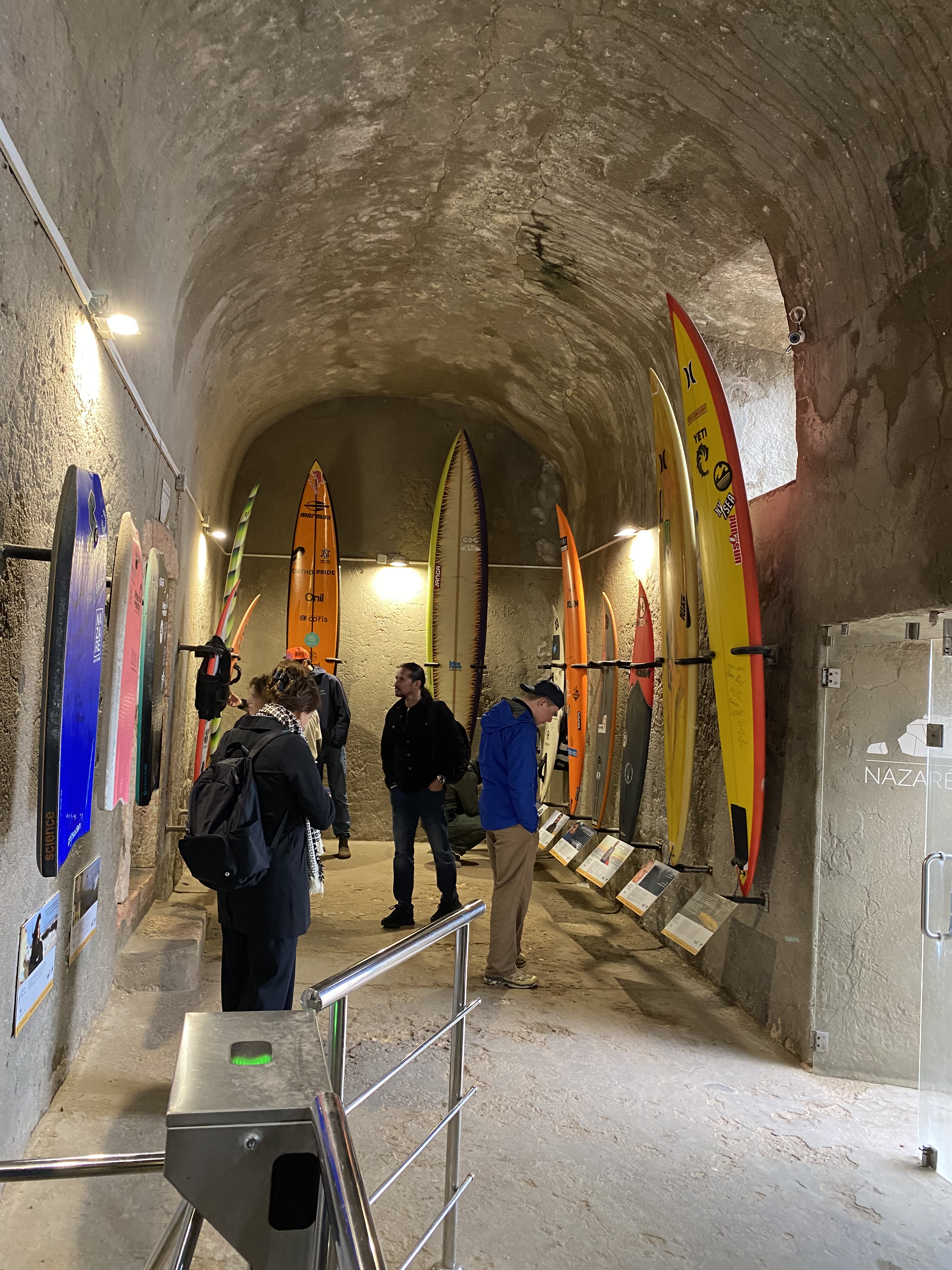
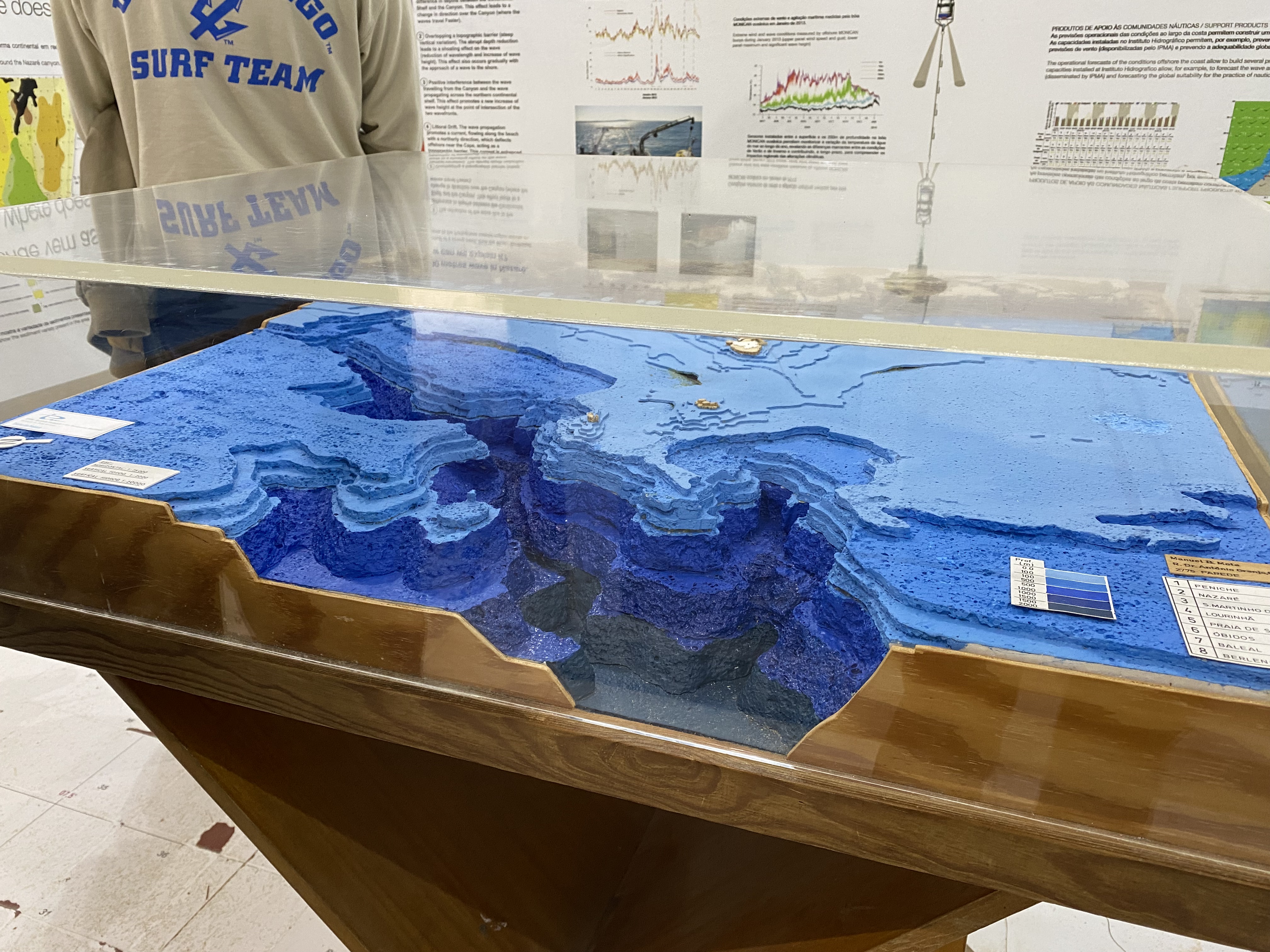
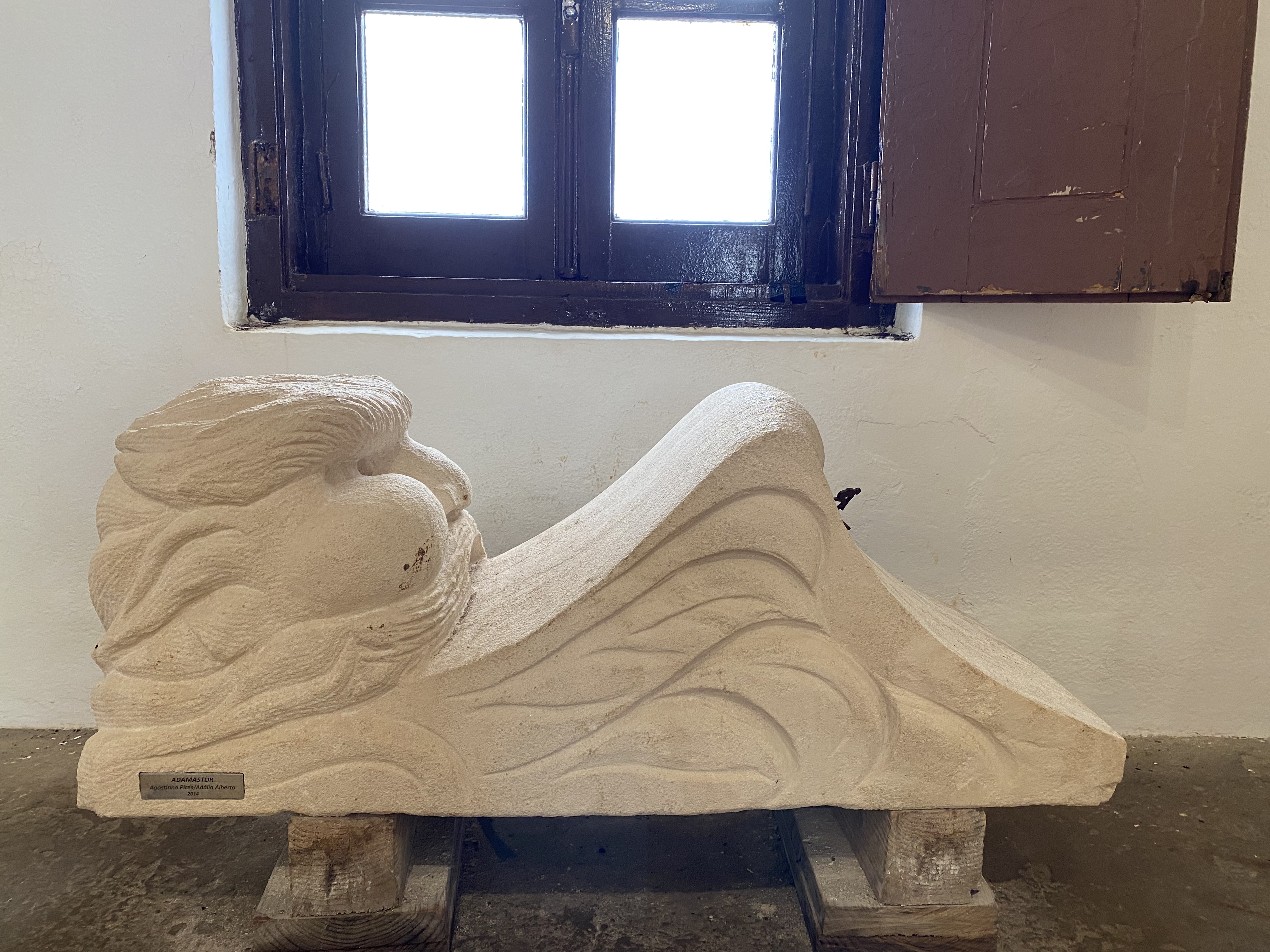
We reached the lighthouse and decided to pay the 2 euro entry fee, mainly because I was convinced that at any minute, the sky would open and it would rain buckets. But also, inside the lighthouse is a little museum honoring the people who have surfed Nazaré’s 30 meter-high waves. There are brightly colored surfboards mounted on stone walls, and a model of the underwater canyon that creates the gigantic waves that roll in. One of the jet skis that tows the surfers out was also mounted on the wall. It was all very cool.
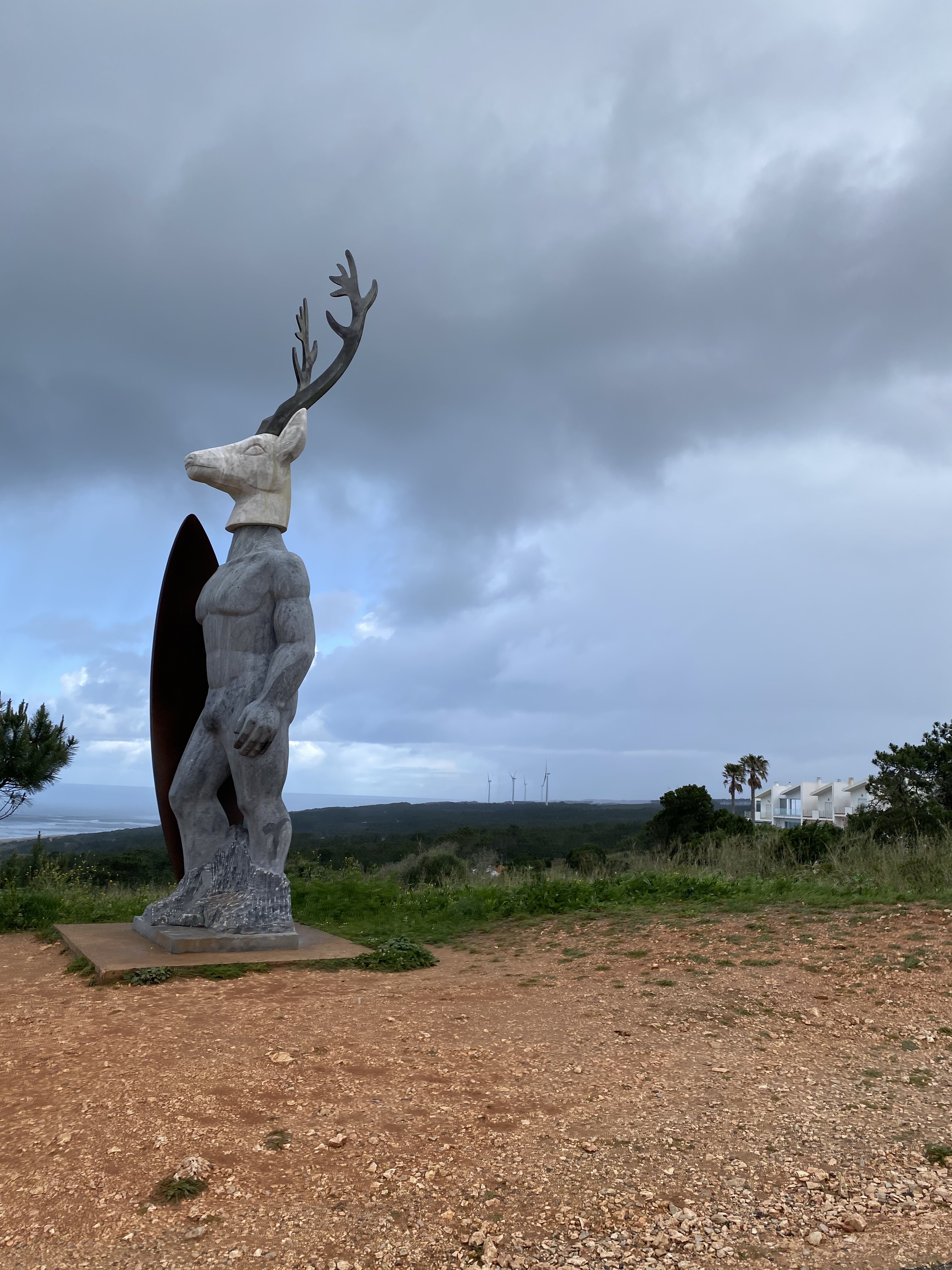
On the way back up the hill, we paused to admire an interesting statue we’d passed at the archway. I read from my Lonely Planet: In 1182, a nobelman named Dom Fuas Roupinho was riding his horse, chasing a deer (there used to be a lot of them in the area, apparently). The deer disappeared off the cliff edge where the statue now stands. Dom Fuas, not wanting to disappear over the cliff edge as well, cried out to “Our Lady of Nazaré”, which my LP calls “the Virgin”, and his horse “miraculously stopped right at the cliff’s edge.” Apparently the mark of one of its horseshoes is still visible, but I didn’t see it. He built a statue, it seems, but not this one; this one is more modern and meant to commemorate this incident as well as the fame Nazaré has accrued in the surfing world.
Since Googling these things, as well as “first women to surf Nazaré”, my Instagram has been overloading me with surfing tips. Thanks, algorithm.
From Nazaré, we drove north, and decided to stop for lunch in Coimbra. (Not to be confused with Coimbrã, which we did and nearly did a U-turn and drove back over an hour the way we’d come.)
Coimbra was buzzing quietly for Easter Sunday, so we parked and found a lunch spot near the car. It was fine, though I think the woman was upset we had chosen lemon sodas over alcohol, as she unhappily collected our glasses together.
Coimbra, I learned, was Portugal’s medieval capital for more than a century (LP) and is home to the country’s oldest university. The Universidade de Coimbra is Portugal’s first university, and one of Europe’s oldest. Confusingly, the university was actually founded in Lisbon in 1290, but “settled” in Coimbra in 1537. (For reference, Oxford University, according to Google, was founded around 1096.)
After lunch, we walked toward a coffee shop I’d read about in my Lonely Planet, which is inside a cathedral. It was closed, even though Google Maps reported “LIVE! Busier than usual!”
Instead, we hiked up a steep street, Rua Quebra Costas (apparently also known as Backbreaker Street) and eventually arrived at the sprawling plaza where the university is. The trek up was through narrow cobbles, houses on both sides looking rather worn and very much graffiti’d. The plaza, or a courtyard, was well-kept and not graffiti’d.
We wandered around, taking photos of the courtyard and the views it offered of Coimbra, before asking someone at the library how we could get back down. The Biblioteca Joanina is billed as “Coimbra’s headline sight”, and if I’d known more about it, I might have tried to go inside. Like most places we saw, you have to book tickets to the library for a certain time slot, so we probably wouldn’t have made it in so last minute. Intriguingly, the library is home to a “colony of bats” that protects the books, because they eat harmful insects. Very cool.
We journeyed back down, stopping in a hostel to get some coffee on our way back to the car. J ordered pingados, but Rebecca and Dan asked for a little more milk in theirs. I tried again, asking about um garota. The hostel manager/barista was very friendly and shook his head politely at me. He had never heard of it. Even when I pulled up the website and showed him the description, he looked baffled. RIP, garoto.
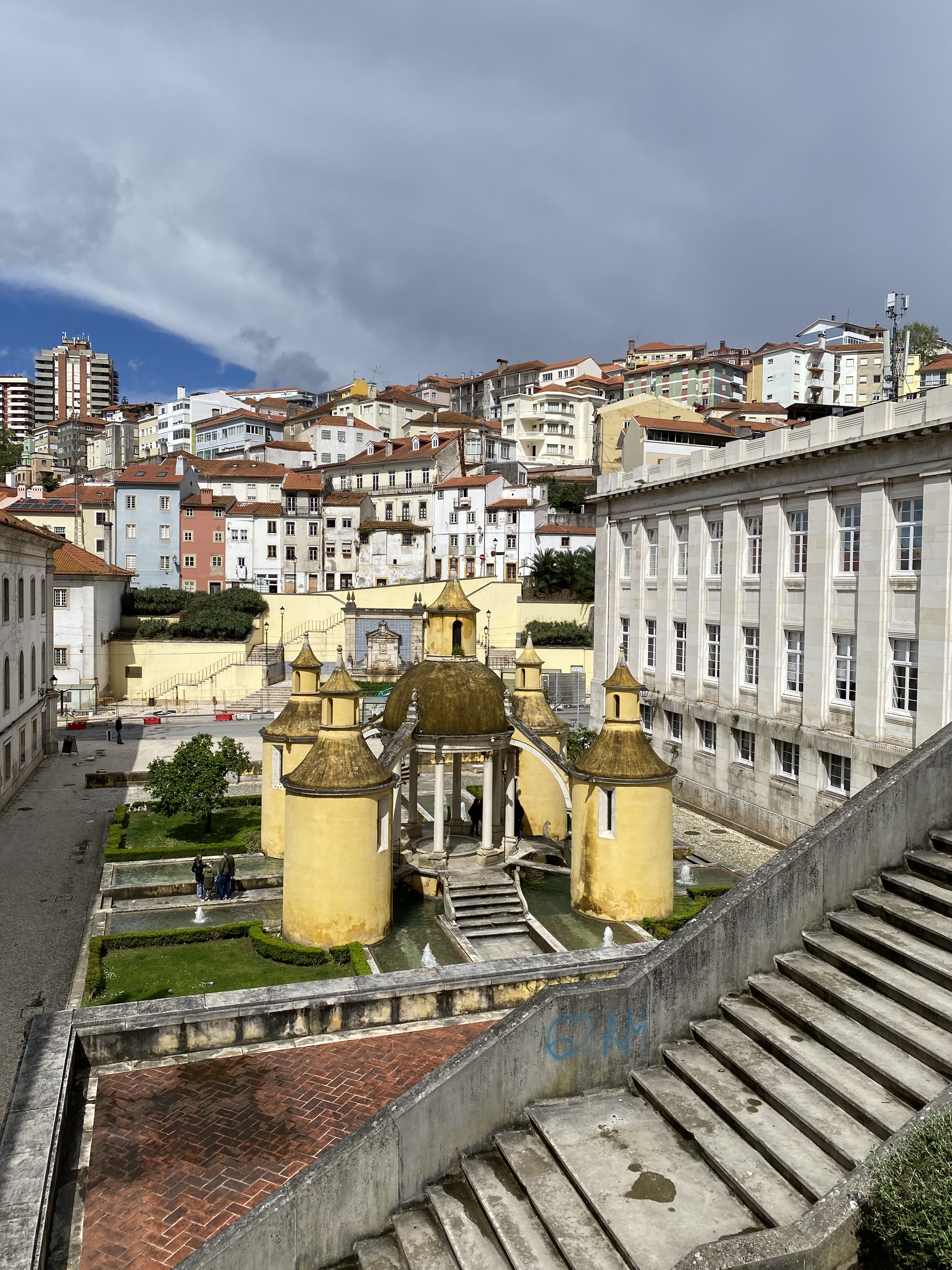
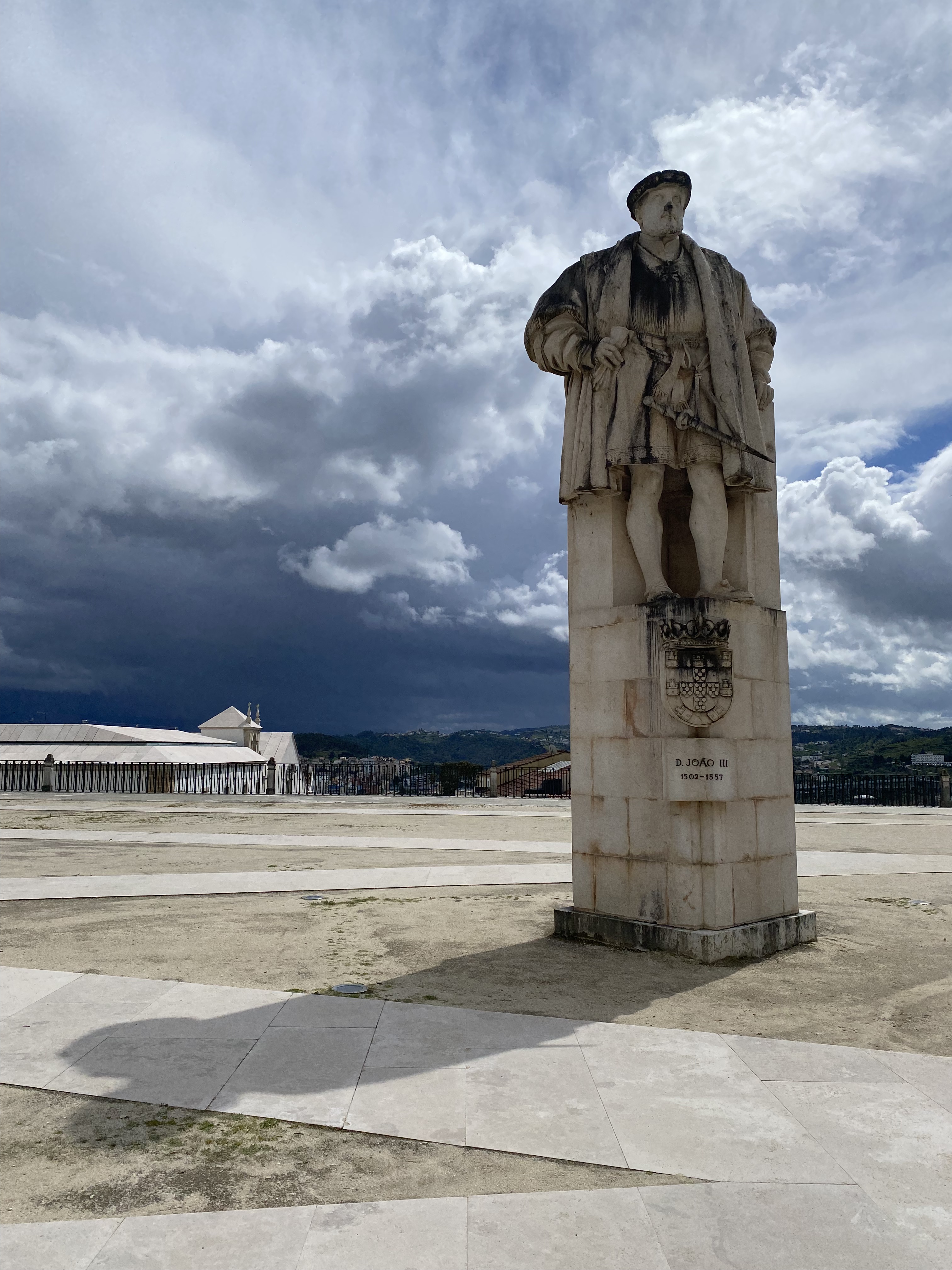
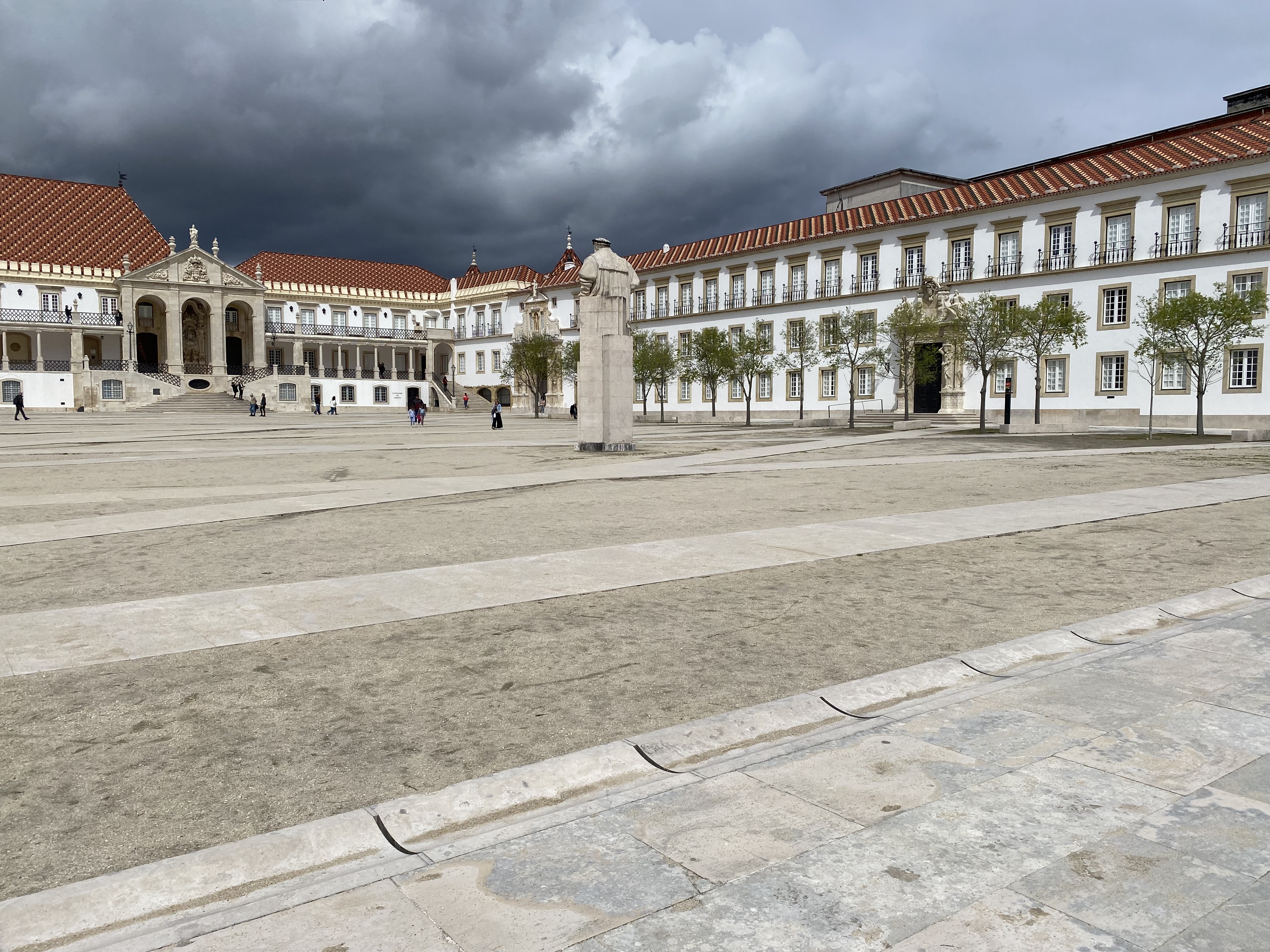
Back in the car, we drove out of the city, and soon bridges and toll plazas were replaced by towering trees and winding mountain roads. It was beautiful, it was dizzying. Literally. I rolled my window down for cool air.
When we reached the palace gates, we had to stop at a booth where other cars ahead of us were handing over cash for something. We told the woman that we were staying there, at the palace (!!!), and she waved us through. The car crunched over roads made of loose pebbles, and we found parking easily right by the palace.
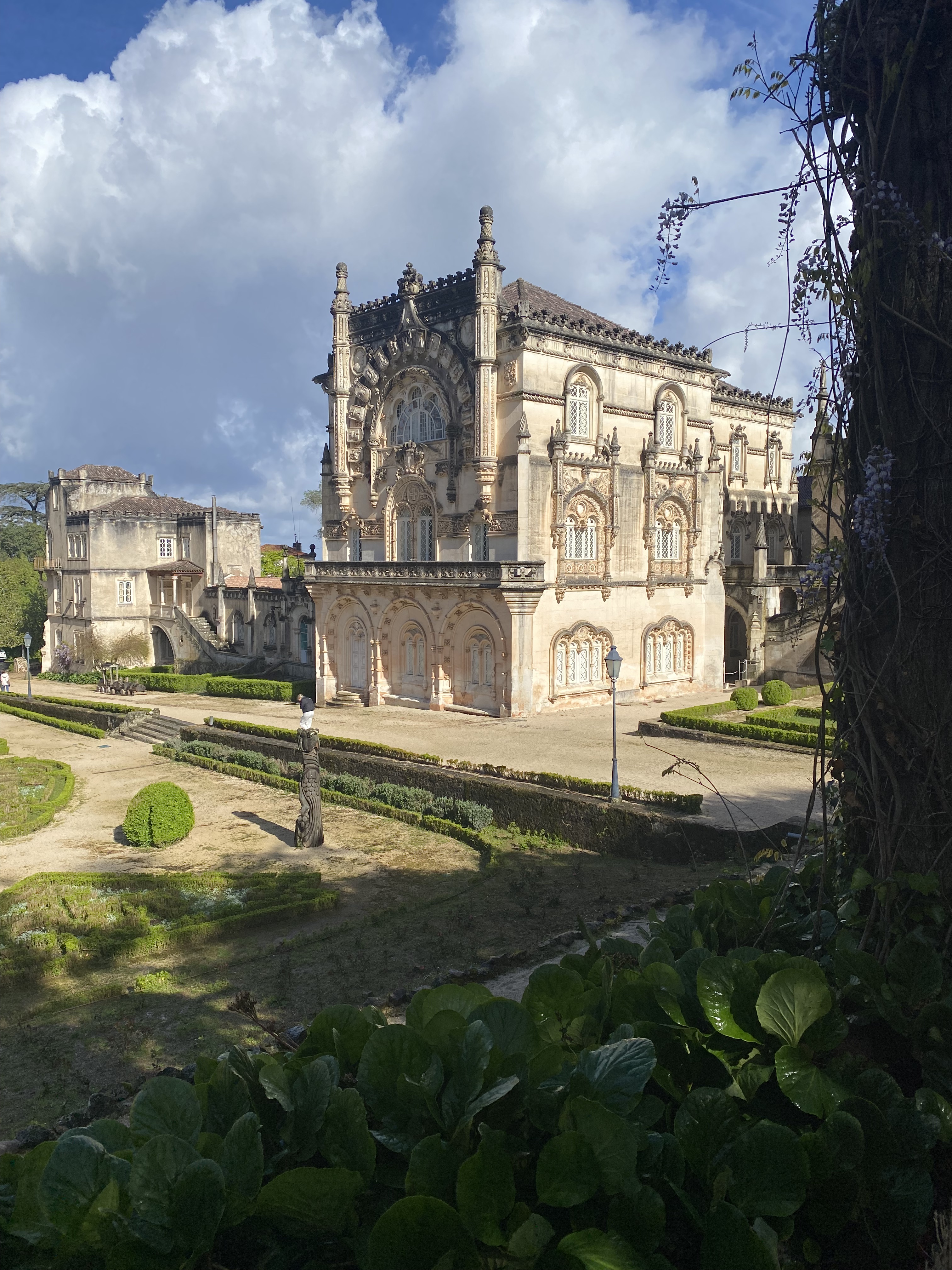
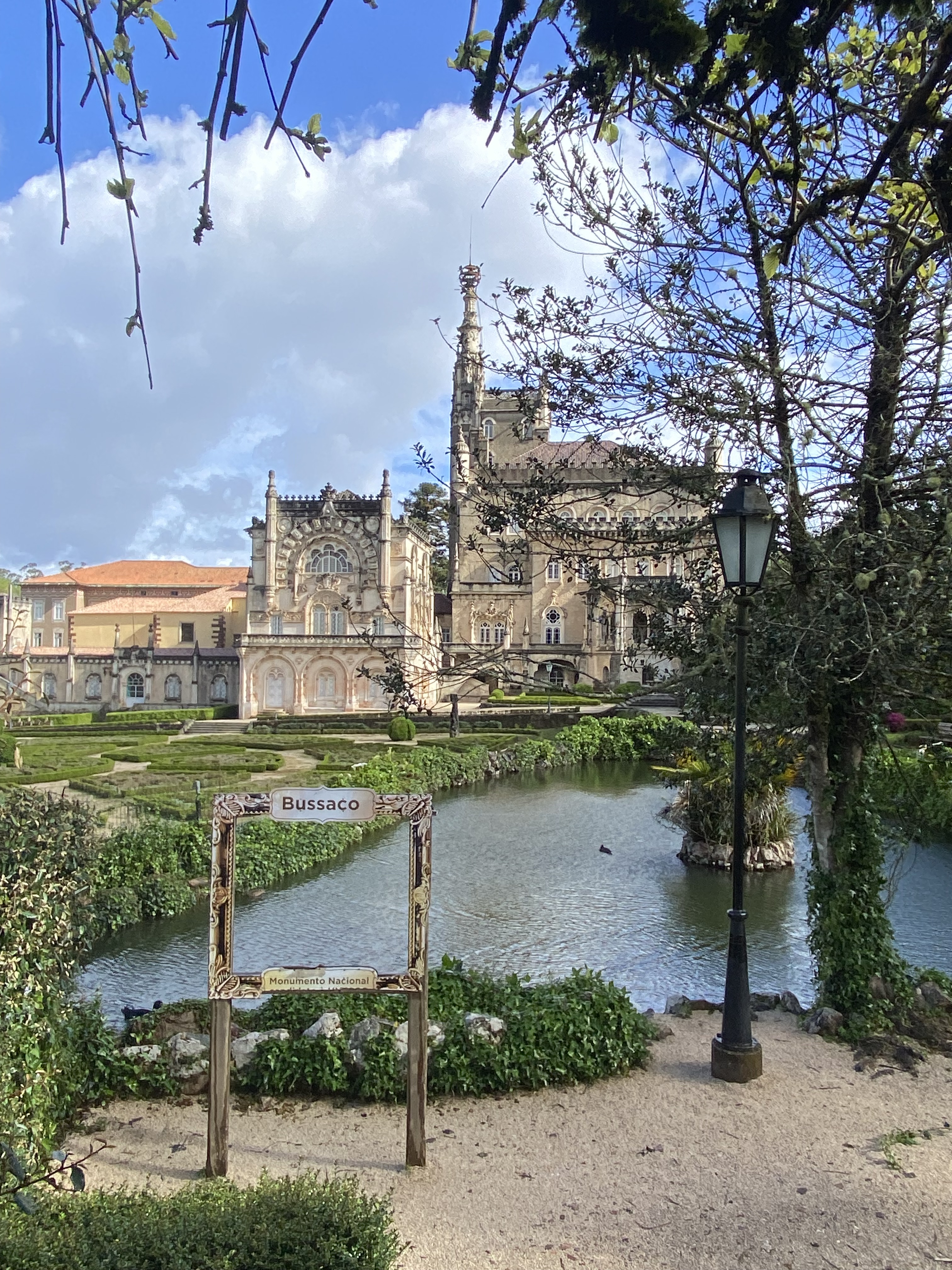
The air was fresh with the smell of trees and earth, and the fresh aroma of recent rain. The palace itself was an eyeful: columns, azulejos, hedge mazes, and thick forest wherever you looked. We entered reception, which was in a high-ceilinged hall. A wide staircase led up and up, past a beautiful stained glass window and a somewhat eerie-looking knight with glowing yellow eyes. (I feel like I once knew why statues had this feature, but a quick Google search only brings me several weird Reddit threads about knights brought back from the dead, and magic.)
Our rooms were gigantic. The ceilings were soaring, chandeliers hung down, the walls bore spiderweb cracks. Our bathroom was larger than the room at our last hotel. Best of all, the massive doors opened up onto a balcony, which connected across all the rooms and led to an even larger balcony that could have hosted a wedding party. Above it, gargoyles smiled down on us, rain water dripping occasionally from their mouths.

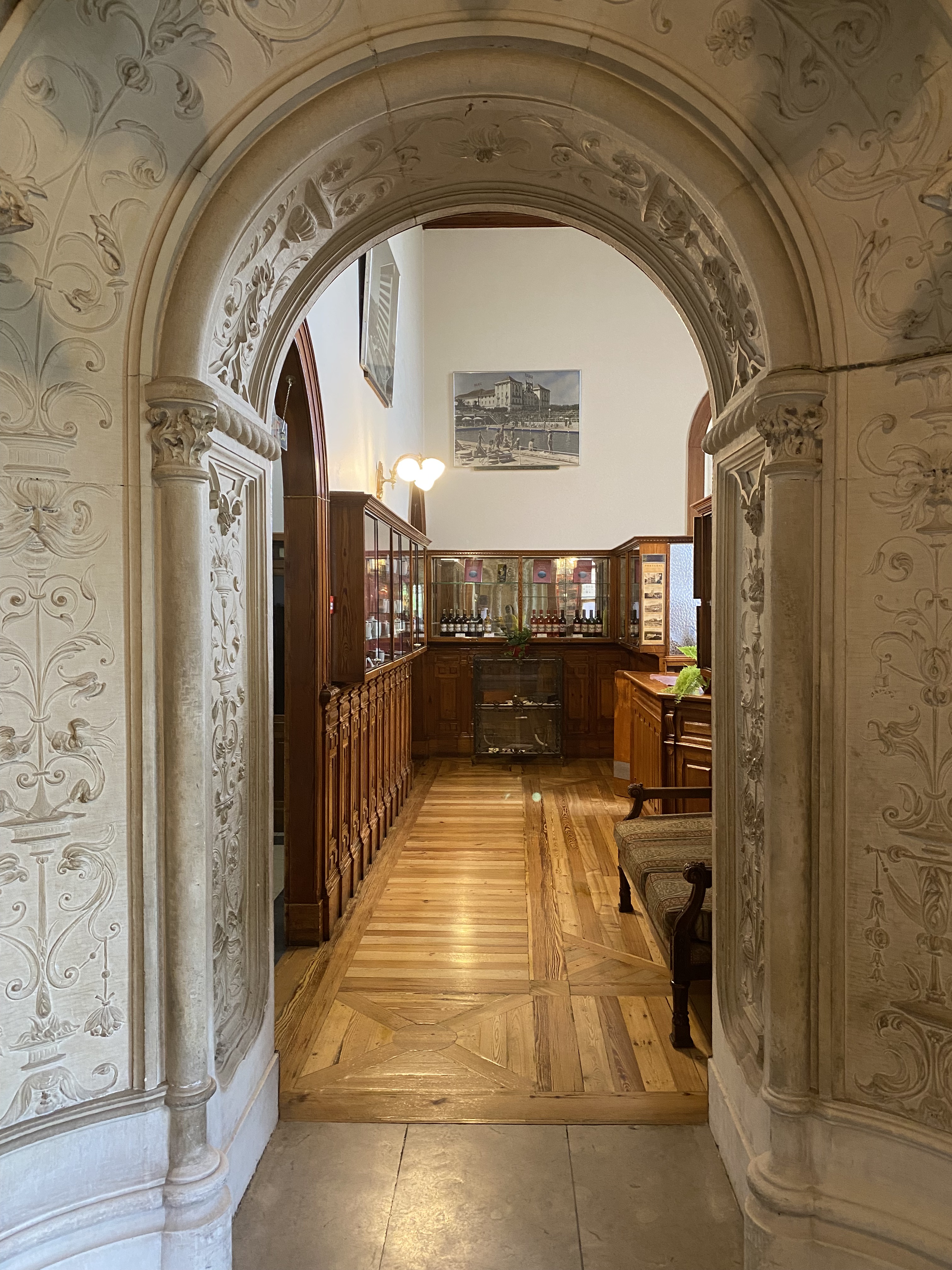
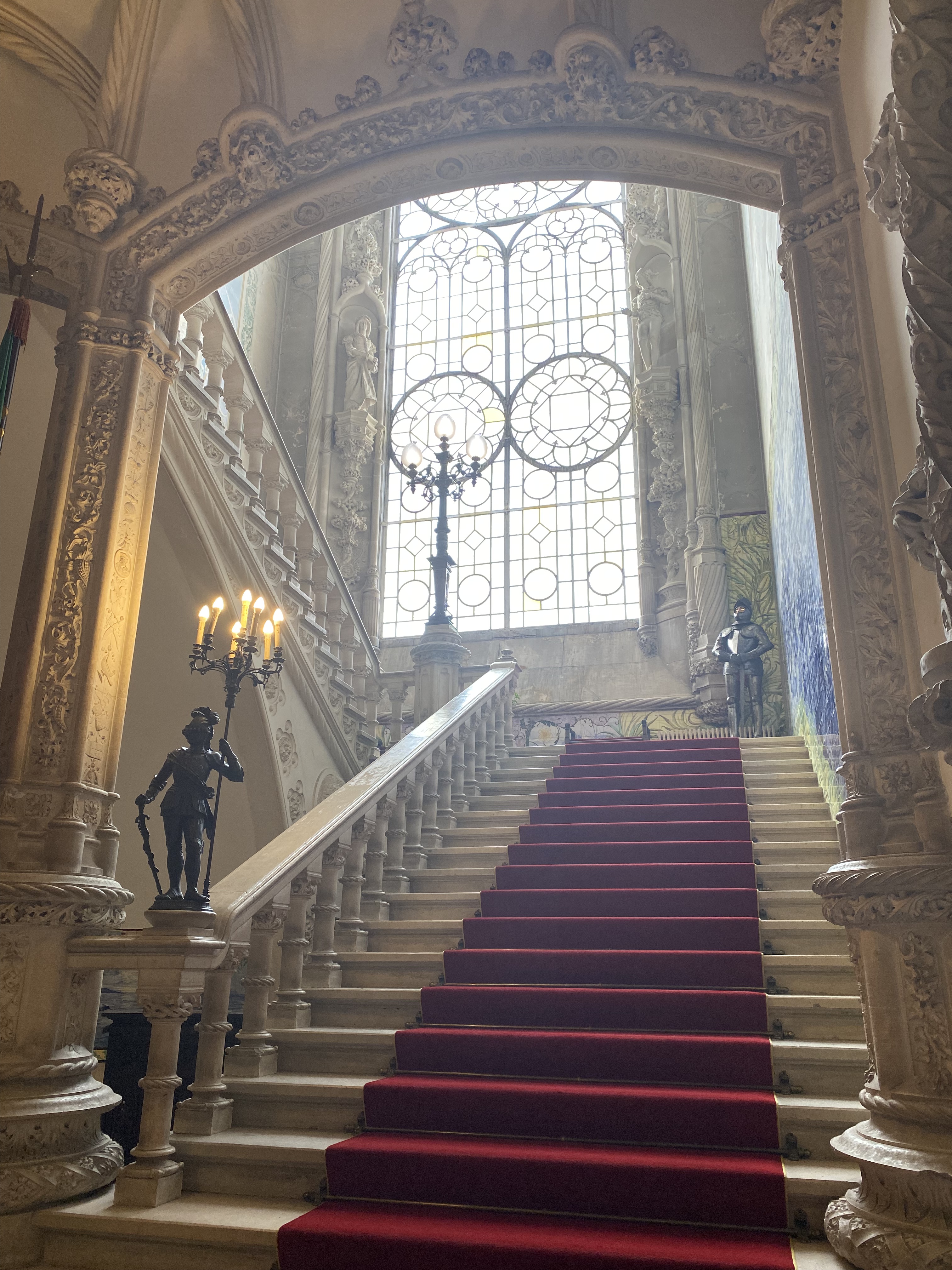
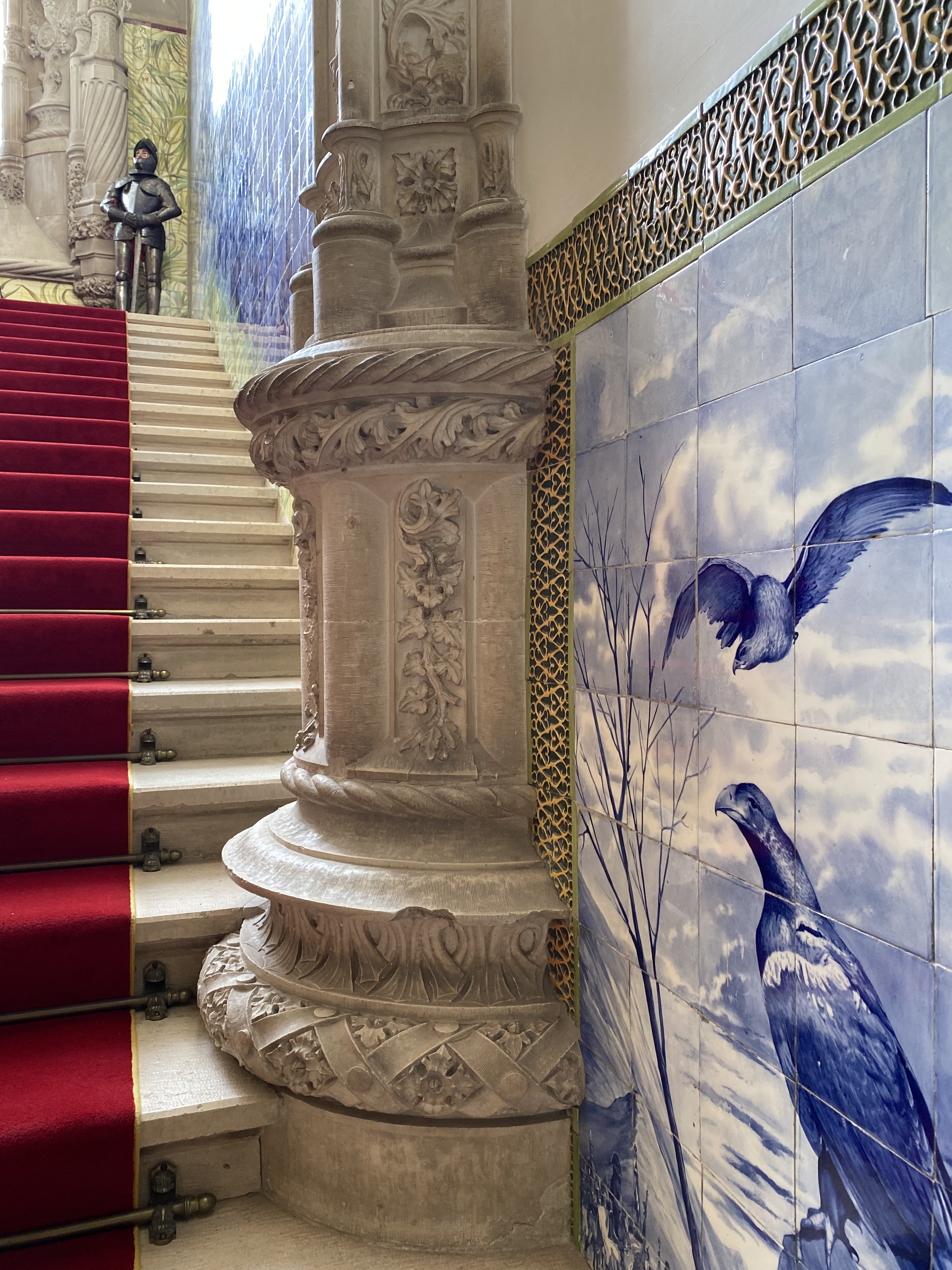
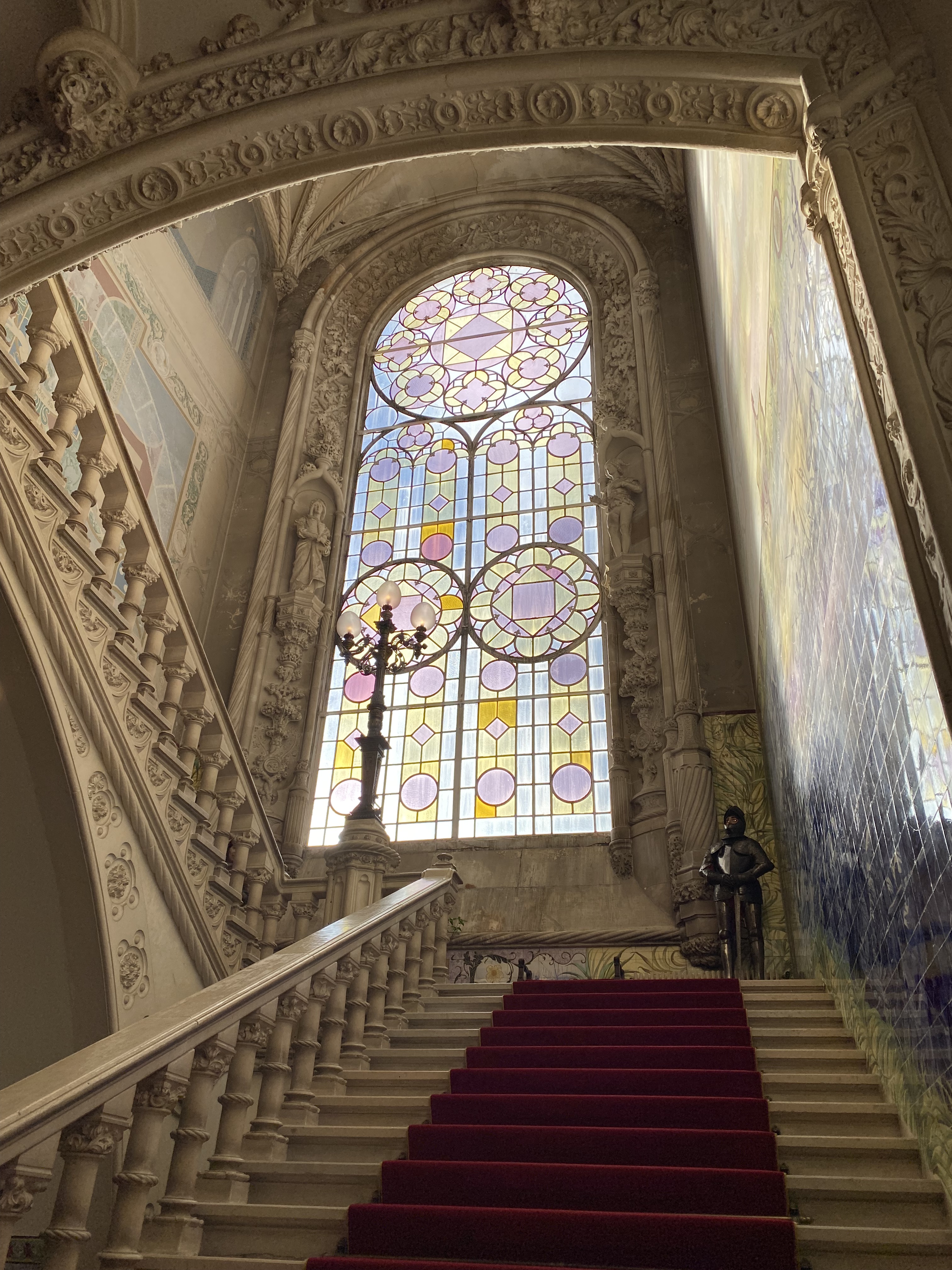
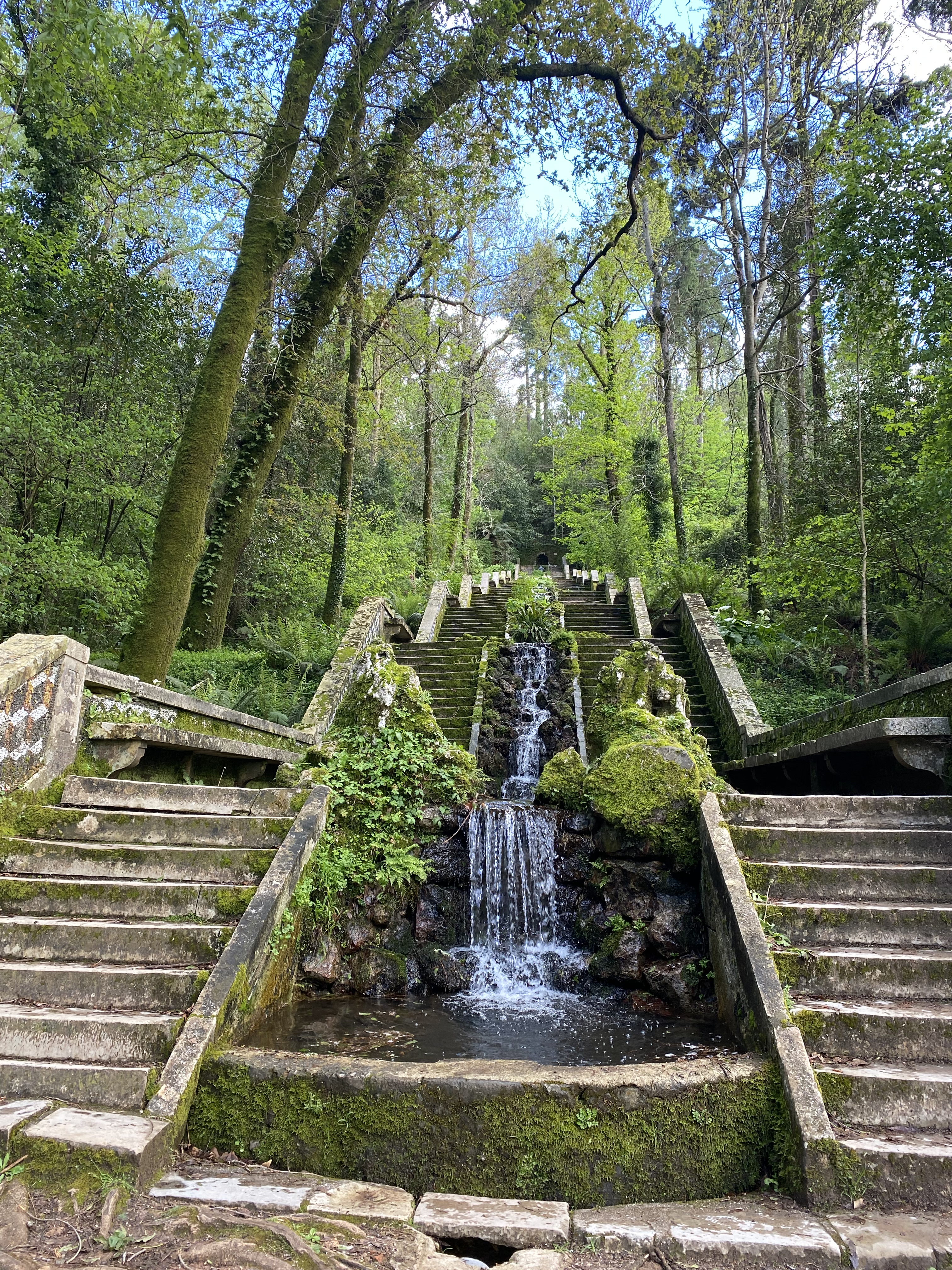
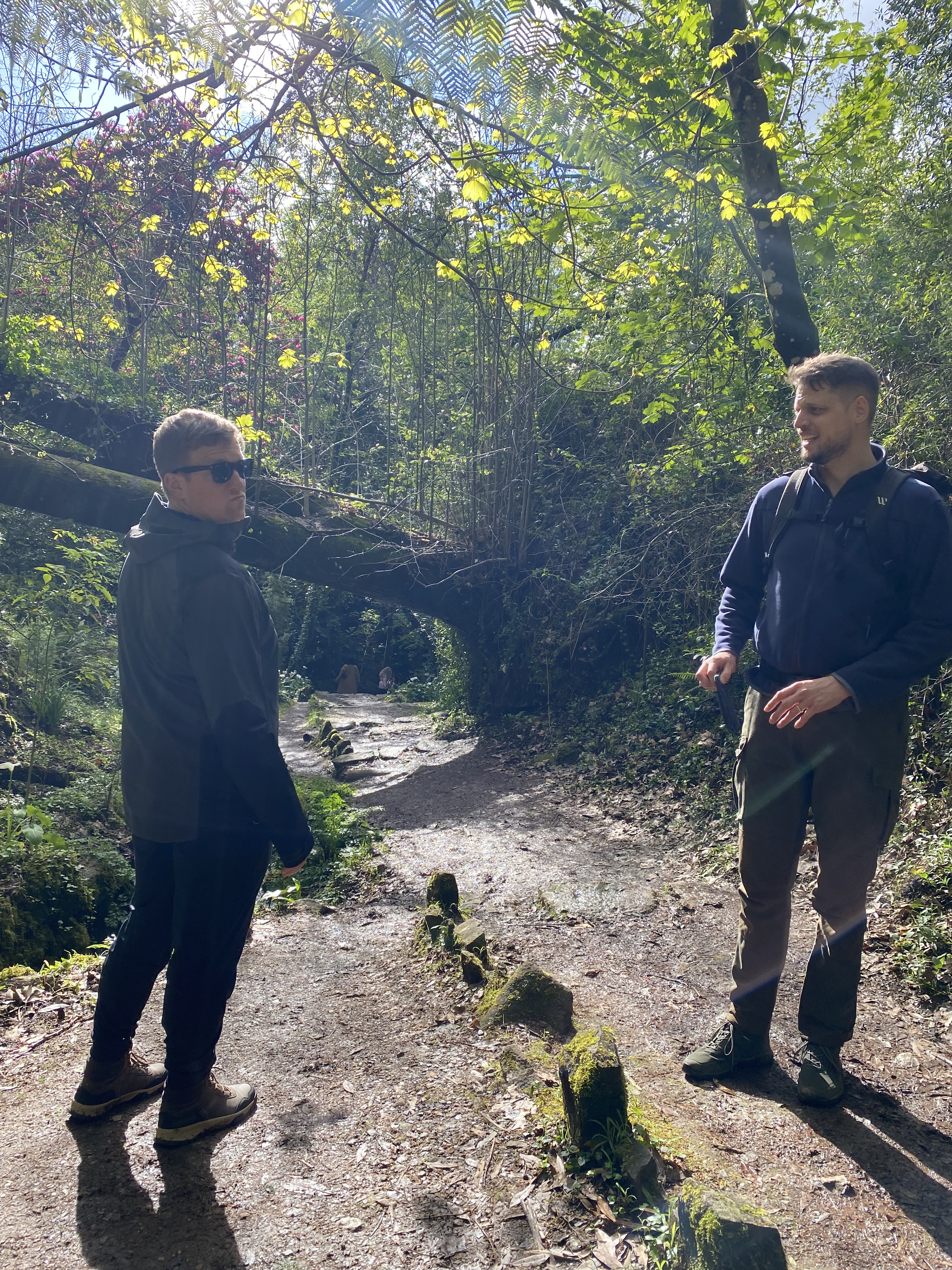
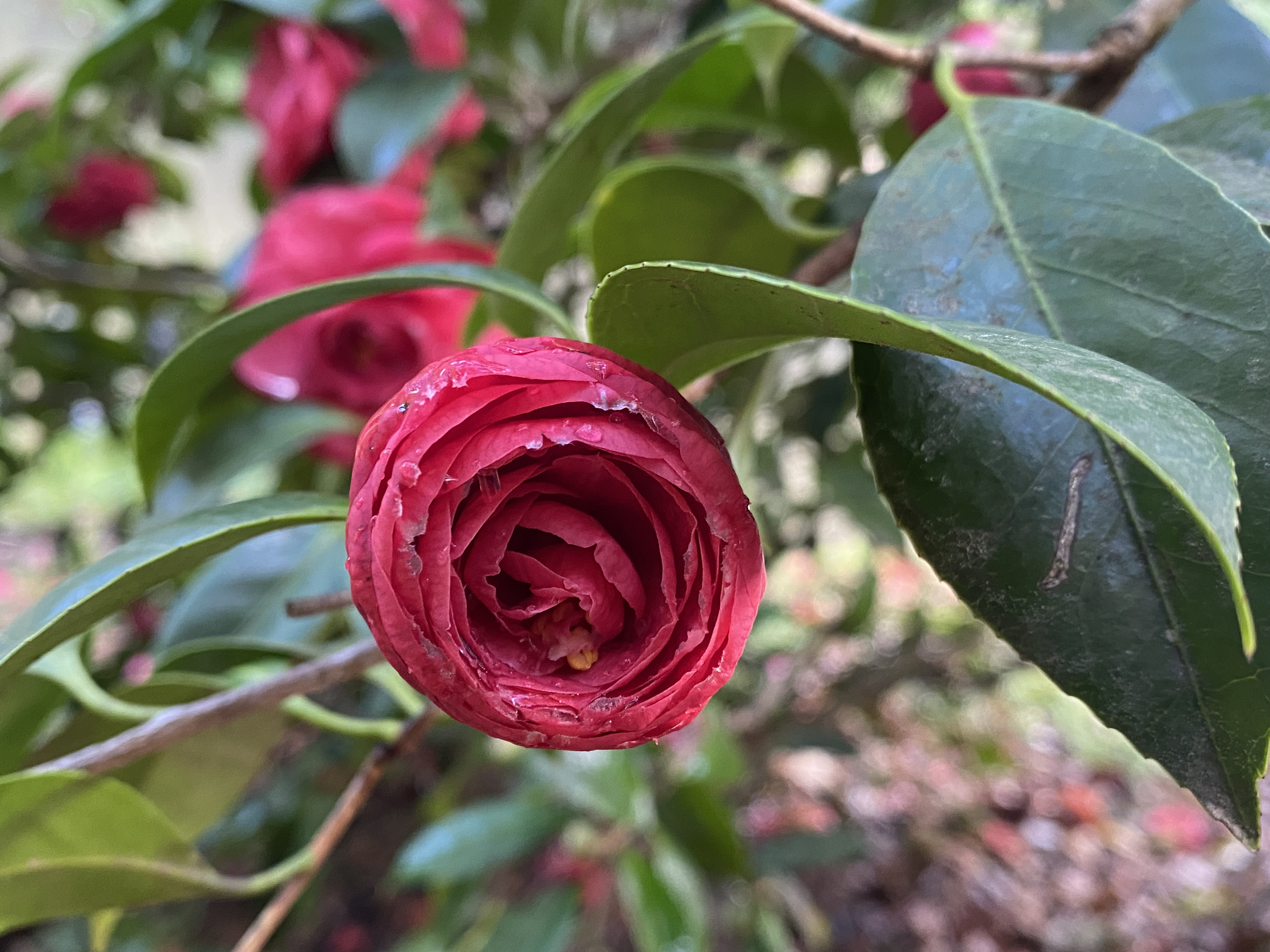
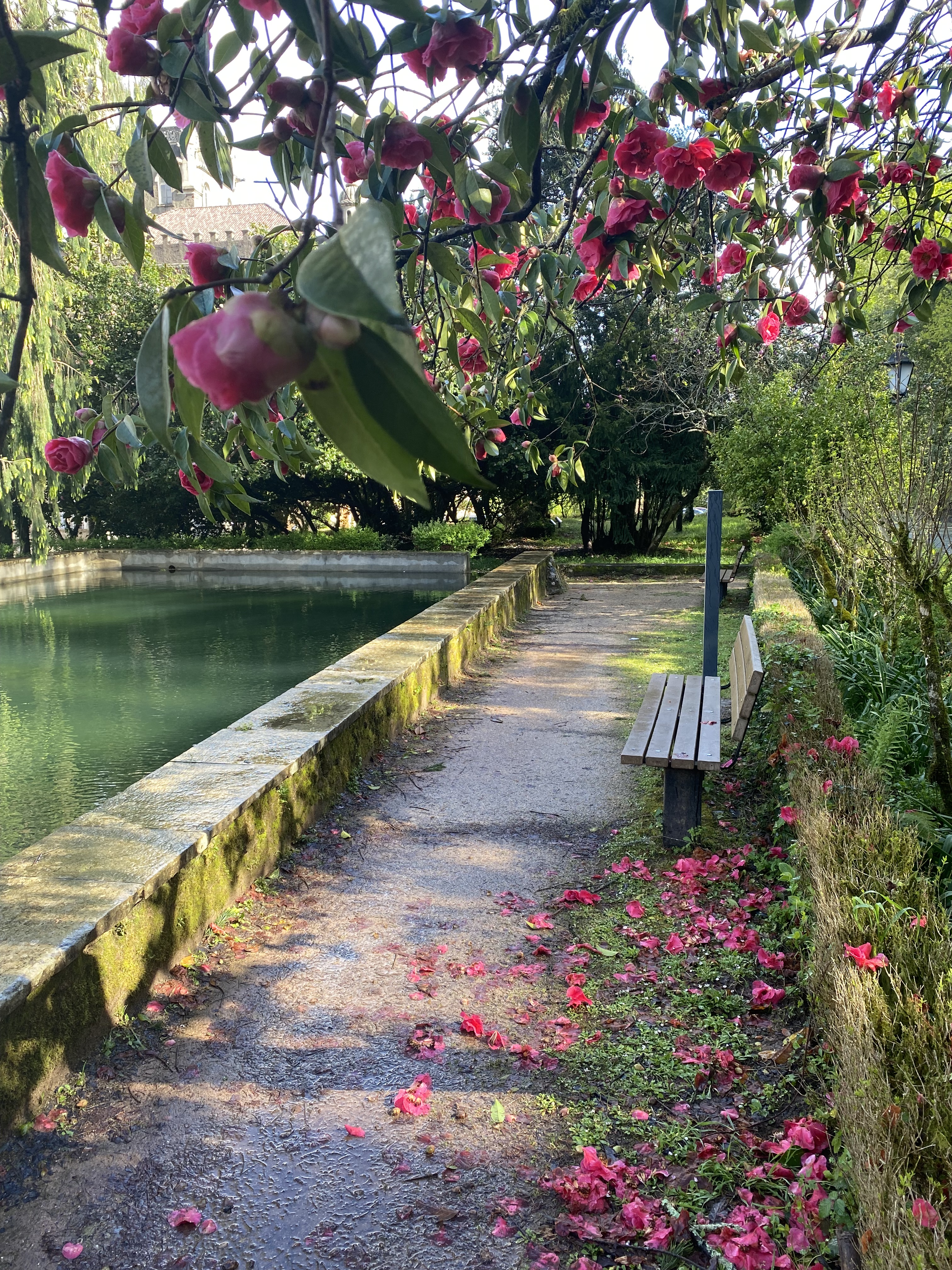
I was surprised to learn that the palace, which I imagined had been languishing here in the forest for centuries, was only built in 1907 as a royal summer retreat. (Though the Lonely Planet states that this was originally a royal hunting lodge. Some lodge.) Before the palace, there had been a 17th century Carmelite monastery, which explains the gardens and the grounds. As we headed off to explore some of the many trails through the forests, we learned that the trees were from everywhere: sequoias, Mexican cedars, and hundreds more. Across the 105-hectare reserve, there’s something like 700 plant species. In 1628, monks embarked on “an extensive program of forestation”, which also involved creating paths, building fountains, tending gardens, and raising up plants and vegetables they could eat themselves. What we were traipsing through on this beautiful Easter Sunday was their legacy. It was magical.
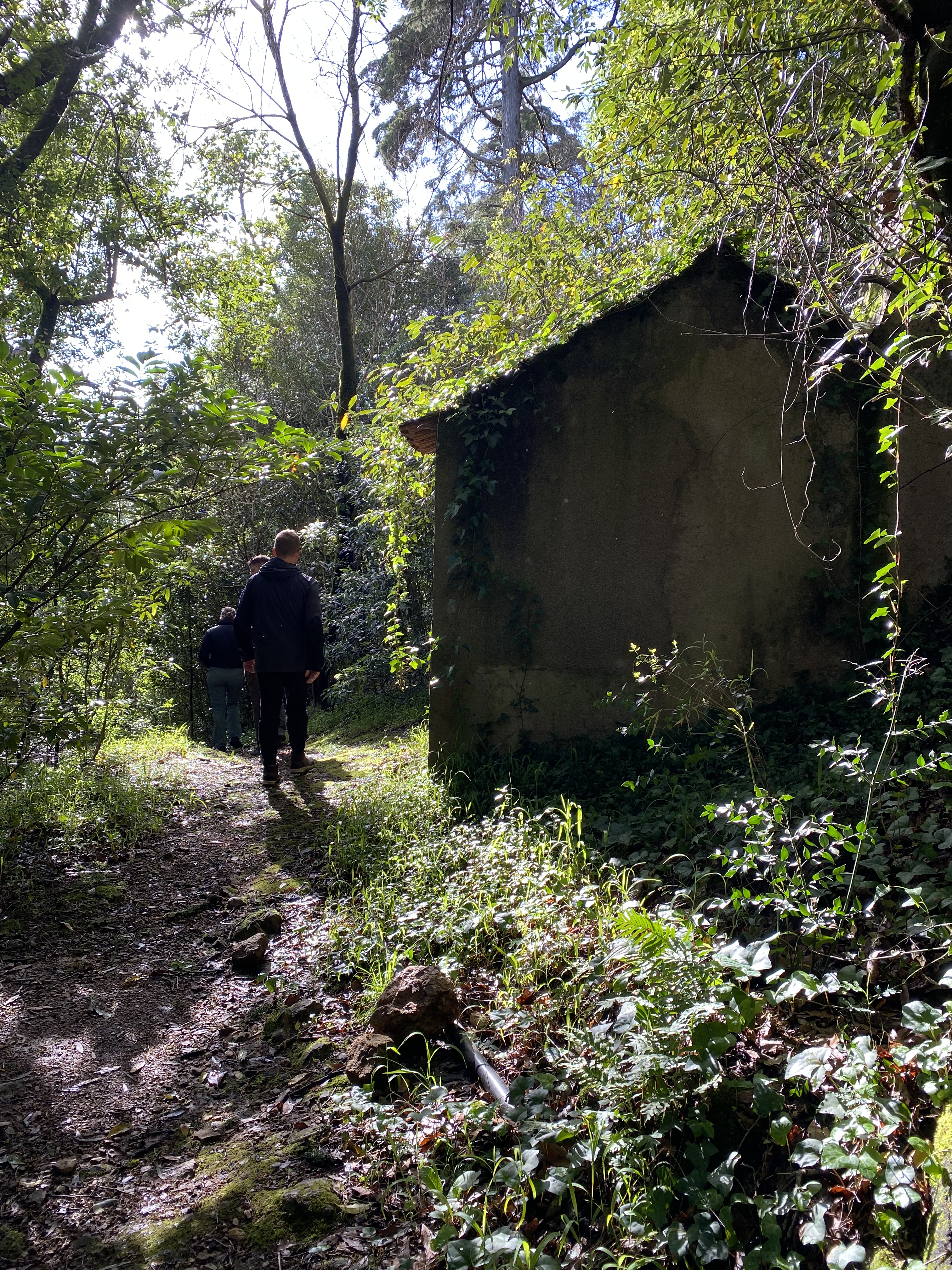
There were several paths we could have taken, but dinner was at 7 and it was somewhere around 5pm as we wandered into the forest, so J guided us on a 2km hike. We ended up on one called the Via Sacra. The first sign we saw along the trail informed us that this very chapel was the house where Jesus was taken to be interrogated by an officer.
I felt confused. Not that I’m a Bible expert, but I grew up going to church and I did not remember anything about Jesus coming to Portugal.
Later, we passed another small house by a creek, where a sign read: “This is the river where the soldiers pushed Jesus down onto the stones. You can still see the signs.” Inside the little house was what looked like an old rock bed.
Were we walking on the same path Jesus had walked on? I tried to do some geographical math and could not figure it out. Instead, I found myself distracted by stone steps, extremely wide steps, fountains, and ponds.
“These steps are so wide,” Dan said at one point. “They’re just not practical.”
“Maybe they were for horses,” I suggested.
The others reacted as if this was the most hilarious suggestion ever.
“Really! A whole horse would have fit on this step. Maybe it was easier for them to go up and down.”
“Horses don’t have opposable thumbs, Nicole.” Dan said.
“I’m not saying the horses built the steps!”
From then on, when we encountered large steps or large anything on the path, they were horse steps.
Everything about the forest was stunning. Poor Rebecca was battling allergies, and we didn’t have much time before dinner, so we headed back and they grabbed ice creams at a little shop in a palace courtyard. There, Rebecca researched and informed us about the Royal Family and secret incest while I researched “Jesus in Portugal.” It was then I realized that the Via Sacra was one of those “Passion” stations of the cross activities, where you can, anywhere in the world, follow a trail that walks you through the last day or so of Jesus’ life as he carried the cross to Calvary. This made a lot more sense.

Dinner in the palace was an absolute royal affair. Everything was ornate and the food was pretty good, though vegetarian options were lacking in flair. We ordered our cheese board and a couvert, which included four glasses of sparkling wine. There were maybe 6 other couples or families seated around us, and they were all silent, so we made sure to not laugh too loudly. A baby entered and screamed a bit, much to our delight. It gave us permission to be a little louder.
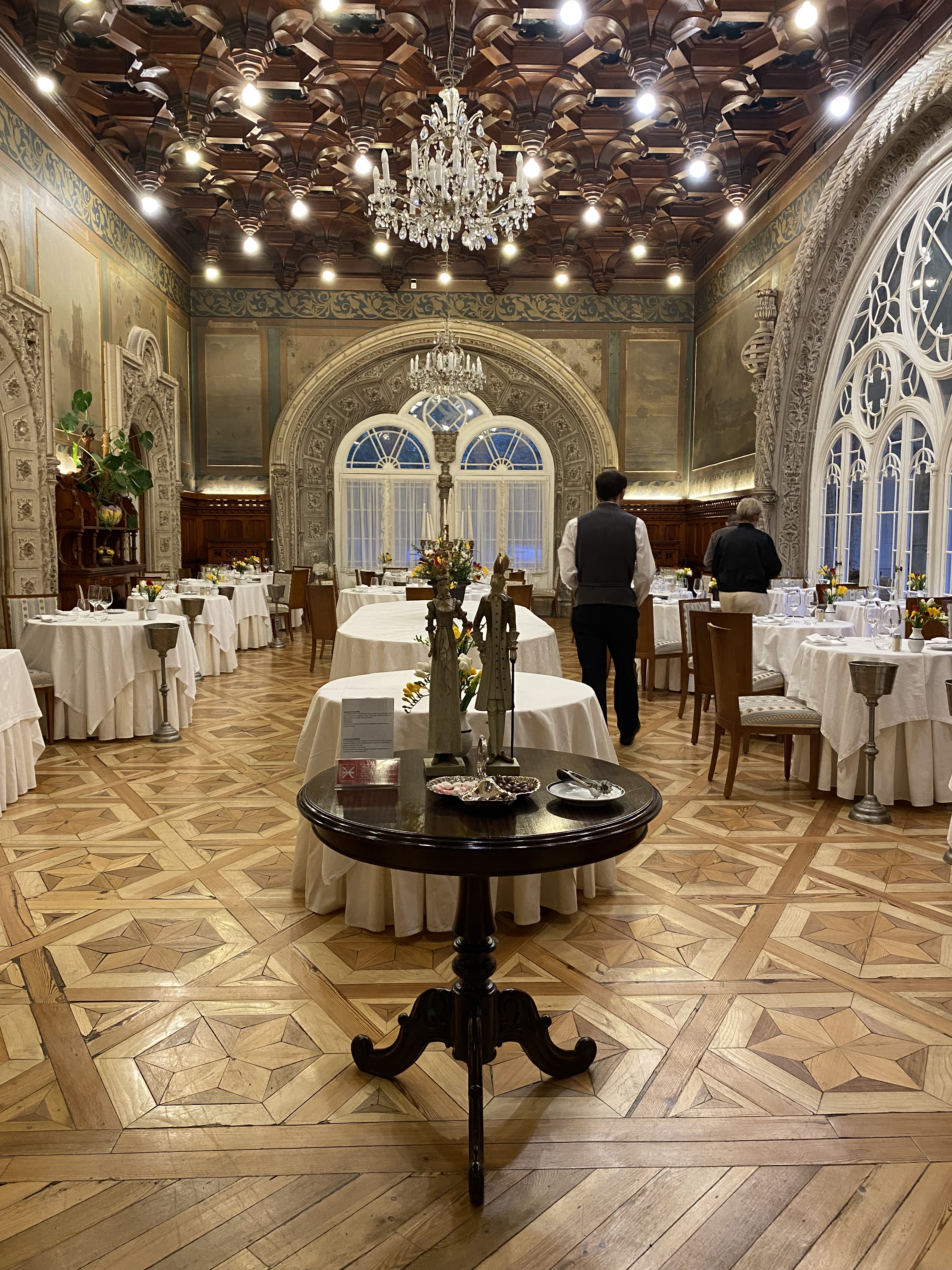
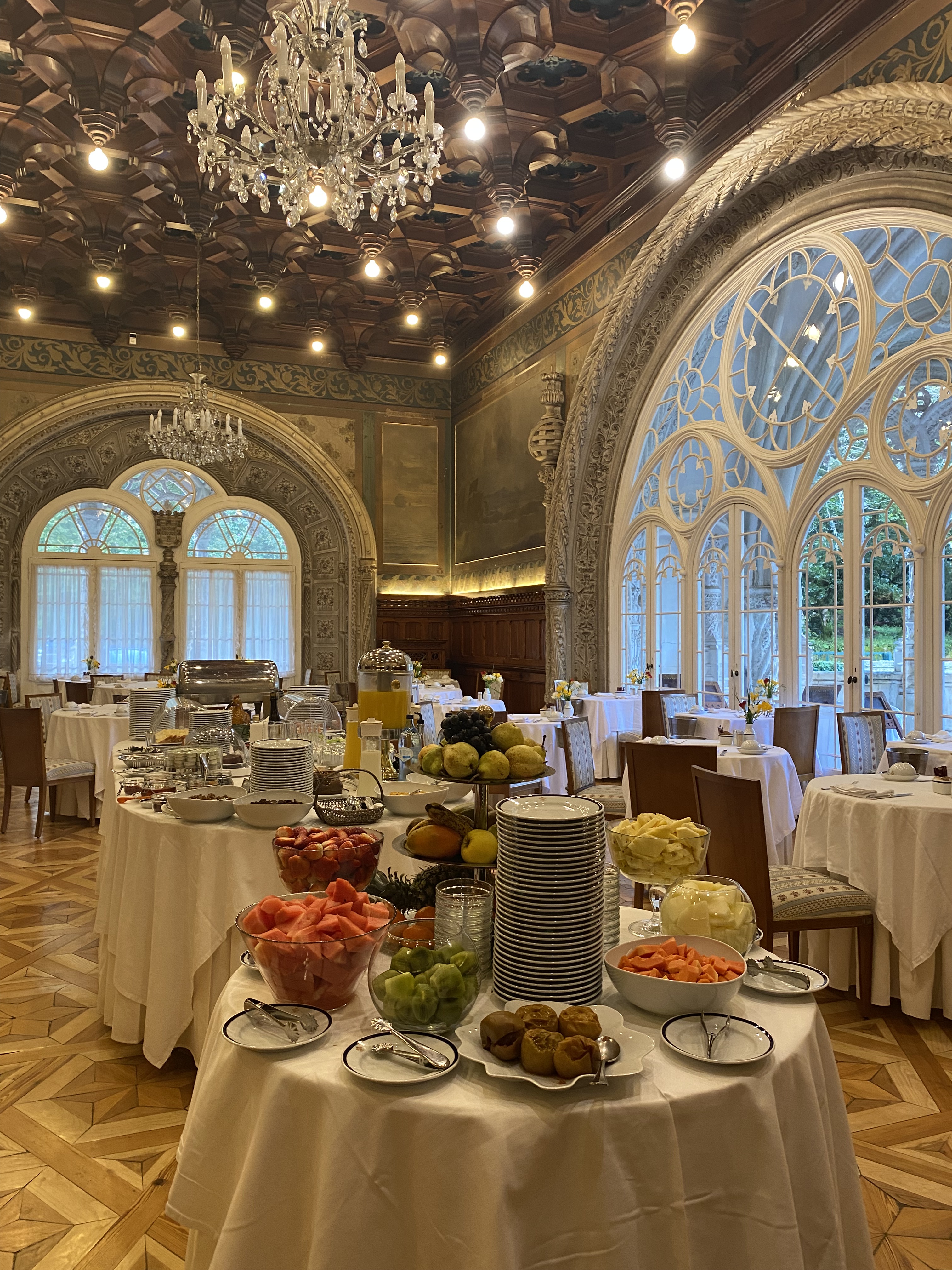
We slept mostly well, and had breakfast at the same table the next morning, with the cool morning sun streaming through the windows. J ordered a “Meile de Leite” and the waitress broke into a huge smile.
“You made her day,” I said to him.
“Portugal is one of those places where people appreciate you knowing the language and trying to speak some of it,” J replied. This was echoed by my Lonely Planet, too. I’d taken a handful of Portuguese lessons on DuoLingo in the airport, while J had worked on it for over a week. Sadly, DuoLingo equipped us only with the tools to inform random people that we were boys or girls (menino / menina) and that we were eating bread or drinking water.
Ordering coffee was its own language, and that seemed to be good enough. We finished breakfast, one of the best on our trip (have I mentioned every breakfast was included in our hotel price?) and packed up our things.
We spent another 15 minutes or so exploring the hedge maze and pond before piling into the car to head onward to Douro. If I could change one thing, I’d have stayed there at the Palace for 2 nights and/or skipped Coimbra. I could have roamed that forest for weeks, I think, and the fresh air was invigorating.
Categories: Portugal
 Lost Among Latitudes