We set off from Bussaco Palace early on Monday morning, with hopes of reaching the rolling green hills of the Douro Valley and hopping on bicycles to explore them. First, we stopped in a nearby town called Luso to see if a pharmacy was open. Rebecca’s allergies were aggressive. J, Rebecca, and I went into the pharmacy while Dan parked. I was hoping to find some chewing gum to make the windy roads a little less aggressive on my stomach.
“Why don’t you see if they have any ginger tablets or candies? Ginger is good for your stomach,” Rebecca told me. I shrugged, but Rebecca went ahead and asked the pharmacist. She disappeared around the back and returned with something.
“This is ginger – no medicine in it,” she explained, which was good. I didn’t want to fall asleep. She handed me a box of ginger lollipops, brilliantly named “VomiKids.” Clearly for children, the box had crayon drawings of all sorts of transportation that might make one vomit. For 8 euros, I was sold.

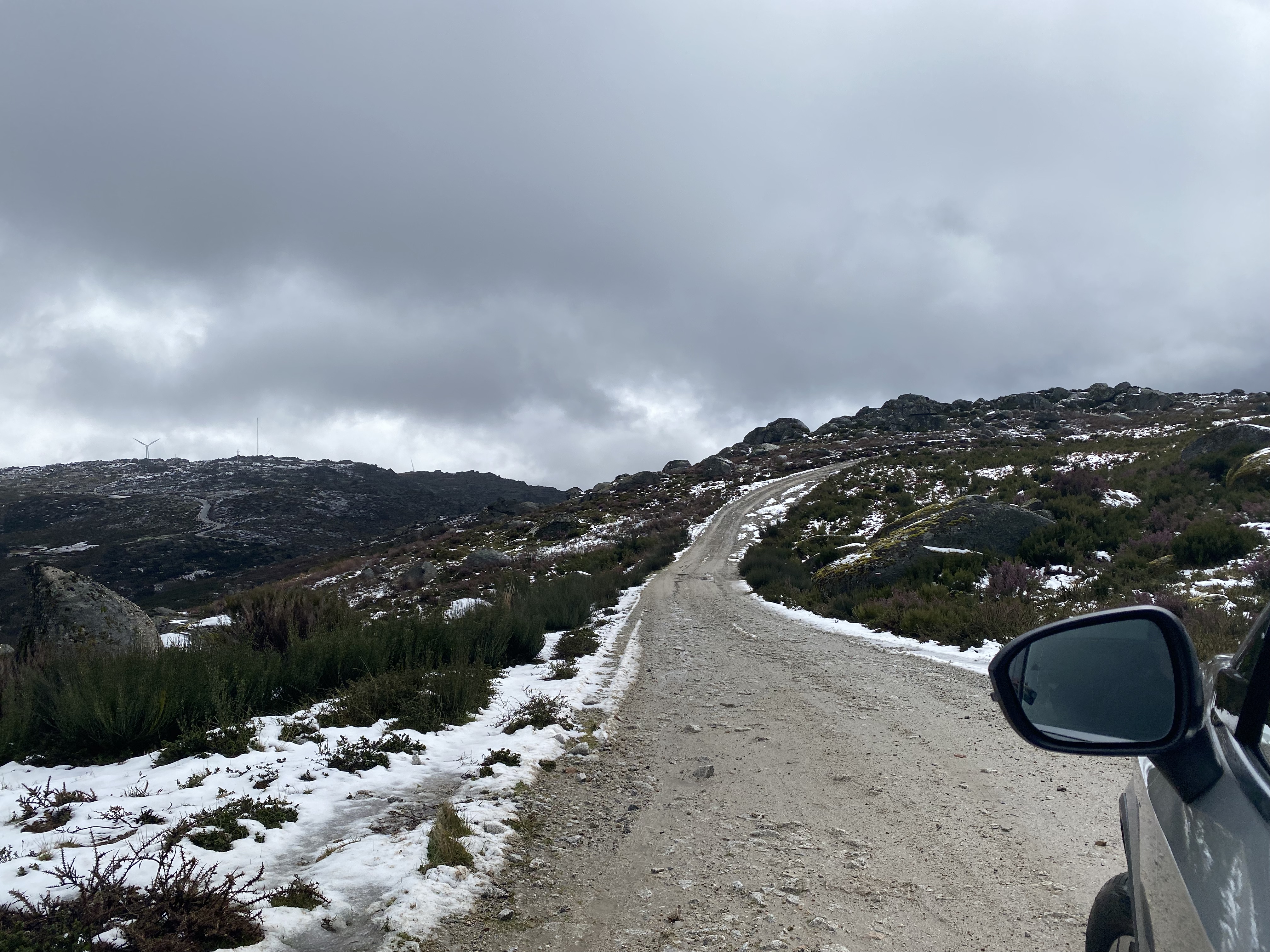
It was good we purchased these, because the roads that took us up to our hotel, a 2-hour drive northeast, were full of swooping curves and hairpin turns. At one point, we approached a mountain range – J read the altitude, unimpressed – and went up it, offroading over gravel roads lined with chunks of snow and bright wildflowers. I devoured two VomiKids and stared out the window.
It was freezing on the mountain top, and I hoped it would warm up when we got down into the valley, but it was kind of chilly there, too. Arriving at our hotel was an absolute relief. A gigantic structure on the banks of the Douro River, visible from the mountain pass and sort of resembling a dam, the Douro Royal Valley Hotel & Spa welcomed us into a massive, pristine lobby, then handed over room keys to rooms with sunny, unobstructed views of the Douro River.

We decided to order room service for lunch, which was actually pretty good, and then we headed up to the rooftop tennis court to play for an hour or so. It was a little nervewracking to play up there; even with the fence we lost two balls. But no matter – it was enjoyable and full of belly laughs, until Dan hurt his back.
That seemed to signal spa time, so we headed down to the rooms to get our spa attire on. Rebecca opted out, so I followed J and Dan to the outdoor pool, which was beautiful but definitely not heated. They both jumped in and immediately clambered out.

Unlike Your Hotel and Spa, this spa was included in our price, so we visited a whirlpool, an indoor pool, and the sauna, which was up to J’s standards: hot enough, and it included a bucket with water you could throw on the coals. Life was good.
For dinner, we drove 15 minutes to a nearby town to a small restaurant, where we were seated at a 4-person table in a small alcove. We ordered white wine and a cheese board, and the service was excellent. A window looking into the kitchen allowed us to see the food being prepared. The owner was a lovely woman who kept bringing us more of her “specialties”, including frozen lemon water we could use as ice cubes in our sparkling water.
She was helpful and willing to accommodate our vegetarians, but when Dan ordered a meat tray, her eyes lit up and the level of excitement was visible. She clapped her hands together and said, “Great choice! You’re going to love it!”
It was a good meal, apparently energizing enough to convince us it was a good idea to play guys vs girls pool in the Ruby Bar at our hotel. We knew we had a 9am pickup the following morning for an off-roading wine tour and tasting, but a nightcap seemed the right option.
What ended up happening was Rebecca and I winning our first game, then nearly winning our second, except I scratched the cue ball on the 8, so we had to play one more time. All of this equaled a late bedtime and a small bar tab.
Dan and I made it down to breakfast, and then I went back up to the room to get my things together. The driver of our tour arrived, and Rebecca and J made it down to grab breakfast in to-go boxes. As we chatted with our driver, Ricardo, he made a joke about carsickness.
“Go and get your VomiKids,” said Rebecca.
“Well, I don’t know, they’re in the car,” I waffled.
“Get the keys and get them,” she said. I am glad she did, because those roads were also windy. However, due to the size of the 4×4, I was able to sit in the front and J, Rebecca, and Dan sat in the back. Dan’s back was hurting him, and we were all a bit of a wreck.
“We are a little rough this morning,” Rebecca explained as we pulled out of the hotel. “We thought it would be a good idea to have a guys vs girls billiards match last night, and it went a bit late. The girls won technically, but the guys needed to get one more match in to feel good.”
Ricardo drove us nearly two hours back along the Douro River to a small town called Pinhão, where we were due to begin our off-roading adventure. Dan was unsure about this, with the state of his back. I was feeling okay and hadn’t needed a VomiKid yet. We explored the train station while Ricardo looked into train timetables: if possible, we could take the train back, and he’d meet us at the station to bring us to our hotel. This would solve the problem of Dan’s back, my motion sickness, and also provide cool views of the river, as the rails went alongside it.
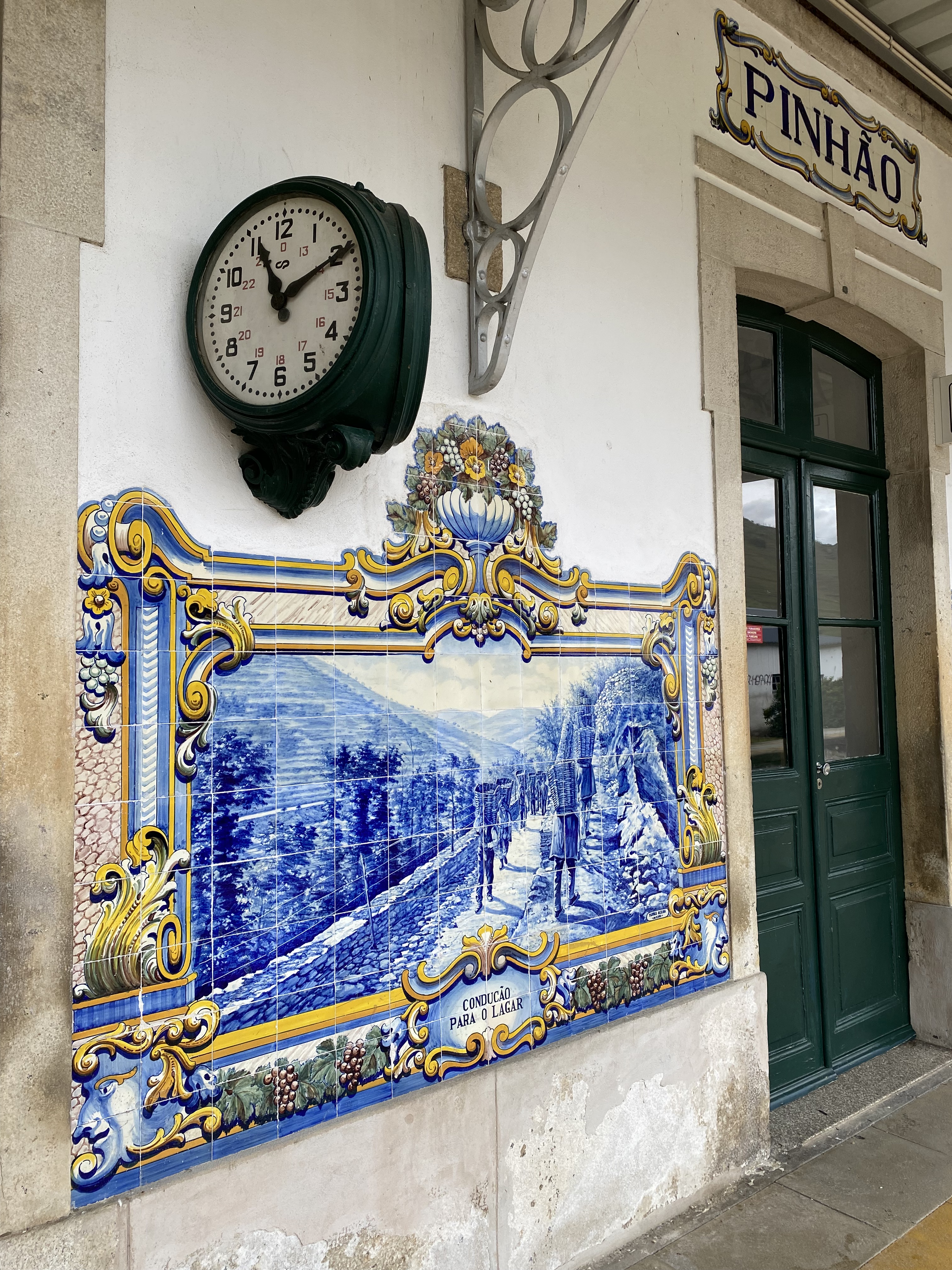
Back in the car, Ricardo mentioned that unfortunately, the train did not go until 6:30pm, but in the meantime, we would swap the order of events. He’d drive us straight to the winery now, and we’d offroad after. We had booked the Adventure Tour, so offroading was something we’d been looking forward to.
As we arrived at the winery, you’ll never guess what happened. It started to rain! Of course it did. We stood outside in a small courtyard while Ricardo called the family to tell them we’d arrived early. He talked to us about vineyards: yes, this was the place for grapes (we’d passed a transition zone hours ago where the grapevines cease to be Vinho Verde and instead become the Douro grapes), but grapevines require a lot of work. If he got land here, he would grow olive trees.

Ricardo also explained that the Douro was the first demarcated wine region in the world, and that it’s one of the first that grows grapes on mountain sides rather than just in valleys. But, he pointed out, everyone wants to claim that they’re the first, and there’s no way to know. He said the first vine in the world was located somewhere in Georgia (the country).
The winery we were at, Quinta do Bucheiro, was one of the oldest in the Douro region. In the car, J had asked him what a “Quinta” was, as there were signs in the valleys marking different ones.
“It’s like a farm, or a villa,” Ricardo explained, “but don’t tell them that. Don’t say farm to them. They’ll kill you. You know how deep this river is? Deep enough to dump a body in there and never be found again.”
He also made a few jokes, pulling off a side road and into this quiet winery, about selling our kidneys, and I wondered if the decals for the tour on his 4×4 were real.
Finally, a young man emerged from the house and began our tour. His name was Roberto, and he was the 7th generation of winemakers in his family. He explained the process, which was similar to some of the processes required in Champagne: grapes are harvested by hand, without machines. No irrigation is allowed, he explained, and part of what makes this area so rich in wine grapes is the soil, which contains some kind of mineral that absorbs water very well. He stood in a small cement enclosure and explained how people would stomp the grapes barefoot all night long. He also showed us how they’d carry and transport the baskets of grapes from the fields to the house. It involved tying a sort of cloth around his forehead, which had a loop in the back that hung down his back. Then, he’d lift up the basket and settle it in the loop on his back, so he was basically bearing the weight of it against his forehead. While they don’t use machines to harvest the grapes, he said, they do use machines to transport the baskets now.
After walking us through the wine process, he brought us out to the shed to a tunnel.
“A long time ago, the Romans were here, and they made tunnels underneath the hills, then left. So my great grandfather, he used the tunnel to store sparkling wine,” he explained. He opened a hatch in the floor that led down 18 meters to where we saw several glass bottles resting.
“How do you get them in there? Where’s the entrance?” J asked. He explained that in the vineyards there was a door.
“How much do they go for on the market?” Rebecca asked. He didn’t give a straight answer, but explained that sparkling wine isn’t a great business to be in.
“When people get sparkling wine, they want Champagne. But it’s the same thing – the process is the same. But people will buy champagne, and not something called sparkling wine.”

He closed the door and led us upstairs through a dining area and into a small room off to the side that clearly served as a museum now. A few windows looked out over the lanes below, and up here, there were stone seats carved into the walls by the window.
“This was Portuguese Tinder,” he told us. “A father would sit there with his daughter, and the suitors would pass by below, and the father would either wave them along to the next house or wave them upstairs.”
He led us to a portrait on the wall, and explained how this man, Dr Joaquim Pinheiro de Azevedo Leite Pereira, is the savior of the Douro region. When the vines began to develop a disease and die, he traveled to other regions in Europe and discovered phylloxera, a blight ruining the vines in Europe. He then traveled to America to see if the vines there were affected, and they weren’t. So he brought back American vines, but in order to preserve the Portuguese wine and grapes, he grafted the vines and the grapes. He apparently also resisted government mandates to turn the vineyards into tobacco fields, solving the phylloxera problem and setting up schools where he taught the processes of tending to vineyards and making wine.
“Without him, you wouldn’t be visiting,” said Roberto, “or we’d all be here smoking cigarettes.”
His family history was interesting, and he introduced some of his other ancestors. He also explained that his own children would take over the business someday, but it’s important to let them have fun now while they’re young rather than forcing it on them.
Both Roberto and Ricardo talked about the changing family dynamics in the region. Rebecca had asked if it’s typical of families to live in multigenerational homes, and Ricardo had said that this was changing. Kids would move away and find jobs in the cities, and if they did return home to take over the wineries, it was too late.
Roberto seemed confident that his children would eventually take over, and that the winery would stay in the family. On that positive note, we all sat down to our tasting menu. We started with a cheese board and an older white. Roberto explained the basic rules for wine tasting.
“There are 3 things: temperature, glass, food. You change one of these, you change the wine.”
He explained that red wine needs a more bulbous glass, because it requires oxygen to open up, whereas white wine gets a smaller-rimmed glass because it doesn’t need more oxygen. He also talked about aging, how when you buy a bottle of wine, especially a port, you shouldn’t hold on to it for too long; vintage ports are meant to be drunk in a certain amount of time.

“We have a question,” Rebecca asked him. “We’ve been playing this game, where we try wine and then guess the notes of it, and we compare the notes to Nicole’s Vivino app. Lots of people describe white wines as ‘mineral.’ What does that mean?”
Roberto seemed to scoff at our game.
“Remember I told you the winemakers and sommeliers are like this?” He motioned two fists colliding. “The sommeliers say, ‘Oh, this tastes like pineapple.’ and the winemakers say, ‘No.’ The 3 rules are the most important: temperature, glass, food.”
After he left, Rebecca turned to us and said, “So…what does mineral taste like?”
“Wine marketing is a huge business,” Roberto told us later, pouring us another glass of wine. “The label, the notes. They’re marketing to you, but all you need to know is the grape. Say you like this wine. This is a Malvasia grape. So you go to the store and you look at the grapes. You narrow down and look for the bottles with that grape, not the labels.”
The wine kept coming. So did the food, brought to the table by his mother. Before we had finished our white wine, Roberto had set out large goblet glasses and poured us some red. We ate, neglecting the red in favor of finishing our white. Then he brought out another set of glasses, smaller ones, and poured in some more red wine.
“Okay, have a sip of that one,” he said, pointing at the big glass. “Then have some water, and try that one.” He pointed to the smaller glass of red.
We did as we were told. The first glass tasted softer, a little sweeter. The smaller glass felt strong, tart.
“What do you think?” he asked.
“Same wine…different year?” J guessed.
“No. Same wine. Same bottle. What’s different?” Roberto said.
“The glass,” said Dan. Awe.
“I’m sorry to do this trick, but now you will remember,” said Roberto. He went on to explain the same thing about champagne: the trendy coupe glasses are wide, so the bubbles go flat quickly. The classic tulip glasses keep the champagne bubbly.
Roberto also taught us how to taste if a wine is good or not. He said to smell the wine when it’s poured in the glass, then swirl the glass, then smell it again. If a wine is bad, you’ll notice it only if you don’t swirl it first; swirling can mask the “mistakes” in the bottle.
For dessert, he served us a delicious quince marmalade with a slice of cow’s cheese, and it was delicious.
“This is Romeo and Juliet,” he said, “a classic dessert.”
Noted. We thanked him and Ricardo escorted us, all a little bit lighter, back to the 4×4 for some off-roading. This part of the trip offered a different perspective on the wine region, as the 4×4 bounced through gravel roads, unpaved muddy ones, all snaking through the vineyards.

“It’s a risk, buying a vineyard,” Ricardo told us as we passed signs advertising some for sale. “Maybe you buy it and your grapes are rated A, top. But after a year, your grapes aren’t so good anymore, and they downgrade your rating. Now your sales will be difficult.”
He pointed out different trees: olive, cherry, plum. Cork trees, he showed us, were abundant, making Portugal the world’s largest exporter of cork.
Our offroading tour ended down by the Douro River, where a small boat awaited us. It was covered, which made it warmer (the winery was not warm at all), and a cut-crystal decanter sat in the center of a table, filled with port wine.
“This is tawny port,” said Ricardo as we set sail. “I like these better than the ruby ports.”
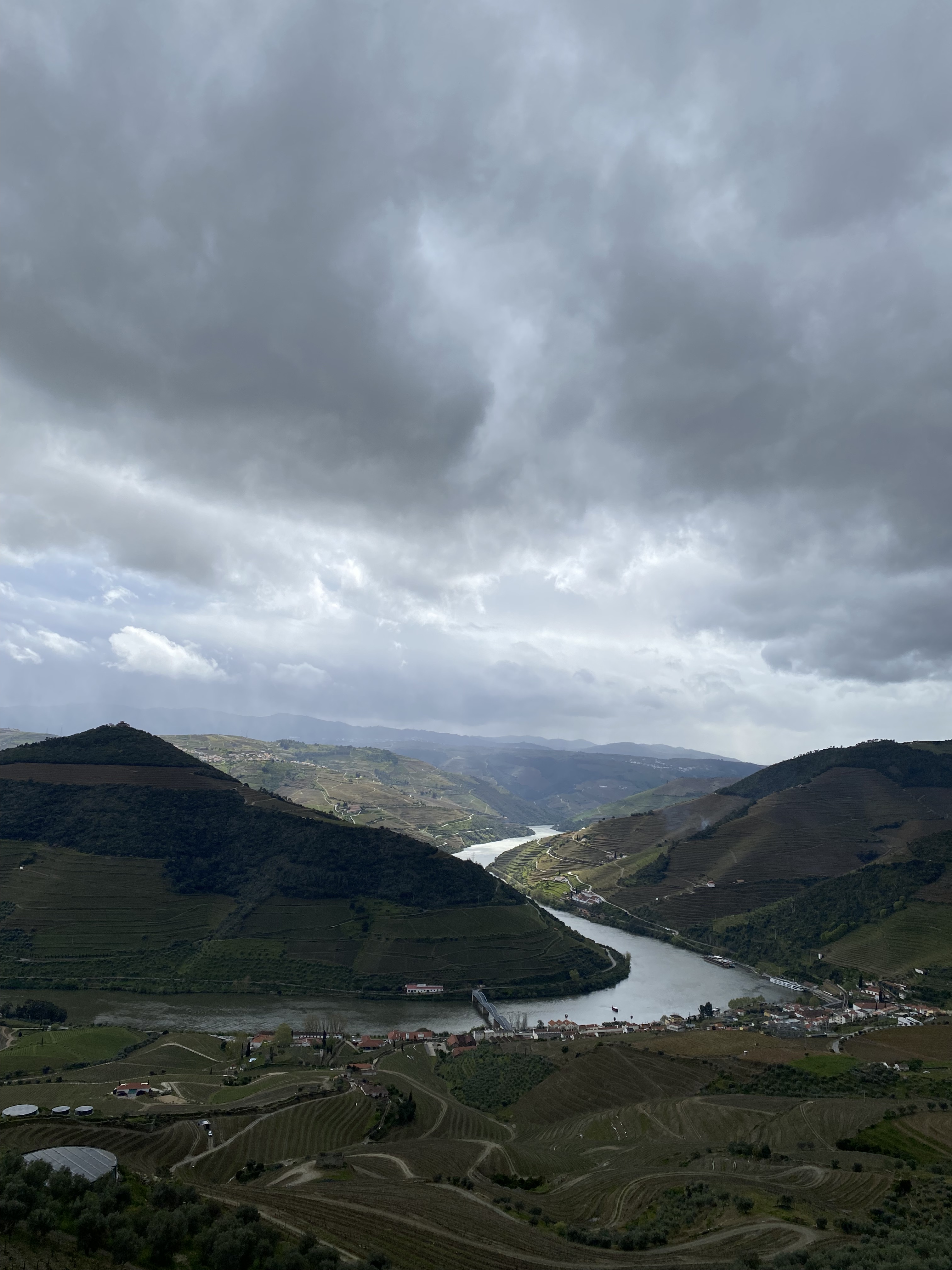

He poured us 4 glasses, which we sipped as we cruised along the Douro River under mercurial skies. Would it rain? Was that sun? It didn’t matter, because the views were stunning and we were under cover.
DeltaTurs, the company we booked, also offers group tours, but we rejoiced at having paid a little extra for the Adventure package, which got us offroading AND our own private boat. We chatted, asked questions about the landscape. Ricardo explained that this was the river where boats would transport barrels of wine to Porto. Back then, it took 3 days. He showed us a video of people rowing a boat through rapids, with gigantic wine barrels on board.
I was sad when the boat turned around to bring us back to land. Why couldn’t we have taken a journey directly to Porto or our hotel via river?
“There are dams,” Ricardo explained. “You have to go through the locks. It takes a while.”
Back at the 4×4, Dan pulled down seats in the back and immediately fell asleep. Rebecca picked at her breakfast box and fell asleep, too, leaving me up front with my VomiKids lollipop while J asked Ricardo questions about the area. We passed a gorgeous hotel on the river.
“That is voted the best countryside hotel in Europe,” Ricardo said with pride. “Six Senses. They know all of their guests and cater to you. It’s wonderful.”
I felt a little guilty, having found our hotel, which was quite a ways outside of the wine region, and figured next time we could try out the Six Senses.
“No way,” said Rebecca, later on. “I looked up rooms there. 1600 a night.”
Nevermind!
Now that we were in a car, the rain cleared and the sky was blue. A rainbow appeared over the river, capping our wonderful day and journey back to the hotel. Exhausted, we ordered room service for dinner and fell asleep nearly immediately afterwards.
It was the best night’s sleep I had the whole trip.


Categories: Portugal
 Lost Among Latitudes