It’s been over a month since I ran this race. I’m finally ready to write about it. Some details might be slightly inaccurate because I don’t feel like researching race sites at the moment. (I’m being lazy.)
Last year, Kelly D, Carly, and I signed up for the Davos X Trails Silver Route. It took place at the end of July, meaning one would need to train over the summer. The race began in Klosters and meandered 24 kilometers through meadows, forests, and alongside lakes. It was beautiful. I had done minimal training because it was too hot in Italy that summer to run too far, and I did okay. It wasn’t a great time and I wasn’t proud of myself, but I finished, and the race course was gorgeous. Mike ran with the dog, Tala. Michael and Dan hopped trains and spectated, sipping beers. The skies were blue. Life was good.
When X-Trails announced it was open for registration again and this time, they were opening the Diamond 68km to relay teams of 3, Kelly and I seized the opportunity. We reached out to Amy, an avid runner whom I’d actually never met because she works at the junior school and I work at the senior school and never the twain shall meet. I’d heard good things about Amy, like she’s an incredible ultramarathoner and was a cool person. I was excited.
Amy would take the first leg of the race, which was 31km out of Davos and involved a climb of several hundred meters. Kelly and I flipped a coin for the second and third legs: Kelly is stronger and faster than me, but was nursing a hamstring injury when we signed up, so while the coin toss landed Kelly with the second leg, we decided not to risk it; instead, I took the middle route of 26km and Kelly would finish the race on an 11km downhill cruise. The division of legs seemed a little unequal, but who were we to question?
My goal for this race was simple: to finish feeling good. The 24km had been fine, but I hadn’t felt good or proud. I figured I’d start training in March and April and started setting an alarm for the cold, dark pre-dawn hour of 5am but kept waking up in irritation and telling myself sleep was more important and I’d start training some other time.
I downloaded training programs – I committed to a great Hal Higdon one a few years back when I wanted to run a sub-2 hour half-marathon and it worked out for me – but they all looked like too much work and didn’t take into account the fact that I’d be flying home to New Jersey in June or chaperoning Duke of Edinburgh, two activities that would disrupt my routine.
I happened to be chatting with my friend Tim, who I’d worked with back in Manila and who now lives in Japan, when he asked about my running. I shared my conundrum: I’d signed up for races (also a backyard ultra in September) but couldn’t be asked to get out of bed to train for them.
“Get a coach,” he suggested. He passed on the contact info of a coach he’d used in the past named Hayden Hawks. (The name may sound familiar because, as I type this post, he’s somewhere in Switzerland celebrating his win yesterday of the UTMB CCC.) Hayden wrote me back saying he wasn’t taking new clients but referred me to his friend Matt, who also replied quickly and was taking new clients.
I’ve never worked with a running coach before, and I wasn’t sure $150 a month wasn’t being gipped. I could always get a training plan online. But Matt and I wrote back and forth about my goals, my obstacles, and countless other things and he’s basically created a bespoke running plan for me that changes based on when I’m injured or sick or traveling. I message him whenever something unexpected happens – a tweaked achilles, plantar fascitis – and he adjusts my plan or gives me advice. Say what you will, but I’ve been working with him since May and I have not missed a single run he’s planned for me. And this was not easy.
I flew to New Jersey over the summer and then down to North Carolina to visit my aunt and uncle. I’d been training for a month or so by then so the routine was formed, which was good because if I hadn’t formed a routine, I am sure I would not have run a foot down in NC. It was absolutely roasting and the air was wet with humidity. I would wake up at 4am – that’s right, in the summer – and step out of their air conditioned house and into a wave of hot. The heat would feel my body and wrap itself around me. In the short walk down their driveway to the road, I’d be glistening already.
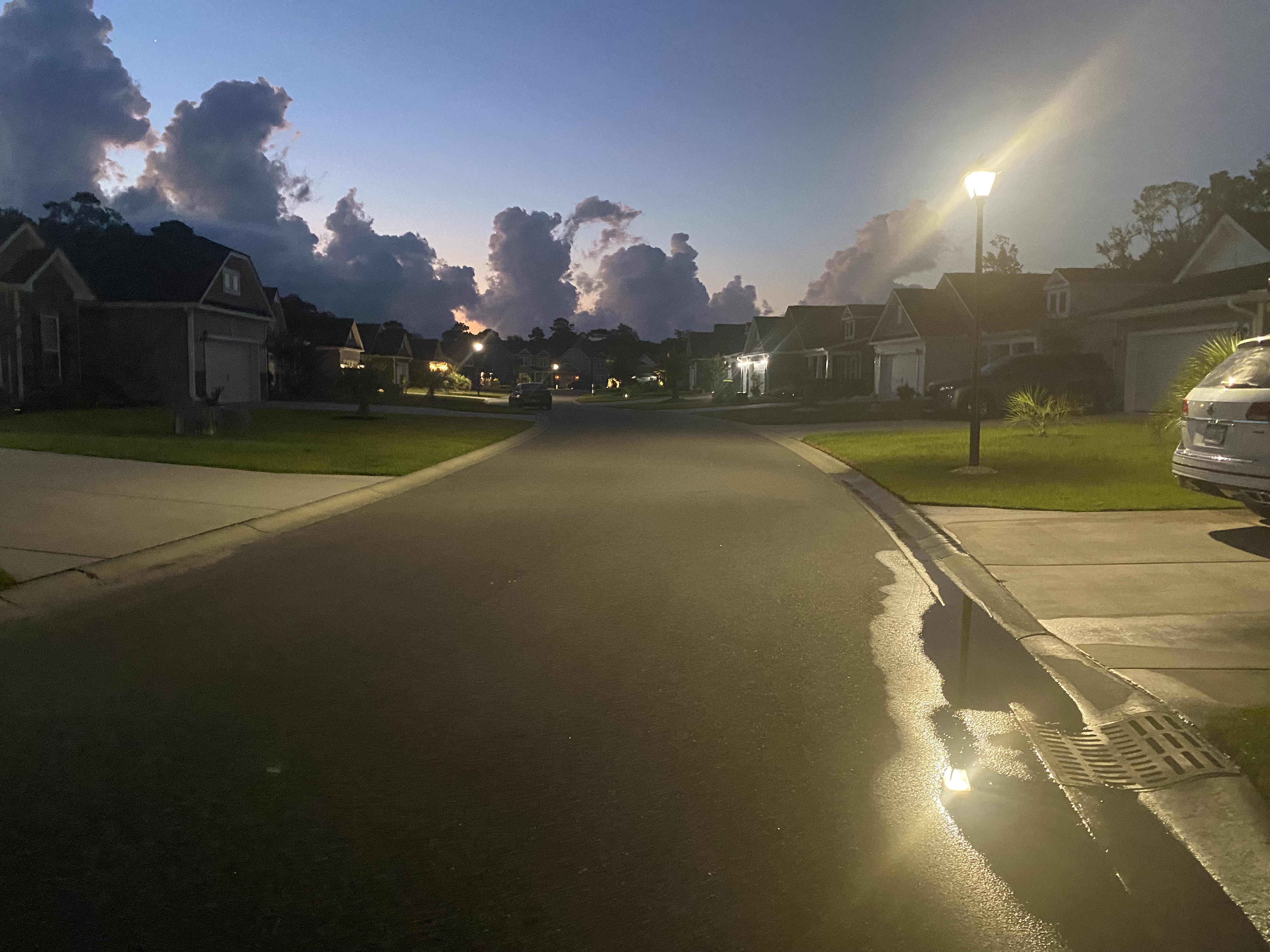
Their neighborhood was in a remote area, so my running options were limited to the looping streets and cul-de-sacs in their gated community. One morning, I logged 2.5 hours. I passed one house with a Trump flag and a motion sensing camera at least 10 times, braved the alligator ponds once it got a little lighter out, and ran through eerily half-developed wooded areas with signs nailed to trees, each one advertising the name of a family who had purchased that plot of land and would eventually sell their family homes and relocate here.
All of this is to say that I ran my heart out this summer. I joined a fancy gym (er, fitness club) and worked with a personal trainer to strength train, met a nutritionist who gave me meal plans and explained protein intake and electrolytes to me, cold plunged after long workouts.
I was strong! I was powerful! I was prepared! Would it really make a difference that New Jersey was at sea level and the highest hills I’d climbed were Mount Joy and Mount Misery in Valley Forge, and that Davos is listed as the highest village in Switzerland, with race organizers recommending 4 days of altitude acclimatisation before race day? Not with these quads!


I flew back to Switzerland 6 days before the race and got a little hill training in. This was easier than in New Jersey, where the best hill is in a gated park that opens at 7am (though I learned by calling a park ranger station that you can access the parks by foot at any time, but also who else is up there lurking in the wooded parks at 4am and can I outrun them?).
The week before the race, we received an email from X-Trails: due to late season snowmelt and a lot of rain, there would be snow on certain parts of the trail. Poles were highly recommended. I hadn’t run with poles ever, but I figured I wouldn’t use them. Instead, I borrowed a pair of Kelly and Michael’s and practiced running with them folded up in my running backpack. It felt effortless. All good.
Additionally, an employee at the hotel we were staying at in Klosters had called me to ask about breakfast for race day, and she mentioned she was also doing the race. She had run the trail a few days ago and didn’t see any snow.
I drove down to Klosters on Friday and met up with Kelly and Amy. Amy had messaged the day before to announce that she’d been feeling sick for the past week and hadn’t been able to train and didn’t feel she could do the race at this point. She transferred her bib to her husband Jesse, a running coach and endurance extraordinaire. We collected our bibs from Davos, took the train back to Klosters, and had dinner at our favorite Italian place before going to bed.
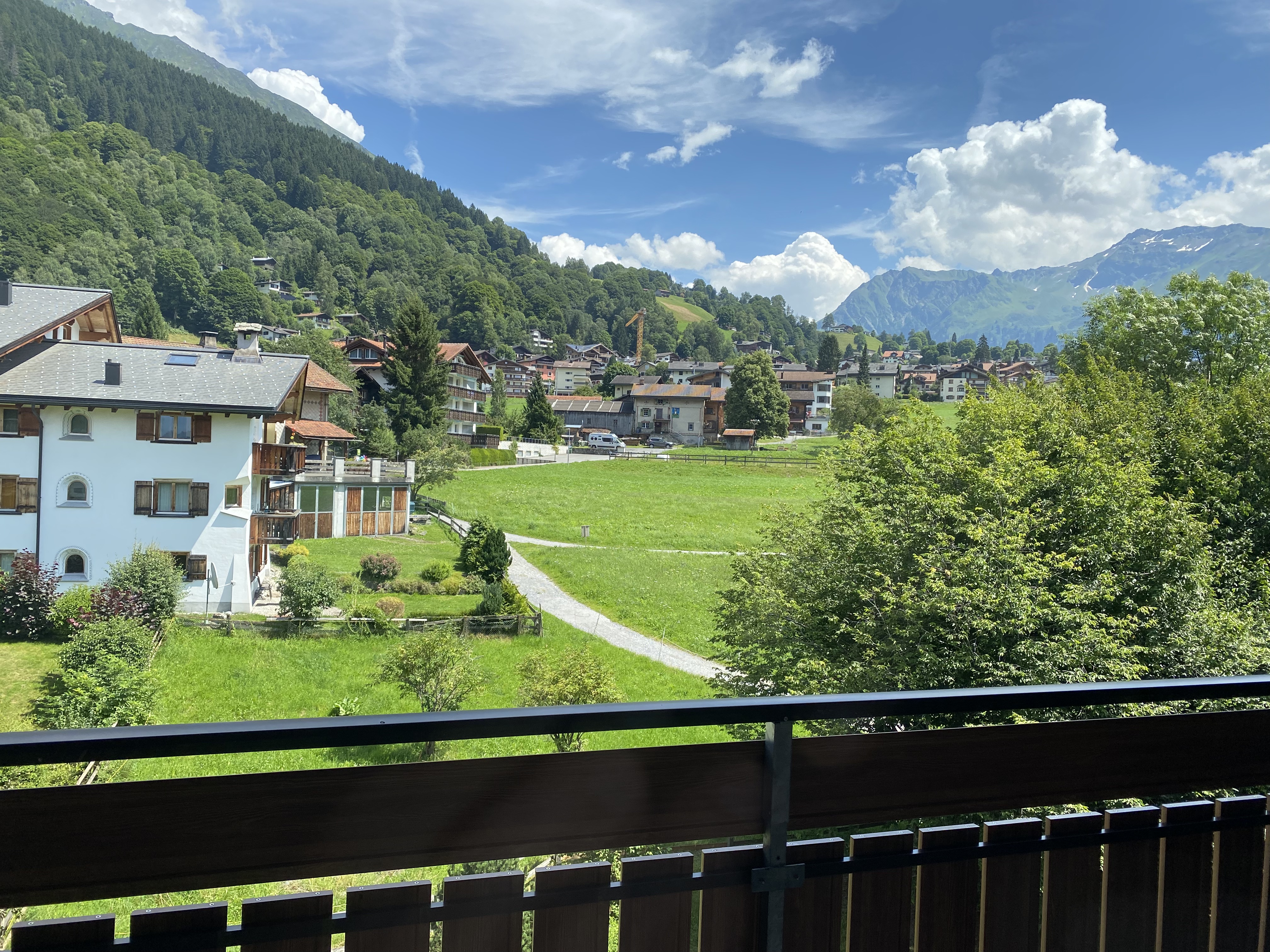


Kelly and Michael watched the opening ceremony of the Olympics, and I remembered that I was meant to be in Paris on the 27th and had changed my travel plans to arrive the next day so I could run this race. I pinned and re-pinned the bib to my shirt. I was excited. I was ready for this. I’d trained for this.
On race day, I got up and went with Michael to the breakfast buffet. Michael was running the 10k with their dog, Finn, and we each took a yogurt and a spoon for the road. Jesse had begun the race at 7am, and we’d done our estimates over dinner last night. Jesse thought he’d finish his leg in 3 hours and 15 minutes, meaning I needed to be at Sertig Wasserfall around 10:15 to take the chip from him and start my leg. I didn’t want him waiting around for me, and a small part of me also thought we could win because he was so fast.
Once at the Davos sportszentrum, I figured out where the shuttle buses were and asked a volunteer what it was like up at the handover station. Was there a bathroom? A tent to keep warm?
“Yes,” she told me.
Thinking it might be wise to just get up there and get into position, I hopped on a shuttle around 8:45 and off we went. A German runner was on there, too, and we got to chatting. I was grateful for him, because the shuttle driver headed up and then stopped, and with no explanation, everyone got off the shuttle. Was this the handover? The German runner was able to ask questions, and we walked another 20 minutes up to the handover zone, which did not have a bathroom or a tent (though there was a portapotty further down the mountain).
By 9:30, I was in position. The GPS tracker we’d been using to track Jesse was not working, much to the chagrin of all the other runners pacing the handover zone with me. I was excited. The weather was cool and brisk, there were trees everywhere, the vibe was fun, and I could see the little hill I’d start up. I was ready.
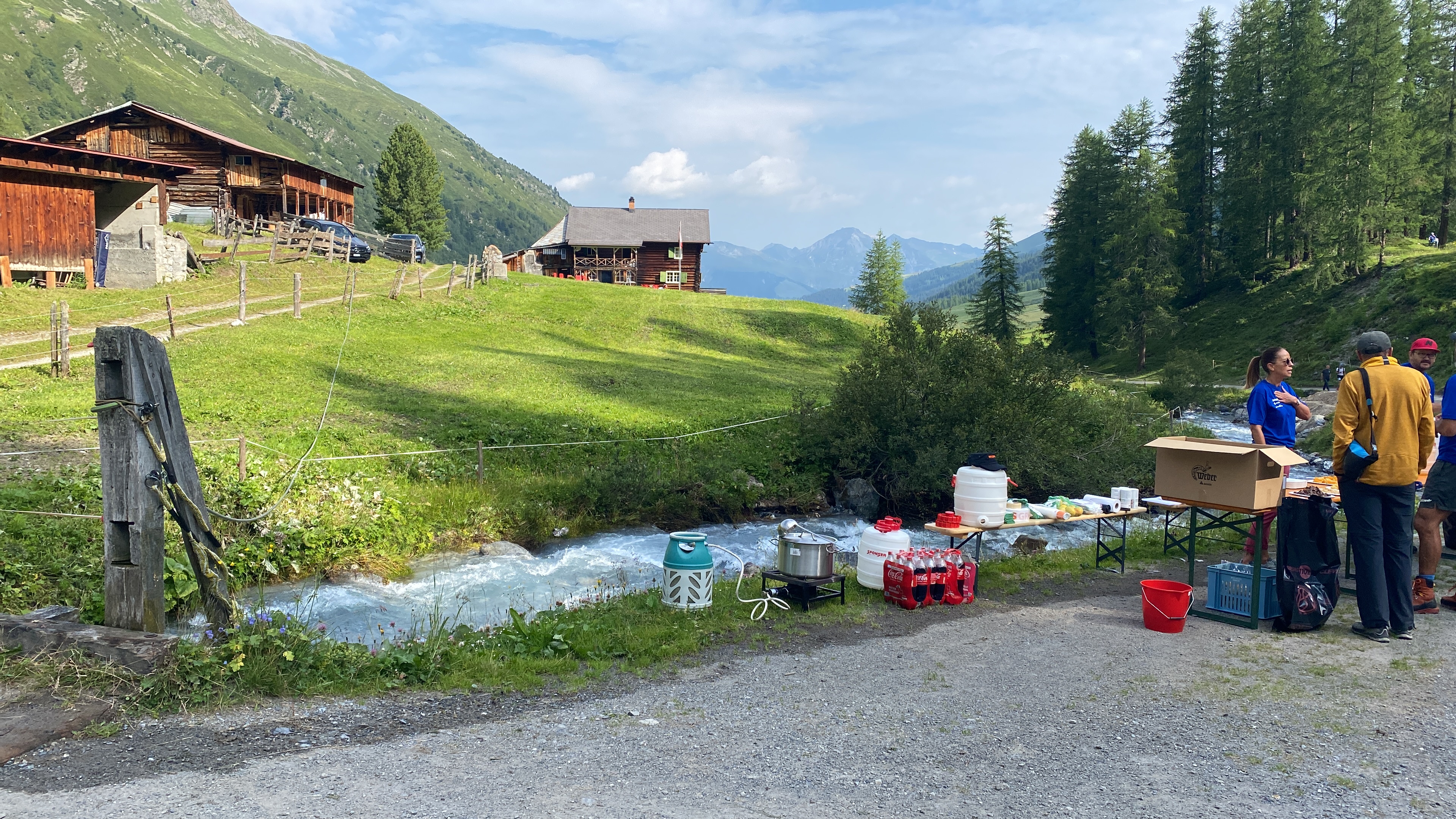
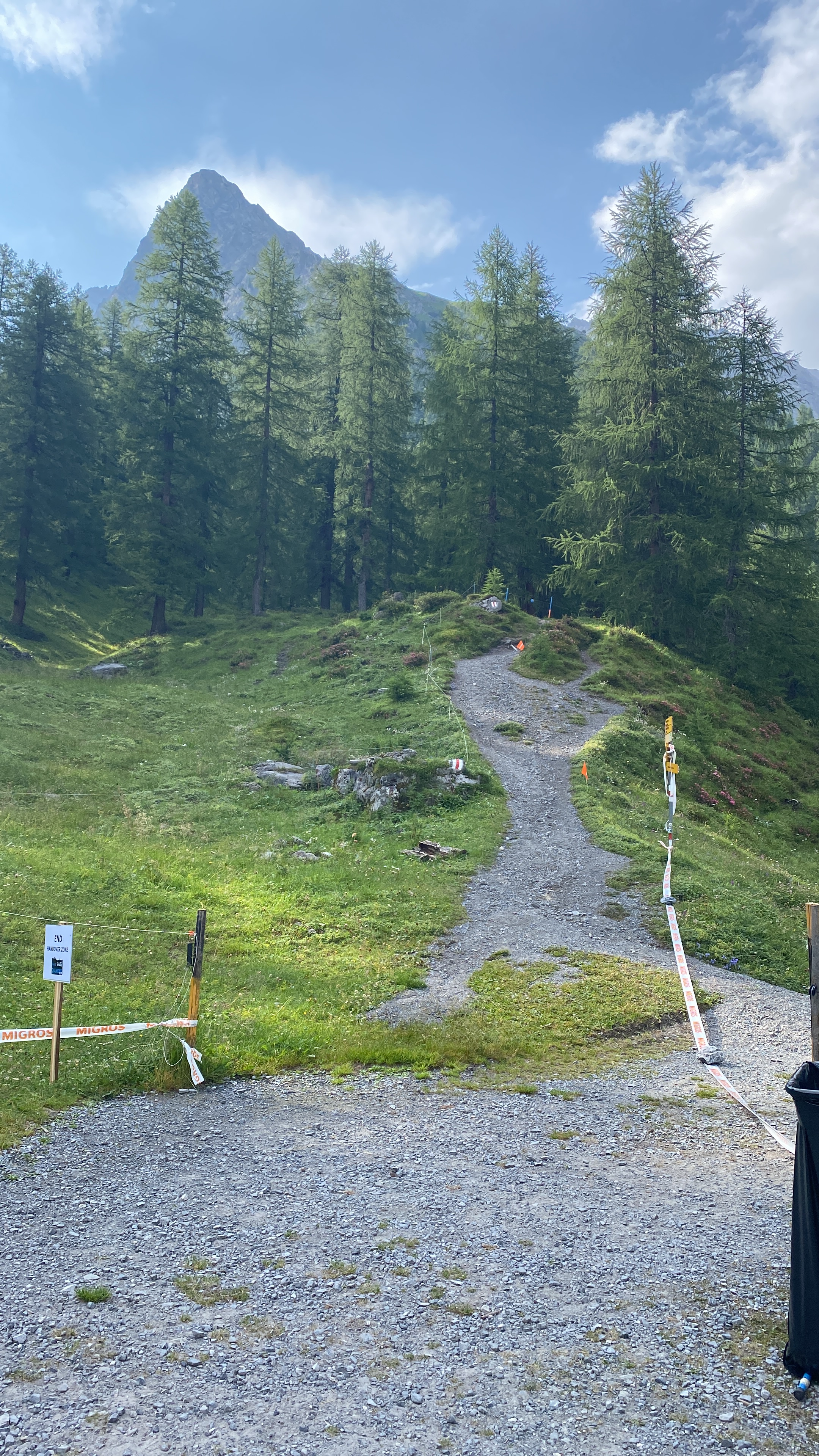
Jesse arrived around 10:30, poles out. There had been snowfields, and during the time I’d waited for him, I watched as other runners beginning my leg set off up that hill, poles out. I figured keeping the poles out wouldn’t hurt, and so once we got the chip bib off him and onto me, I was off.
I had seen others walk up the hill, but I was excited and set off running. And then, halfway up, I walked. I realized with some surprise that breathing had suddenly become difficult. Even as the trail flattened out a bit, I was finding moving hard. My legs felt heavy and my lungs felt smaller.
I told myself it was all good. I’d done the math last night, pored over the race route, and calculated as precisely as I could exactly what my kilometer-elevation ratio was. I would begin by going straight up hill about 400 meters for 3 kilometers, followed by a near-vertical descent of 800m over 4 kilometers, followed by a longer stretch of 5km up another 400m. Then it was rolling flat bits.
Somehow all of this was wrong. I plodded up and up, my watch ticking off the kilometers: 3km, 4km. No downhill was in sight. At one point, I was hiking up the side of a mountain, the trail all scree, my poles not helping at all as I slip-slid up. As I swallowed my pride and basically scrabbled up using my hands, I could hear the hum of a distant drone. I prayed the drone was not filming this.
Once I crested the mountain, there was an aid station and the 800 meter descent. I’d been off by more than 2km, so I knew this would also be off. I was still struggling to breathe, though the descent took me out of the high altitude a little, even if I was going slowly. The entire trail was, well, trail, and I was in my Nike Vomeros. I wished I’d invested in straight up trail shoes. I rolled my ankles over and over, stepped awkwardly on roots and pebbles, and found myself swearing.
The terrain was gorgeous. Because of the staggered start, there was almost no one else around, so it felt as if this massive vista of meadow, stream, and huge alps was all mine and mine alone. If I hadn’t felt so much like I was dying, I would have been in a real state of bliss.
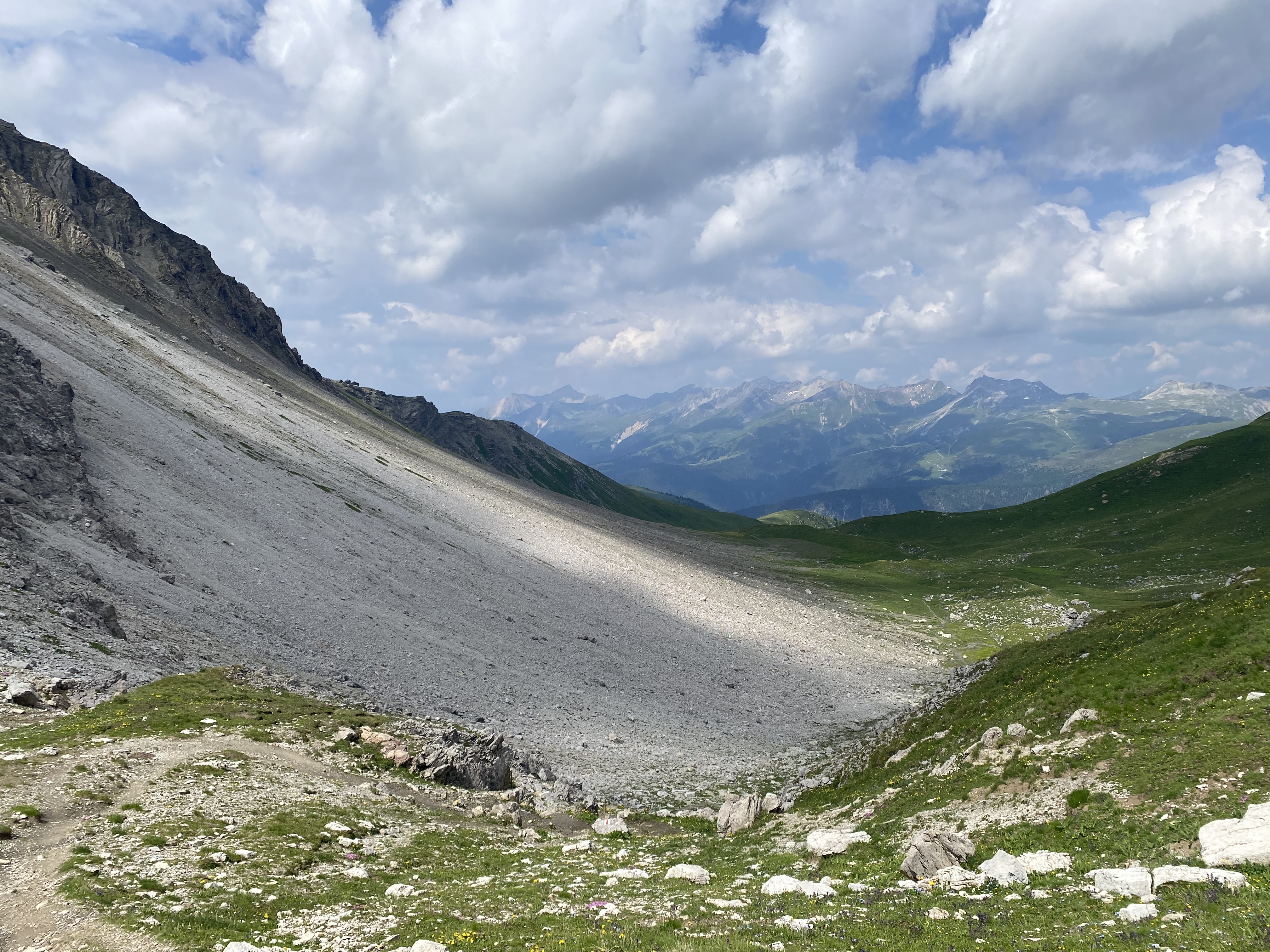
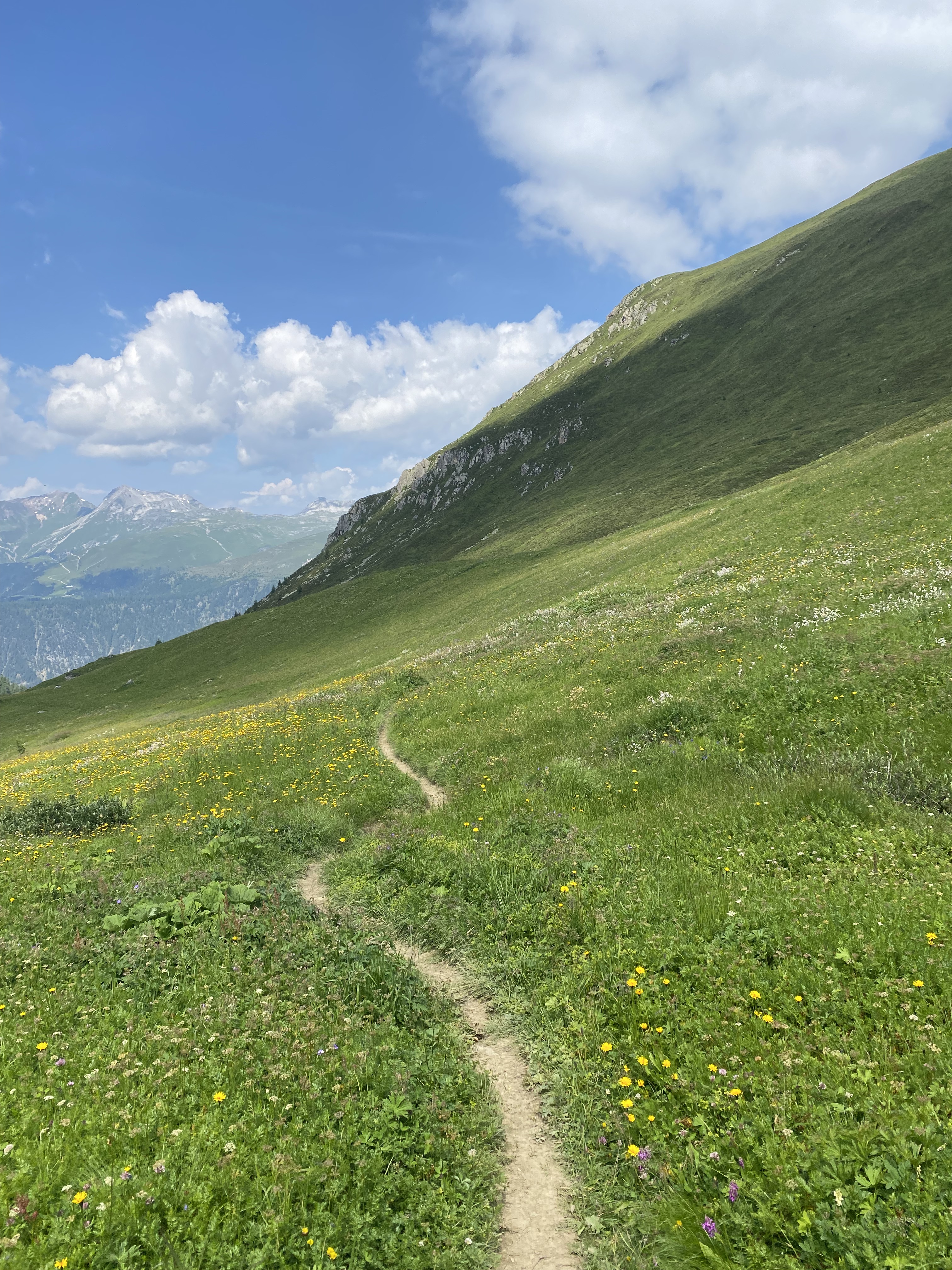
The downhill ended and the uphill began again, and I was basically walking. People were passing me. Even when I was jogging, I felt like I was moving through tar. And the sun had come out. One thing I felt very grateful for was my hat, without which I probably would have melted and died.
I finally hit some pavement and picked up the pace. It was hot. I had 1 liter of water with me and as I sipped, I heard the worst possible sound: the gurgle of water and air, meaning I’d run out of water. I had no idea when the next aid station was, and each kilometer marker appeared alone on the side of the trail, no aid station in sight.
At one point, sweating and panting and dehydrated, I crested a hill and came up on a race volunteer. I asked him where the aid station was and he wasn’t sure. I felt like crying.
“Do you need water?” he asked me.
“Yes,” I told him, and he took out his bottle. I opened up the bladder in my running backpack and he began to pour it in.
“There’s nothing in it, like electrolytes,” he said.
“That’s fine,” I wept. “I don’t need all of it.”
“It’s okay, I have more,” he told me, emptying his bottle. I was practically sobbing with gratitude here.
I trotted onward, checking my watch with every kilometer. With my math, I’d estimated I’d finish my leg in about 4 hours and 15 minutes. In reality, I hauled myself into Sertig Dorf after about 4 hours and 50 minutes. I felt awful. I was angry, I’d fallen over roots and wiped out, I felt unprepared. All of my training seemed moot. And I’d felt bad for Kelly, who’d been waiting there for ages.
I was a wreck when I arrived at the handover station, just grateful to not be running. There had been a sprint zone before the handover station, a brief 100 meters where you could pick up your pace and see how fast you were going, and I’d just scoffed at it. Normally I love that stuff.
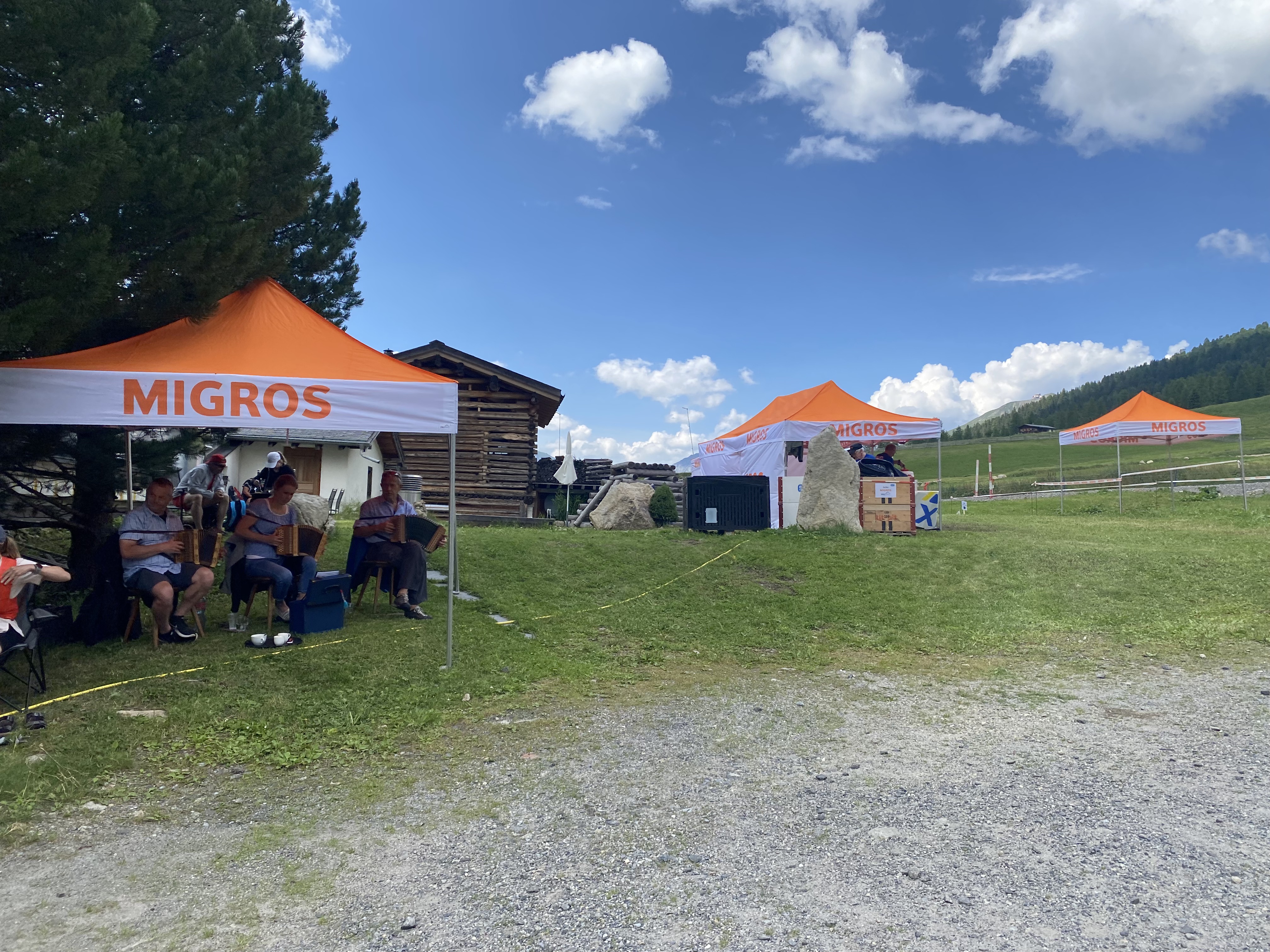
It took a long time for me to get my head together again. I was angry, disappointed, frustrated, and felt completely blindsided by how hard this had been. In the back of the shuttle back down to Davos, I texted my sister. It had been the worst race I’d run.
It took a few days and some debriefing with Kelly and Dan to realize a few things that might have messed with me.
The first was obviously the altitude. Nothing I could have done this summer could have prepared me for this, unless I guess I ran in one of those oxygen-depriving masks. In retrospect, Kelly should have run the 26km because she’d spent the summer in Switzerland.
The second was something Dan pointed out the next day when I arrived in Paris.
“You’ve never run with poles,” he told me. “Ever. And I bet you they messed with your arm swing.”
This made a lot of sense. When I was able to run, I’d done so with the poles at my sides, my arms practically straight. That is not how I normally run, ever.
Third: trail shoes would have served me well here.
In the end, it’s all a lesson learned. It was a tough race, and if we do it again next year, I’ll happily take the last 11km. I’m still training, looking ahead toward the backyard ultra now. I’m feeling strong and confident again. So while my summer runs may not have prepped me for the mighty altitude of Davos, they weren’t all for nothing.
Categories: Switzerland
 Lost Among Latitudes