You are jogging along a relatively flat stretch of loose gravel road. It is a Saturday morning in late September, and the last of the cool, morning fog has finally dispersed under the warmth of the rising sun. The sky is blue and cloudless. You are wearing your favorite running shorts and a loose running tank top. Your feet feel comfortable in your ankle socks, and every footfall reminds you of the soft insoles padding your foot soles from the impact of sneaker on earth. Your sunglasses – futuristic, purple, and unmoving with each stride – keep the sun out of your eyes, but its warmth feels nice on your cheeks. A cool breeze skates across your arms and legs. You are not in a rush. You have one hour to complete a 4-mile/6.7km loop. This isn’t a race. On your left, a grove of trees and the sound of water trickling through a fountain. On your right, cornfields and farmland roll away to the east. You take a breath. Breathing is easy. Everything feels easy. You pull out a date from your running backpack and take a bite. It’s like candy. In about twenty minutes, you’ll be back where you started. And then you’ll have a choice: do you do it again? And again? And…?
Welcome to the Backyard Ultra. What is a backyard ultra, you ask? Or maybe even, what is an ultra? Some running math for you: a half-marathon is about 13.1 miles/21.1 kilometers. A full marathon is 26.2 miles, or 42.1 km. An ultra, by definition, is anything longer than a marathon. So you could run 43km and you’d have done an ultra, technically, but the more popular ones are around 50km or 100km, or more.
What the heck is a backyard ultra!?
The famous ultras – UTMB, Western States, etc. – are continuous. You set off at the start and off you go until you come to the finish line however many hundreds of kilometers later. The Backyard format feels to me like a bite-size ultra, a little taster and a way to dip your toe into the world of ultrarunning without finding yourself 78km into some foresaken mountain pass wondering what the heck you signed up for and can helicopter rescues even reach me out here?
Dreamed up by the wildly eccentric Lazarus Lake, inventor of the Barkley Marathons, the Backyard Ultra has gained itself the informal tagline of “One More Lap”. The rules are simple. Beginning at a certain time runners line up at the starting line, and at the signal, they’re off to complete a loop of 4.1 miles or 6.7km. Runners have one hour to complete this loop before lining up at the start again to do it all over again. And again. And again.
The winner is the person who runs the most loops, but they must run the final loop alone in order to win.
My relationship with running and races looks like this. I look at a run and think, am I the kind of person who could complete a half-marathon? Probably not. That seems far. Then, a running pal will say to me, “I’ve just signed up for the So-and-So Half-Marathon. You should, too.” So I sign up, get training, and then think, “Whoa, Body, we did it! Wow! I can do half-marathons. Cool. Probably good with that, though. Not going to try a marathon.”
Then, while drinking beers after the half-marathon, Jen S will say, “Hey, the Amsterdam Marathon is next year on our October break. Want to sign up together?” and Carly will say, “Hey, the Jungfrau Marathon is next September. I’ve already signed up. You should, too.”
And then I sign up, too, and then I think, “Wow, Body! We did it. Two marathons in a month. That was wild. I’m good with that, though. Not sure I could ever handle an ultra.”
And then Jen S told me about the Ettinger Backyard Ultra. She had witnessed it herself in 2023, its inaugural year.
“There were only about 20 people last year,” she told me, “and we came out to watch the winner on Sunday morning. He ran 25 laps.”
To win a backyard, you must essentially outlast everyone else. After each lap, people drop out, one by one. But it may be that you and one other person are still in the race. And you and that other person arrive at the starting line together over and over. Until that other person turns in their chip, you have no idea how many laps you have to do to win. Once their chip is turned in, the end is in sight: you must only run one last lap, all by yourself, to be crowned the winner. Everyone else gets a DNF (Did Not Finish) but also a cool medal.
It was Jen who sent the link to the website and said she was signing up. It’s proof of Jen’s influencer status as a runner that 6 of us followed suit.
The Ettinger Backyard Ultra
Our group comprised of me, Ringo, Amy, Stefan, Kelly, and Jen. We all had different goals, but we each wanted to cross the threshold into Ultra territory; apart from Stefan, none of us had ever run farther than a marathon. My original goal was 8 laps, or 53km. That felt sufficient for me, if only I could get off the couch and start running. This was the major difficulty; in the past, I could follow online training plans with ease, but for some reason, I could not motivate. My friend Tim suggested I get a coach, and connected me with a runner in the US who linked me up with his friend. With my coach, I got on track pretty fast and never missed a training plan. I also added in strength training while in the US this summer and once a week when back in Basel.
Training for a race is a serious thing. I ran 5 days a week, often waking up at 4am during the week and 5:30 on the weekends (both Saturday and Sunday), followed by a strength session on Sundays. This usually meant foregoing nice, long Sunday coffee mornings and instead doing goblet squats in the weight room at my school. It also meant foregoing lots of late nights and booze, saying no to invitations, and getting under the covers by 8pm most nights. I changed my diet to be healthier, eating more often but eating better. (Translated: no more cheese.)
So on race day Saturday, September 21, I felt prepared. We borrowed a tent from the school’s athletics department and pitched it. Jen found out from the organizers that there were two sections where you could pitch your tent: people aiming for below 10 laps and people aiming for above. Ringo, Amy, and Stefan were aiming for above, so we pitched there. As I’d reflected on this earlier in the wee, and how well my training was going, I decided to adjust my goal to be 10 laps, or 67km. That felt respectable.
The Day of the Run
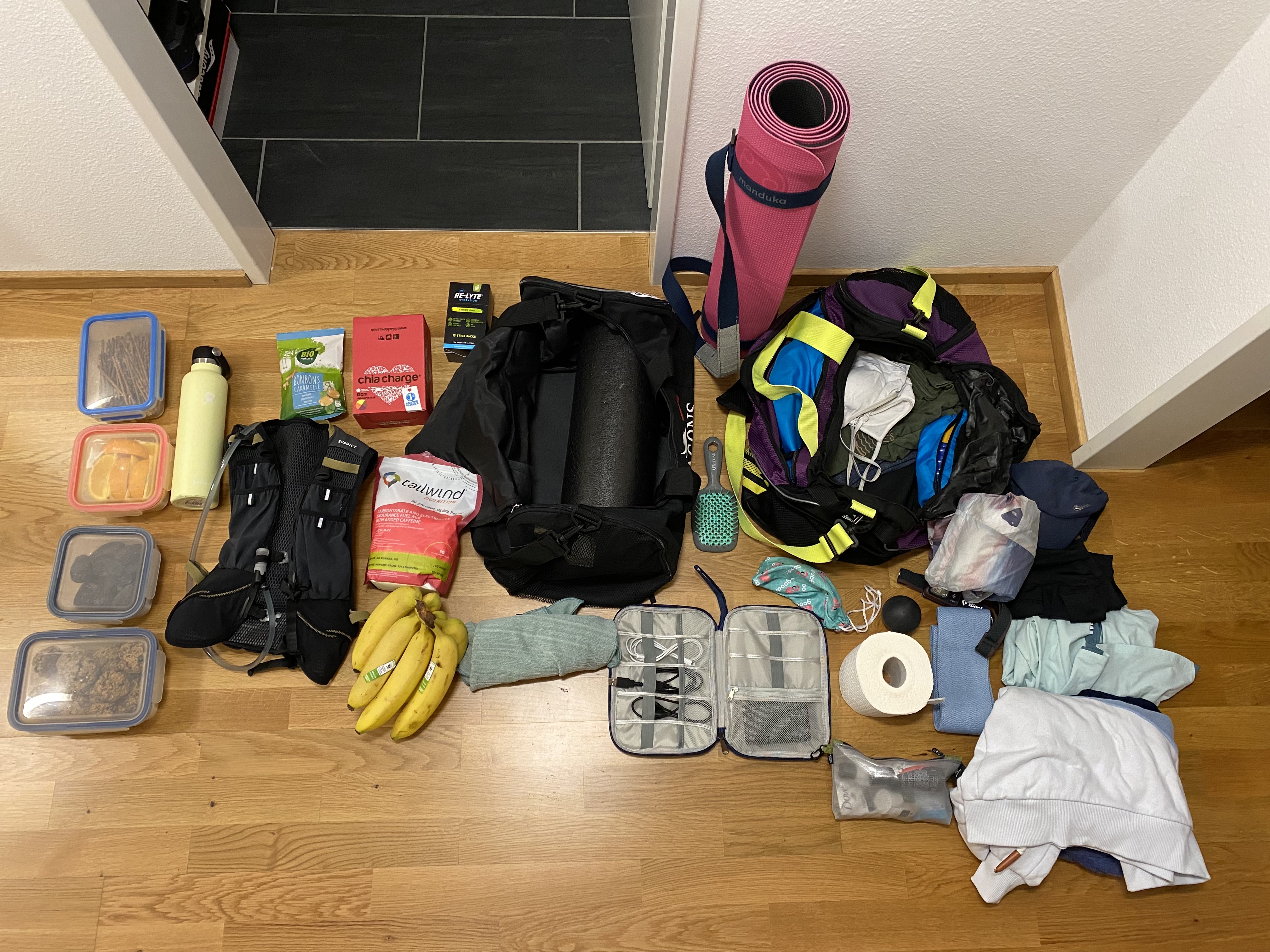
On race day, I packed two duffel bags and a yoga mat, stuffed our things into the car, and headed up the hill to pick up Kelly and journey at the starting point. There was some cool energy already in the foggy morning air. Kelly had wisely brought along slippers she’d taken from hotels as well as gloves, and we sat on our yoga mats using the foam rollers to massage our muscles into wakefulness.

We registered, receiving tracking chips that fit around your ankle like prison trackers, as well as race shirts. Additionally, we had to pose with our starting number so someone could take our photograph. It printed out as a Polaroid, and the photographs of all runners were then clipped to a string over the registration booth. To tap out, you turned in your anklet and took down your photograph. It was very Hunger Games-esque.
Jen told me that this was only the second Ettinger Backyard Ultra. The year before, only 20 people had signed up. This year, there were close to 80.
Our tent home was very cozy. Dan helped put up the “walls”, Ringo had brought along a camping shelf/table system, and me, Amy, and Kelly had laid out our yoga mats and had our duffel bags strategically placed along the wall. All of us had food and electrolytes. Ringo’s camping stand had a water jug on top, bags and cylinders of electrolyte powder, and shelves stocked full of snacks for us all to share.
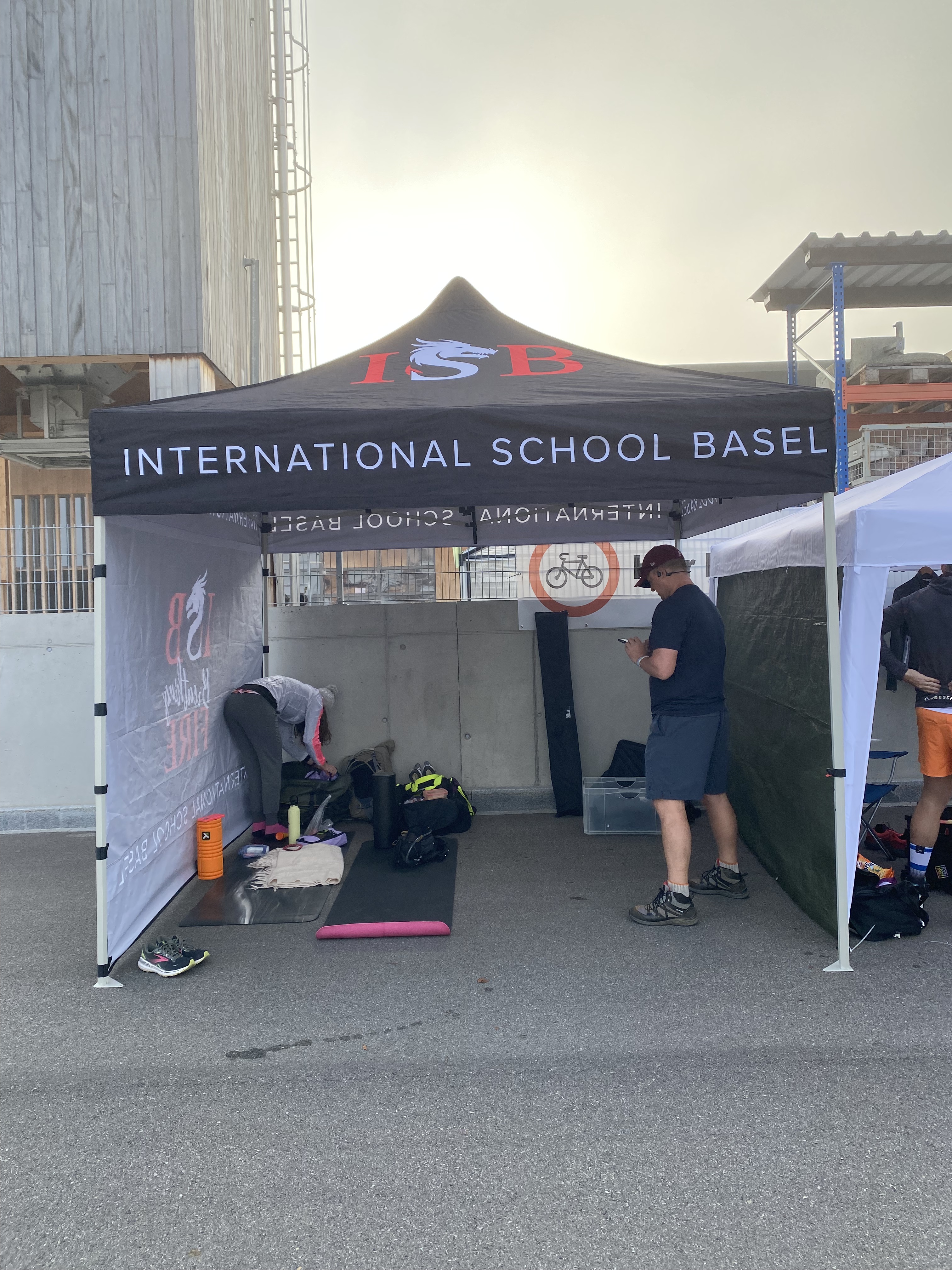
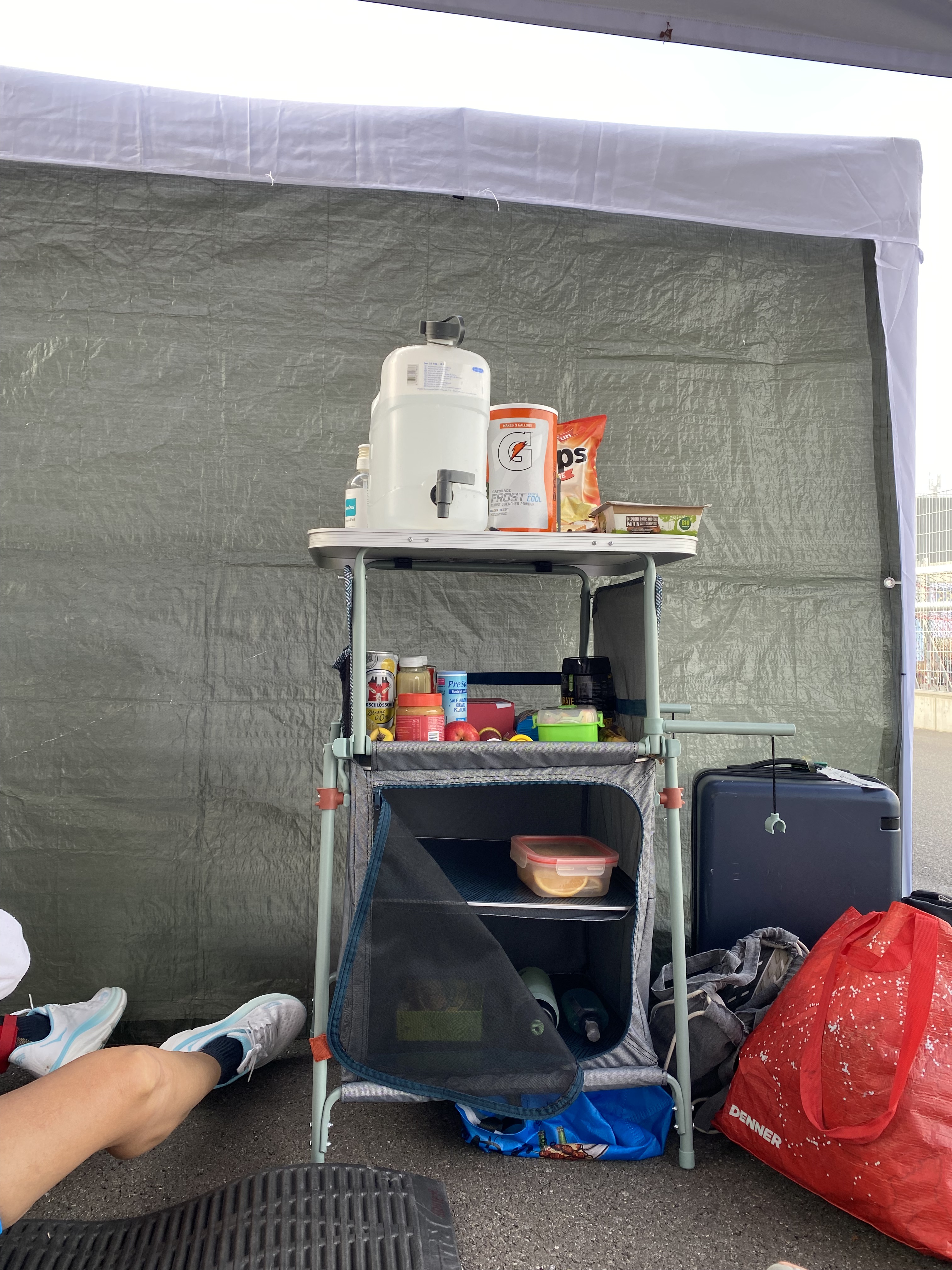
We had the beginnings of our pit crew: Dan and John were setting up an area next to the tent with camping chairs and a little coffee pot. I realized as I laid on the yoga mat that this was the longest amount of time we’d be spending in our home base all day.
My goal was to run each lap in about 50 minutes, leaving 10 minutes to use the bathroom or come stock up on food at our tent. So even as folks trickled in and out to show support, I’d barely get to spend any time with them.
A few minutes before 10am, the sound of a cow bell clanged from the starting line. (And I mean the Swiss cow bells, the ones they hang around the cows’ necks, not the SNL cowbell.) This was the signal to assemble.
We headed up with the crowd of 80, set our Garmins, and we were off at the second cow bell. It was a cloudless day with the peak temperature hitting 75 Fahrenheit. The route was beautiful. We’d run it back in April, but the organizer had made some minor changes since then, and I couldn’t complain. The changes included more farmland, and while they advertised 140m of elevation gain, the reality was only 53m.
We decided to restart our Garmins after each lap. So every time we lined up at the start, we only had a meager 4 miles or 6.7km ahead of us. Mentally, this was achievable.

The Route
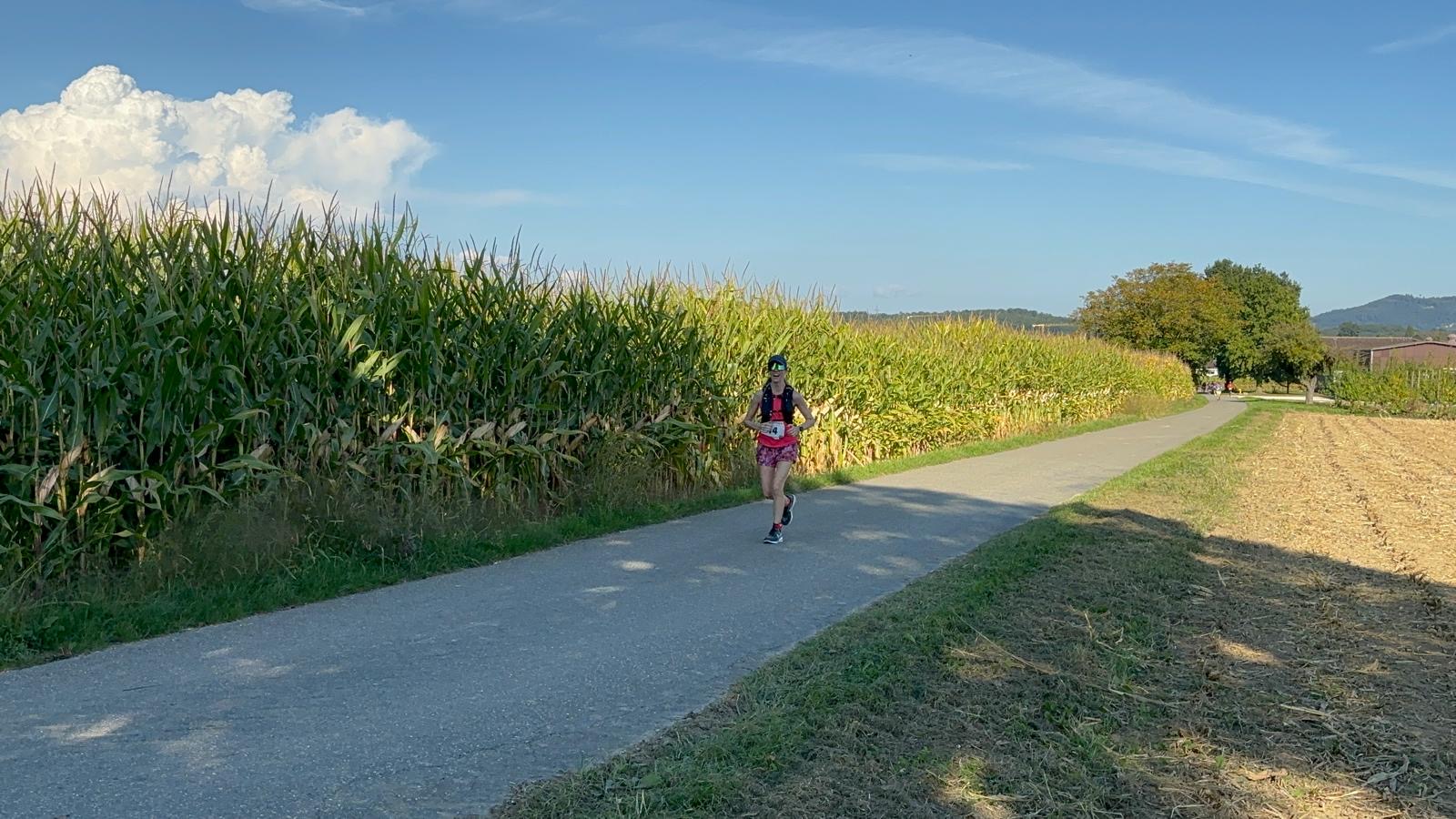
If you want to imagine it with me, here is the route we ran: You run through the start and then along the road beside the tram line before turning right up a loose gravel hill. Eventually, it turns to pavement, but not for long; you’re turning right briefly, then left onto some grass and mud. It’s uneven, but gentle on the joints. You emerge again on rocky road and follow it left for some time. There is another left turn in there, then you head straight along on a slight incline beside cornfields before turning right into an unhurried descent on paved road. Eventually, the road slopes up again and you turn right, running along pavement but in the shade alongside a creek hidden by thick trees. From there, the road opens up to a farm, where at 10am, 5 or 6 men are working on building some kind of wooden float or stall or something. Behold the construction process. (As the day progressed, so, too, did the float. Each lap presented a more completed float than the lap before; it was fun to look forward to that moment each lap, especially toward the end of the day when the float was almost complete and they were celebrating by blasting “No Scrubs.”)
But back to you! After the farm, you come to another stretch of paved road alongside cornfields, which eventually turn right and then left again down a paved stretch, and then another left on to blissful trail (bless dirt and earth, a gift to sore joints). The trail then turns to pavement as you turn right, then left down a slight incline before turning right up a small hill – gravel, cornfield – which you can run up, but I began walking after my second lap (I’ll tell you why in 6.5 paragraphs).
Then it’s right out of the cornfield and along quite a long stretch of paved road past – surprise! – more cornfields and sunflower fields. Eventually, finally, you turn left onto some loose gravel again, which curved slightly up before turning into a generous downhill that deposits you on the paved road you started on, turning left at the bottom and immediately seeing just a short while away the starting line and the soccer fields. It’s lap one, your legs feel strong, your lungs full of powerful oxygen, your skin a little sun-kissed. 10-15 minutes of rest await you, and then it’s back to the start!


24 hours after my first lap, as I wrote part of this entry, I felt this course as if it was encoded in my DNA. I can picture every single arrow spraypainted into the ground or on the dirt, every little flag and arrow pointing which way to go, and eventually, at night, the little golden lanterns they strung up at each of our turns to light the way. It was weird to think that over the course of the next few days, this route would become less and less familiar to me.
The Ultra
The first loop was great. I did my best not to compare myself to others. People passed me, laughing and chatting, and I plodded along at what I considered a slow pace, but which turned out to be around 6.30 per km, with some stretches averaging 6.05 per km. Amazingly, hours later, this was still my pace. I felt locked in, even as my muscles and joints began to ache. No matter what, I was consistent. Amy compared me to a metronome. What a compliment.
On my second loop, an older gentleman took the corner behind me and ran up along side me, asking me in German if this was my first ultra marathon.
I responded in my broken German, and we got to chatting. Was this his first ultra? No, he told me, but his fourth. What were the others, I asked? This one, he mentioned, last year, and two others. I asked him how many laps he managed last year, and he said, “25.” And then I realized: I was running with the winner of last year’s backyard ultra!
“Beruhmt!” I said excitedly. “Vorschlag?” Advice?
“Go slow. Walk from time to time. This is actually quite fast,” he said to me, and then began walking up the cornfield hill. So I walked with him. It seemed wise to mimic the champion. Amy jogged past us and pointed at him.
“Daniel! I follow you on Instagram!” she said, followed by something in German. Amy is an impressive person for a lot of reasons, so of course she can also speak German.
Daniel told me about the Basel Run Club, and pointed out a girl in front of us as a member. She told me she was from upstate New York, and we got to chatting. Her name was Sarah, and she ended up being one of the last 4 women in the race. As we ran, Daniel pointed out the joys of the backyard format. You get to chat with people, and there isn’t the intensity of a “race.” You don’t get anywhere by being faster than anyone else.
This is how my many mantras of the day came about. I have my usual (“Take it easy, win the war”) from the Dutch guy building castles on the beach, whose father was a Marconist during World War 2. Then there was a message from my friend Tim the day before: “Remember, ultras aren’t about who runs the fastest, but who slows down the least. It’s all about pacing.” My training taught me exactly my pacing style, and as others flew past me, I kept reminding myself that I know myself, my pace is good, and their goals might be different from mine. A few laps in, I added another one: “Running up this hill does not serve me.” Because what difference does it make if I run up the hill or walk up? I’ll still get back in time. Carly taught me this when we trained for Jungfrau. Every time I run, I always find myself reflecting on other runs I’ve done and people who have inspired me with their wise words. It also helps to pass the time.
My plan was to run without headphones – because that’s how I train – but if things got tough, I’d put on my Harry Potter audiobook. I imagined it fueling me to an overall win. But things turned out differently than I expected.
After 8 laps, I felt awesome. Our support crew had grown to include Jillian and Nat, Blair and Holly, and Jen W, who should win medals for her level of support at every race ever. Sometimes she goes out to watch races in her neighborhood without knowing anybody, just to cheer them on. She’s an awesome human being.
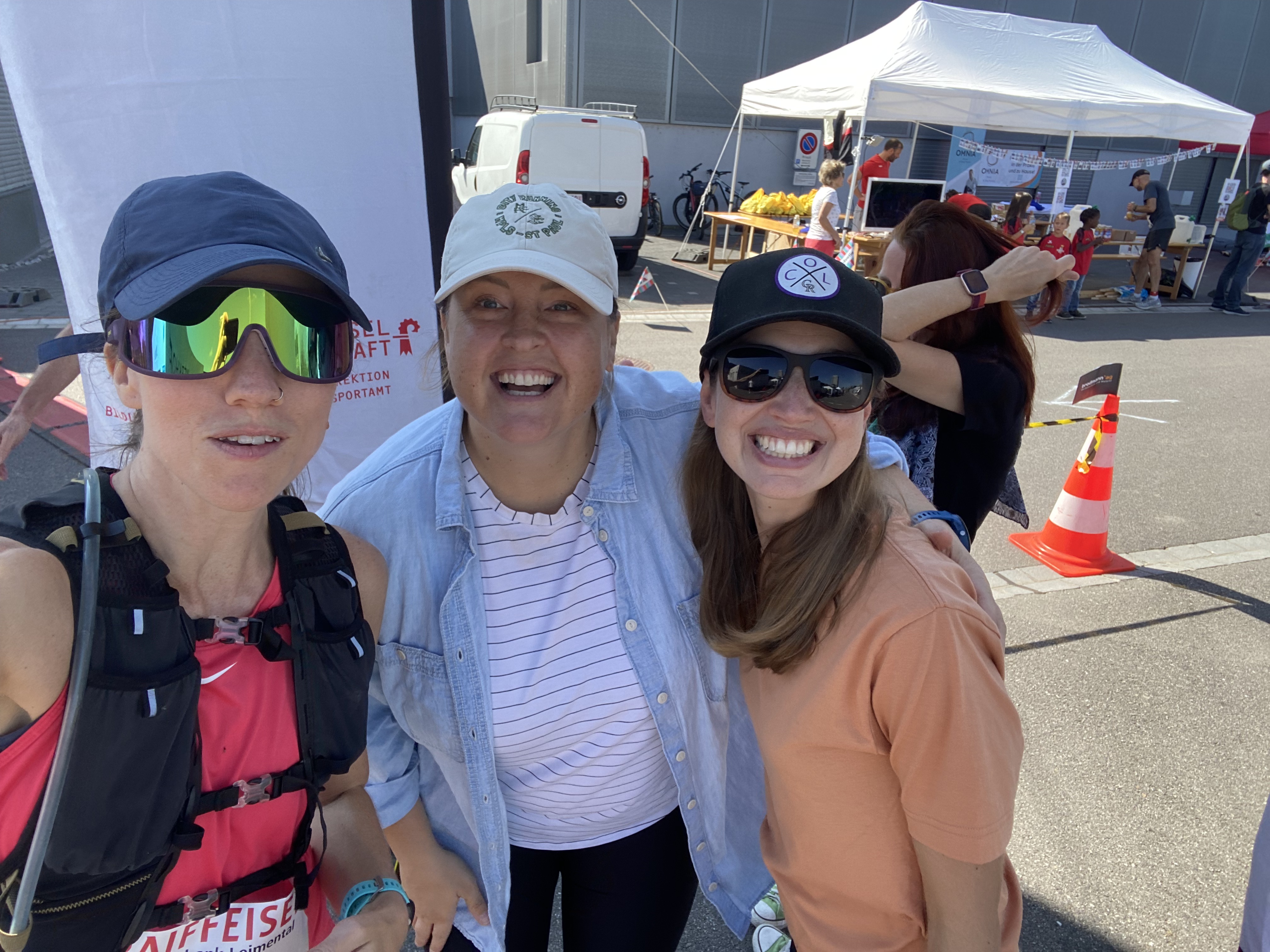
Every time we finished a lap, everyone would run around and ask, “What do you need? Can I fill your bottle? Do you want this bouillion?” Ringo and Jillian’s son took a liking to the massage gun and took it upon himself to give surprise calf massages to the runners nearby, including me. (Not gonna lie, it was pretty great.) At one point, I was receiving a massage gun massage from a child with chocolate ice cream all over his face and a melting cone in his hand. The vibes were good.
It helped that every time we finished a lap, the cheers from our friends were deafening. In addition, all the runners that had turned in their chips and were still hanging around were also there at the end. It was an ocean of support.
When I finished my tenth lap, I still felt pretty good, so I figured I’d do another two. Twelve would be a good number to stop at. The tenth lap started at 7pm, but time was fluid at this point. I really didn’t know what time it was, except that it was darker now. It could have been 10am or 8pm, I didn’t know.

When I ran in at twelve with Ringo, Amy, and Stefan, Dan and Jen suggested I keep going.
“But my feet hurt, and my left leg,” I told them.
“That’s normal,” said Jen, as if I’d told her that I turned my stove on and it was getting hot. “You’ve been on your feet all day. It’s fine.”
“But look at this bruise!” I said to them, pointing at where the anklet had turned the skin on my left shin blue.
“Chafing,” they both said. “It’s normal. You’re fine. Keep going.”
“There’s only 23 people left,” they added, “and only 6 of them are women.”
Stefan was done after 12, but Ringo and Amy were up for another. I was feeling sore, but I had juice. I still had something to give. By this point, though, eating was difficult. I forced myself to eat dates or portions of Chia Charges as I walked up the cornfield hill. Dan and John had made bouillion back at the tent, which I forced myself to sip.

It was around 10pm, and Blair had come back and Jenny was still there, as were Kelly and Michael and Jen and John. There was still a buzz.
Also, the sun had officially set during lap 10, and so I’d gotten to run with a headlamp for the past two laps. I’ve never run with a headlamp before, a point illustrated by the fact that I’d worn it upside down during the first lap and only fixed it after Blair pointed it out.
Amy, Ringo, and I lined up to start lap 13. Back on Lap 11, as we trotted out the start gate, Amy asked if I wanted to run together. Our paces had been pretty similar all day, she said, but we took our walking breaks at different times. This made me feel more invigorated, running next to someone.
On Lap 13, the three of us ran together, mostly in silence, apart from a moment to admire the most beautiful moon rise I’ve seen. The moon was orange and huge as it poked up over the hills, and looked massive behind the silos as we passed the now quiet farm. At the cornfield hill, people had cheered for us from their backyard a few laps earlier; now they were all in bed, like normal people. As we ran and turned a corner, we’d look back behind us at the other runners. It was a beautiful thing to see, this line of interspersed points of light from the headlamps, like dozens of stars bobbing in the dark behind us.
It was cooler and the air was easier to breathe. There were hundreds of stars overhead. The world was asleep. The lantern lights glowed up ahead, showing us the way.
It was after the 13th cornfield run that I did a little math in my head and realized that if we did 2 more laps, we would reach 100km. Ringo was done, he said, but Amy was up for it. This would be my final goal. 100km. Because I’ve been training since May, and if not now, when?

I told this to Dan and Jen upon return. Our support crew was thinner now. Michael and Kelly had gone home after staying out admirably long.
“Everything had been broken down, and we were breaking down,” said Kelly. “And the tram schedule.”
“We knew there would be a haul ahead of us, a 45 minute tram ride,” Michael added. Dan, Jen, and John were still sitting around the camping table making boullion on the camping stove. I felt weak and a little loopy.
Dan had started to give me a leg shakeout, where I’d lay on my now-filthy yoga mat on my back and he’d shake my legs and move them around, getting the blood flowing.
The hardest part of the race was this rest time, in the end. I never hit my 50-minute target; I was always in around 45 minutes, with 15 minutes left to spare. I’d drink some of my Tailwind electrolytes, try to eat a bite of banana or a sip or two of boullion, go to the bathroom, keep moving, and then start again. It was always the tent-to-start that was the hardest part. Mentally, I felt drained and out of it.
Dan and Jen and John had taken the tent down before our last leg. Amy and I laid on our yoga mats while Dan shook out our legs in turn. I laid on my back, looking up at a sky full of stars, my headlamp comfortably on my forehead. I have rarely felt that feeling, wanting to be done, feeling fatigued and wanting to just be done, but also wanting to touch that milestone of 100km.
Amy and I hobbled to the starting line. There were only about 15 people starting together. Four of us were women.
Amy and I kept our pace the whole way through. We were always at the front of the pack, locked in at our 6.30. Every time someone would pass us, we’d cheer or Amy would congratulate them. I felt my energy waning; Amy seemed as consistent and strong as if it was still 10am.
The 15th lap was the hardest, though there was a bit of energy there knowing that this would be our last one. Each time I ran up an incline or made a turn, I told myself, appreciate this. It’s your last one. You’re not doing this again. We ran in silence, side by side, only speaking when we wanted to walk for a few minutes. I could see my breath in a cloud in the pool of light from my headlamp.
When we turned the final corner to that last gravelly downhill, Amy said, “I think I’m gonna do one more. I have more in me.”
I did not have anything left to give, so when we returned to the start, I shakily got my things together with Dan. John was asleep in the camping chair, but Jen was also moving about with the calm delight she had since 10am. She did not seem tired at all. Jen, Dan, and I walked Amy to the start. The other girl, Sarah, had also turned her chip in alongside me (I think there were 13 people in the 15th lap), so Amy was left with one other woman.
Somehow, I drove the car home. I hobbled inside the house at around 1:45. A message came into the group, from Amy: the only remaining woman just turned her chip in, so I think I’ll do one more.
In the end, Amy ran 17 laps, 113km, and was the last woman standing. I went to bed around 2am and woke up at 6 after having slept horribly. The race was still going on: Daniel, last year’s winner, was still in along with someone called Ray. As I made breakfast and texted Jen S and Jen W, we watched the live stream and messaged each other when Daniel couldn’t finish his lap. Ray went on to win this one. They were on lap 23 or 24.

The day after, I felt rough, and while I thought I’d experience a week’s worth of soreness, I was shocked to find myself walking just fine on Tuesday. With the exception of my knees aching through Monday, everything else felt just fine. Calories and sleep were my friends the next few days. Kelly and Amy noted that they also slept poorly on Saturday night, but the next few days brought better sleep.
I’m so glad I pushed myself to 100km, and that Jen W and Dan were there to convince me I could do it (and Jen S and Kelly who reminded me that I did not have to do it). It was an incredible experience, and I know I’ll look back at those last quiet laps in the dark when Ringo, Amy, and I ran quietly together and I felt bolstered by being with them. It’s amazing what empowering company and a good head lamp can do to a run.
At 1am, if you asked me if I wanted to do an ultra again, the answer would be no. By 10am on Sunday, I was looking up other ones we could enter in the future.
Mainly, though, I’m so proud of everyone in our group. Everyone went into that Ultra not having run more than a marathon, and everyone left having run an ultra. So cool.

The Spectator Ultra – Bonus Interview
Dan and Michael spectated and supported the race and were kind enough to offer some reflections and tips for others who are hoping to spectate. We are grateful to all those who speculated, though only Dan, Michael, and Kelly are with me as I write this entry.
Question: What was your favorite part of spectating?
Dan: (“crushes can”) Feeling like a Formula 1 style pit stop. Even though 13 minutes would be a record slow F1 pit stop,
Michael: We are pushing new boundaries, the wrong way.
Dan: It was still super fun.
Michael: We enjoyed being supportive of our partners.
Dan: Little shakeouts.
Kelly: It was funny the differences in the two of you. Dan was like, ‘Why would you stop? Just keep going.’ And Michael was like, ‘Kelly, listen to your body. You don’t have to keep running.’
Michael: I was channeling my mother there.
Kelly: It was a great juxtaposition.
Michael: You’d already done 13 marathons.
Kelly: This was my 15th.
Question: What was the hardest part of spectating?
Dan: I really wish we had a grill. I was jealous of the people with the grill next to us. Cause maybe I wouldn’t have got so drunk.
Michael: It would have supported the long-term effects. I don’t think I ate anything.
Kelly: The mentality was, the food belongs to the runners.
Michael: Stefan tried to give me his meal tickets, but I thought, someone else could use this. Keeping away from getting the RPMs up to 11.
Dan: Red-lining.
Michael: We were at 9, 7. At different periods.
Kelly: In your energy levels?
Michael: Uh, consumption levels.
Dan: Fighting this subconscious need to drink a beer for every lap you ran.
Michael: In solidarity.
Dan: They’re coming! We have to finish the beer.
Michael: We needed all our hands ready. You don’t want to be the one drinking when –
Dan: – you get back and you’re like, “Salts!”
Question: What was your biggest contribution as support crew?
Michael: Making coolers lighter.
Dan: Reducing the weight that John had to roll back to the house.
Kelly: Child entertainment?
Michael: Paradoxically, I was also taking care of the children.
Dan: If we weren’t positioned directly next to the bathroom…because we also had to make pit stops.
Michael: If I’d eaten something, that would have changed everything.
Kelly: There was a restaurant right there. You could have eaten.
Michael: But you were sacrificing, so we had to sacrifice. Solidarity.
Question: Was there ever a time you thought, I should just stop?
Kelly (8 laps): Truly, when I went to the bathroom and I couldn’t pee. I realized my hydration levels were so low, I worried my kidneys were going to shut down. They actually hurt. I was going into Lap 8. I figured I’d do one more, but I think it’s bad for my body and it’s too late now to catch up with my hydration. I need to finish my final one, as my goal, which I can do. My kidneys will hang on. But I needed to stop. I need to drink. It wasn’t my legs, it wasn’t my heart, it was my kidneys. I wanted to run, I wanted to listen to my body, and I didn’t want to end up in the medic tent.
Dan (0 laps): The only time was when we were low on beers, and I realized I had been drinking all the beers. I thought, no one else is going to have a beer. I said, John, we’re gonna need that second 18. And he went home and got one!
Kelly: There were 4 drinkers left when we needed the 18.
Dan: It was 9pm.
Kelly: No, it was 11pm. And John was just drinking the warm beers. Which he said he liked.
Michael (0 laps): I was very much dipping into the cooler. (Reflecting on the question) Just stop? Just hitting the brakes? I mean, you don’t want to come down too fast.
Kelly: Like, one beer every two laps?
Michael and Dan: (nodding quietly) No, it didn’t dip that bad.
Michael: We weren’t shotgunning.
Dan: No funnels. When Nicole drove us home, that’s when I realized I left it all on the field. As I sat in the passenger seat, I knew I gave it all I had.


Categories: Switzerland
 Lost Among Latitudes