On Tuesday, Kelly and I ran in the morning and we all enjoyed coffee until a little after 10, when we caught the bus into town. Our plans for the day involved “getting lost in Bergen”, as recommended by our Lonely Planet, checking out some breweries, and dining on Norwegian cuisine at a restaurant that came highly rated.
I imagined hours of wandering through colorful houses and meandering alleyways and sipping beers on the harbor. My imaginings were not too far off.
We took the bus to Loddefjord, the bus hub, and then transferred to the number 3 bus into town. The bus dropped us off in front of a beautiful park with a gazebo decked out in pink and white flowers. We wandered a short way from the stop towards the harbor, where we glimpsed Bergen’s famous colorful buildings, now a UNESCO World Heritage site.

The area is known as Bryggen, which sounds rather exotic until you learn it’s the Norwegian word for “dock” (although my Lonely Planet argues it is the word for “wharf”, and Google Translate concurs). According to Wikipedia, the area is also sometimes known as Tyskebryggen, meaning “German dock”, and I appreciate the very literal and helpful nomenclature here. I imagined sailors arriving in medieval Bryggen and not having to sift through a list of arbitrary names and places to ask where the German dock was.
A cursory research of the area tells me that the 58 buildings were constructed sometime after 1350 and used to store stockfish, Norway’s specialty, and cereal. Then they burned down in 1702, were rebuilt, and then many burned down again around 1754. And then again in 1955. In fact, the Lonely Planet notes that fire “has destroyed Bryggen at least seven times.” What a resilient place, to keep rebuilding and preserving its 12th century architecture.
Some locals eventually petitioned to get rid of Bryggen and proposed some kind of fancy new harborside aesthetic, to which others responded with an even more popular proposal to preserve Bryggen, making it a UNESCO World Heritage site in 1979. We are grateful to these folks, as stepping foot on the promenade along the colorful wharf was a real joy. Additionally, the Lonely Planet claims that “Bryggen is actually sinking by an estimated 8mm each year”, which adds an extra layer of gratitude for getting to explore it.
We expected old, historic buildings, so we were surprised to see “Radisson Blu” painted on several of them. This was the juxtaposition: the buildings were, themselves, quite old, with the wood creaking and bending and the architecture reminiscent of ancient times, but the interior shops sold expensive and chic winterwear rather than many hundred tons of stockfish. (Fun sidenote: according to Lonely Planet, the “tilt of the structures was caused in 1944, when a Dutch munitions ship exploded in the harbour, blowing off the roofs and shifting the pilings”.)

My Lonely Planet described Bryggen as “enchanting”, but warned about the misfortune of timing your visit to coincide with a cruise ship docking. The four of us were lucky to not encounter massive throngs of cruise passengers, and only spotted one or two large cruise ships the entire time we were in Norway. Shoulder season can be a pain, but it also has its perks, and this was for sure one of them.
Eager to “get lost” in the alleyways, we ducked down one and enjoyed a narrow journey through cramped and crooked wood structures before emerging behind the buildings, definitely not lost. Still, it was beautiful and we were surprised that the alleyways wound so far behind the structures facing the harbor. We spent some time exploring a church before ducking into Folk & Røvere for an afternoon libation. The vibe in here was quirky and bright, with locals sipping beers or chatting up the bartender while a playlist ran through covers of golden oldies.
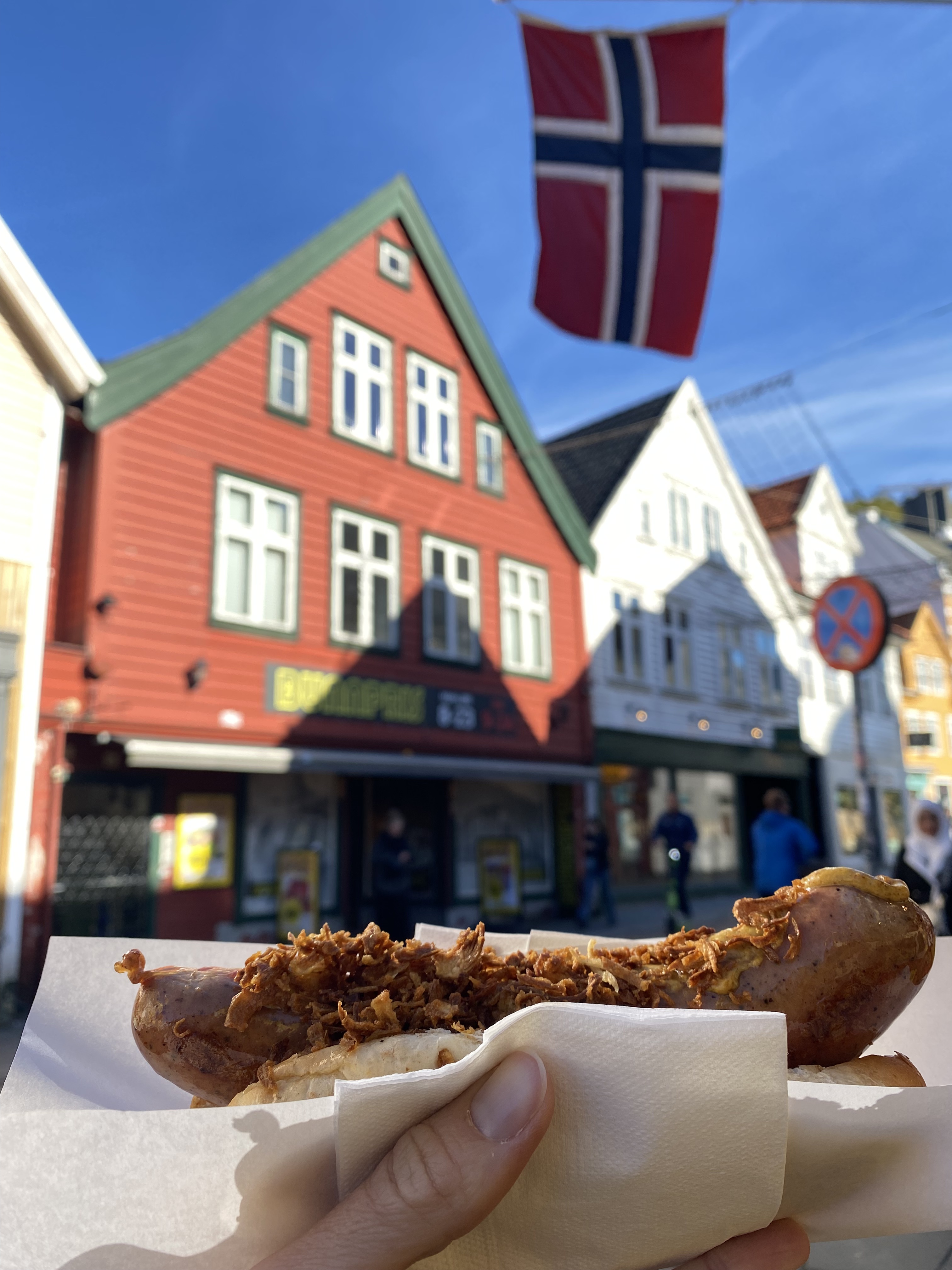
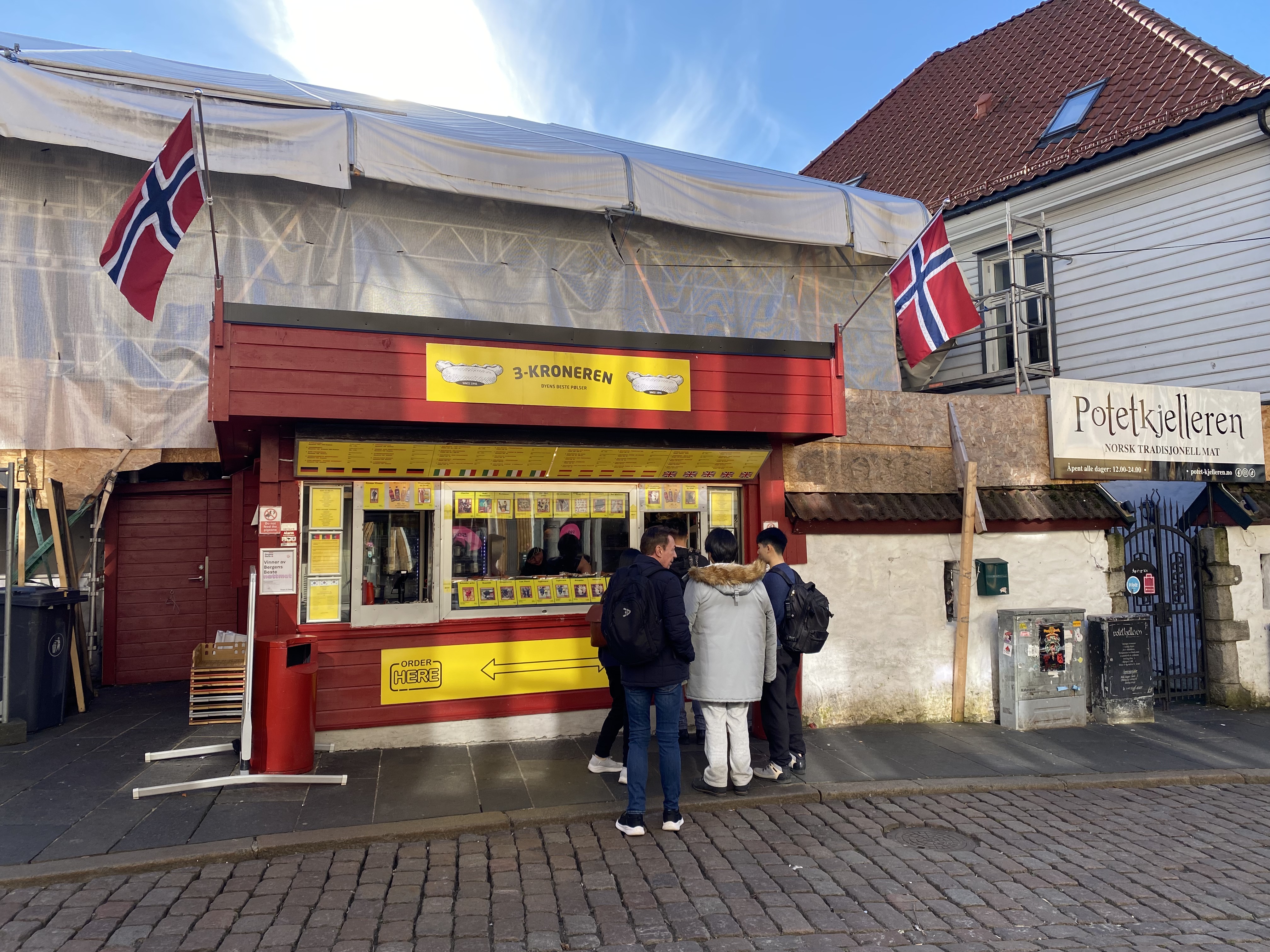
Unfortunately, they didn’t serve food, so we made our way to a stand we’d passed earlier. Unassuming but also listed in my Lonely Planet, the Pølse Kiosk offered “real sausages, including wild game, reindeer, lamb and chilli”, and so we snagged a few of those. The reindeer sausage came topped with fried onions and lingonberry sauce, and pigeons flocked around our feet as we stood across the street in a pool of sunlight to eat.

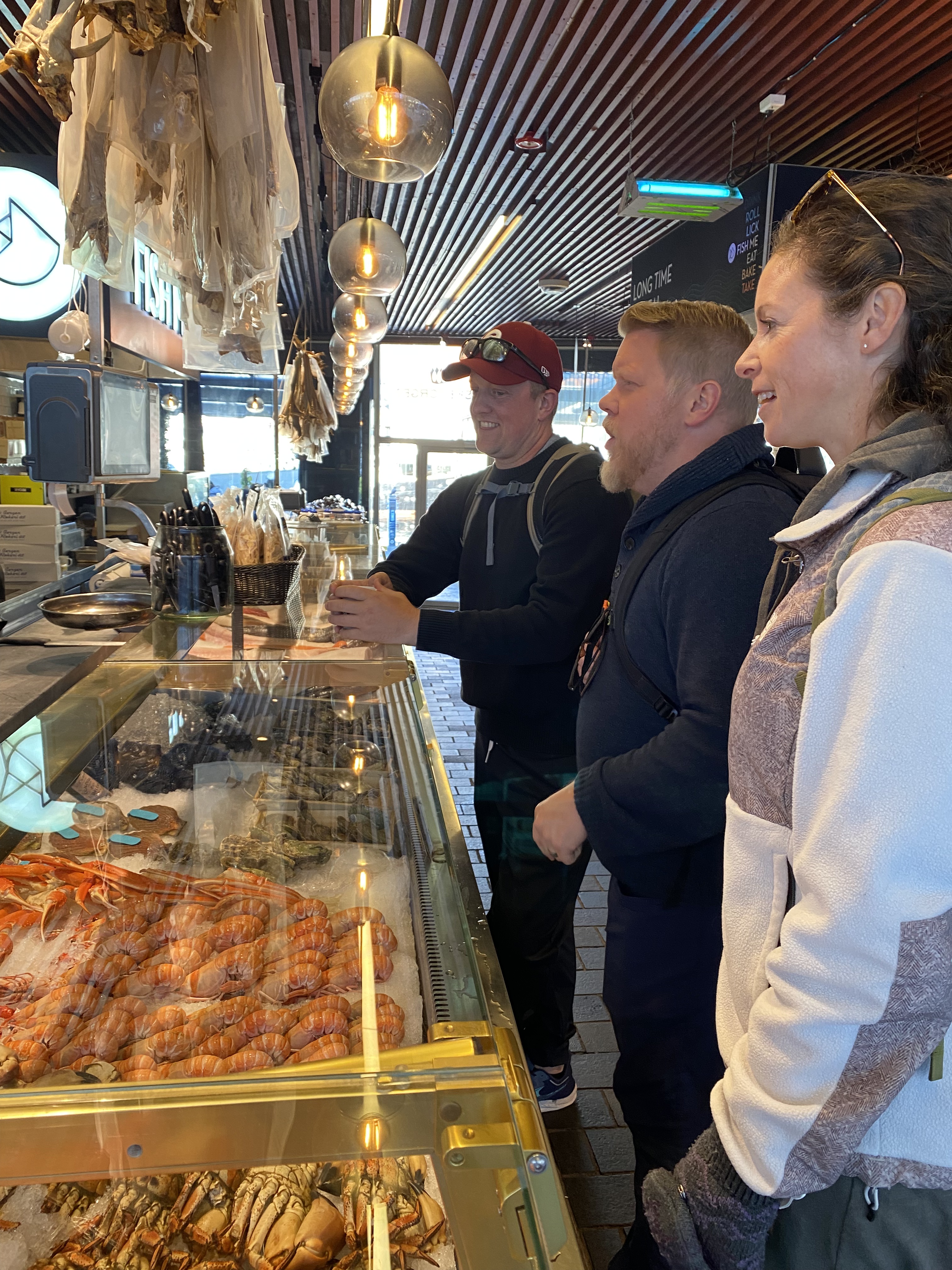
We wandered the wharfside again, making our way past the Torget Fish Market, where we expected something a lot more bustling and fishy – “I was expecting Pike Place,” said Kelly – but instead found a rather orderly maze of display cases and sad king crabs trapped in small tanks.
“Feel free to walk around and look,” said a helpful woman nearby. This we did, until somehow ending up at a counter top filled with shrimp and prawns resting on ice.
“I was standing there with my nose against the glass looking at a lobster,” said Dan, “when Michael called down to me, ‘Dan! Get down here. This guy used to live in Mexico City!'”
Dan, Kelly, and Michael struck up a conversation with Alex, the fisherman, chatting in and out of Spanish before we decided it was best to move along since we weren’t actually buying anything. We continued down the road and up a hillside that offered some views of the harbor from a different angle.
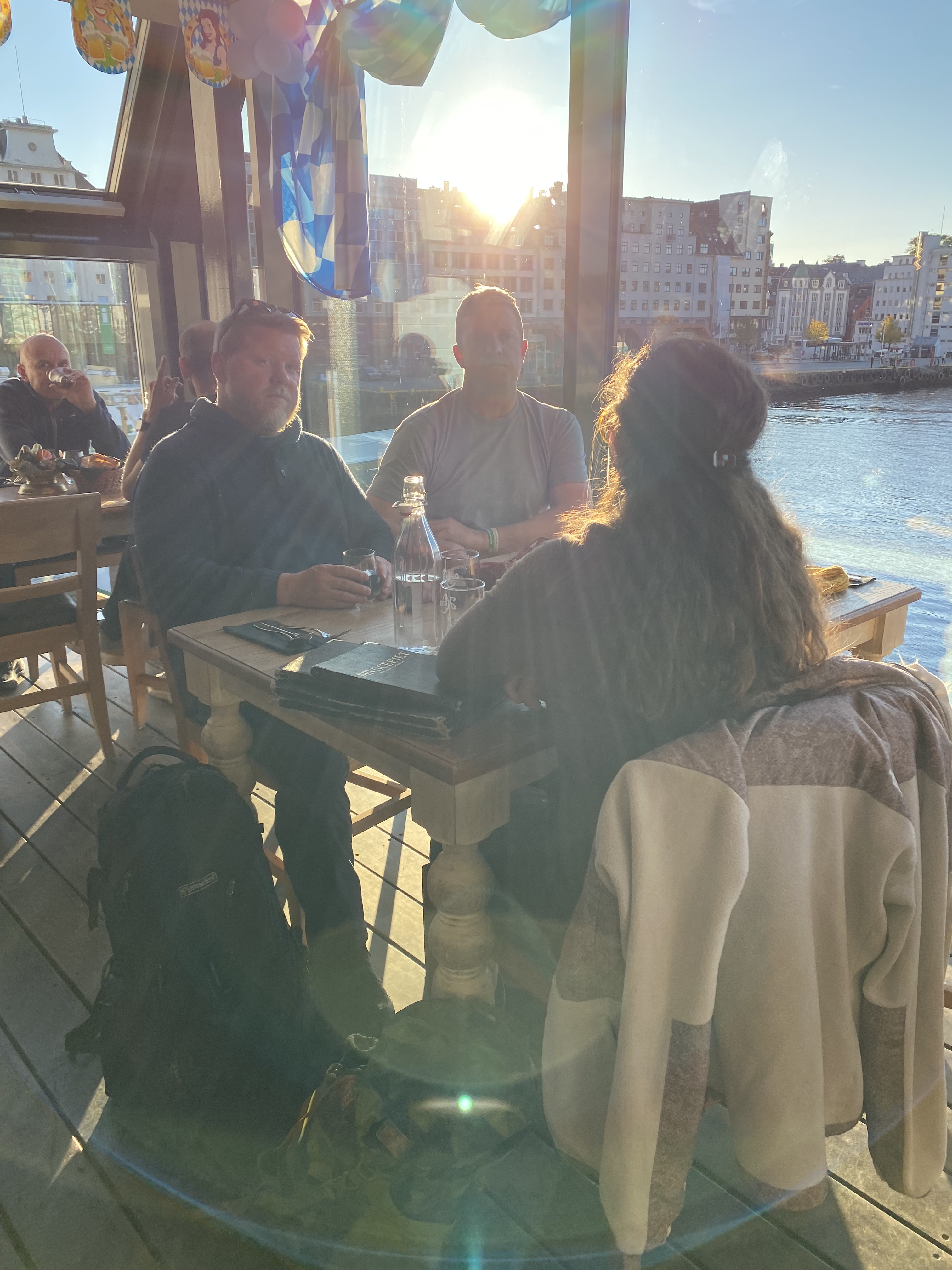
We had some time to spare before dinner, so we returned to the wharf where a brewery – named, with Bergen’s characteristic literal flair, “The Brewery” – offered “creative, interesting beers” and an enviable view of the harbor through floor-to-ceiling windows. Bryggeriet had just opened as we walked through the door, and a friendly woman greeted us.
“Sit where you like,” she said, before adding, “We’re done with all of our craft beers for the season, but we still have a few on tap.”
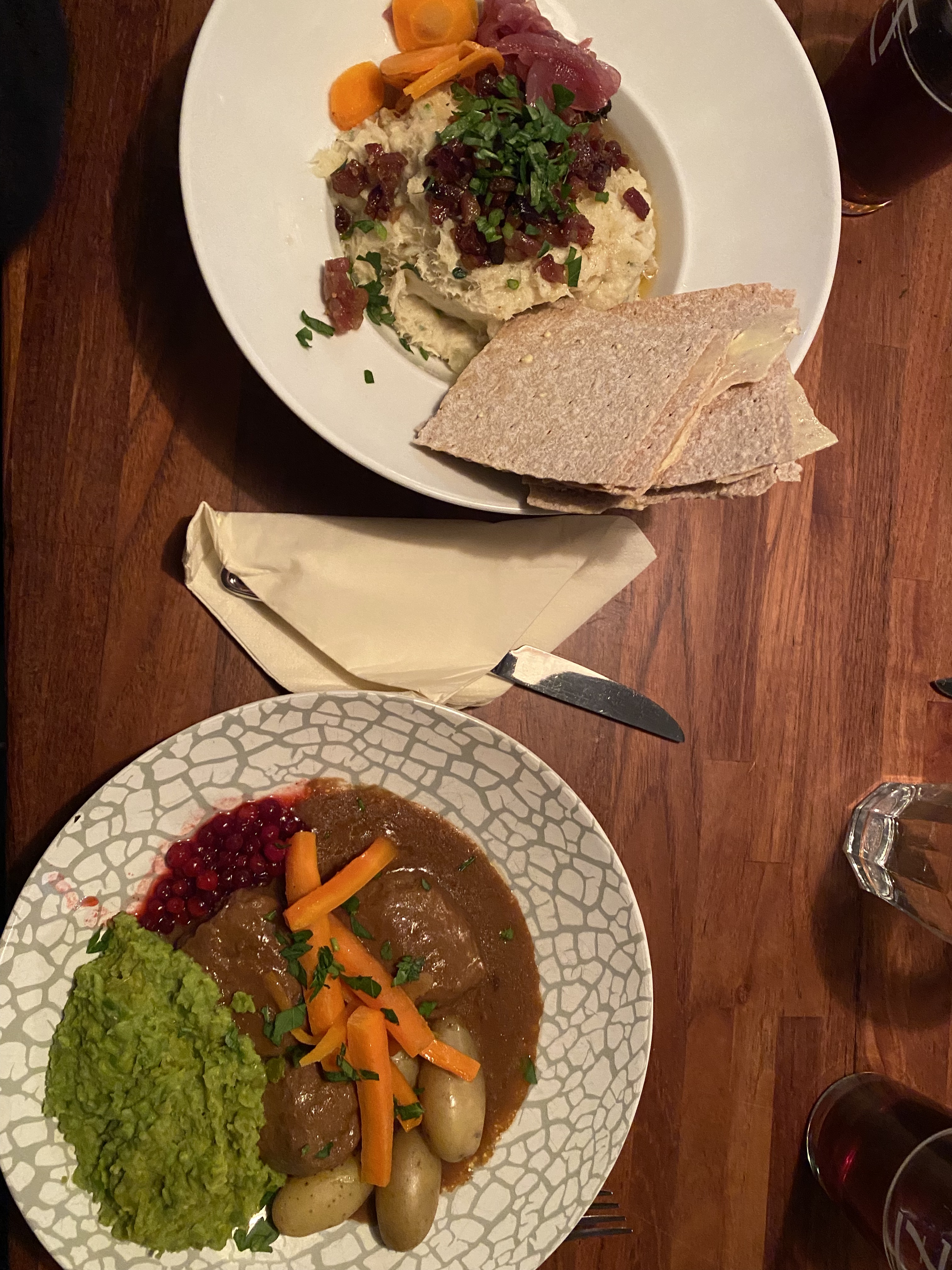
We enjoyed a few at our table by the water, watching the sun slowly sink down in the sky, coloring the Bryggen storefronts in an orange glow. For dinner, we set off back into town in search of Pingvinen, a Norwegian restaurant described by my Lonely Planet as “the old favorite of everyone in Bergen. They come for meals their mothers and grandparents used to cook.” It was a cozy little place with delicious options on the menu with prices that didn’t break the bank. We ordered crisp beers and reindeer meatballs and a mashed cod dish that tasted a bit like a brandade.

Interestingly, Lonely Planet points out that this restaurant also serves whale, which they seem to note for all restaurants that…serve whale. The moment we sat down, our waitress told us that they were out of whale today because they’d served minke whale yesterday and all the locals had devoured it. (Not in those words.)
The notion of eating whale was one that we talked about a little on our trip. None of us ate whale the entire time we were in Norway, but it was interesting to note which restaurants served it and I wonder if there is a large cohort of people who would refuse to eat at Pingvinen or other places because they serve whale on the menu.
A quick Google search of minke whales lists them as “least concern” in terms of risk of endangerment, but the reason for this is because they were “less depleted by commercial whaling than other baleen whale species.” So maybe they’re not of concern now, but if this is the whale that’s most commonly killed for meat these days, does that mean they’re next?
We left Pingvinen feeling warm and full and happy, and headed back to our AirBnB for a good night’s sleep.
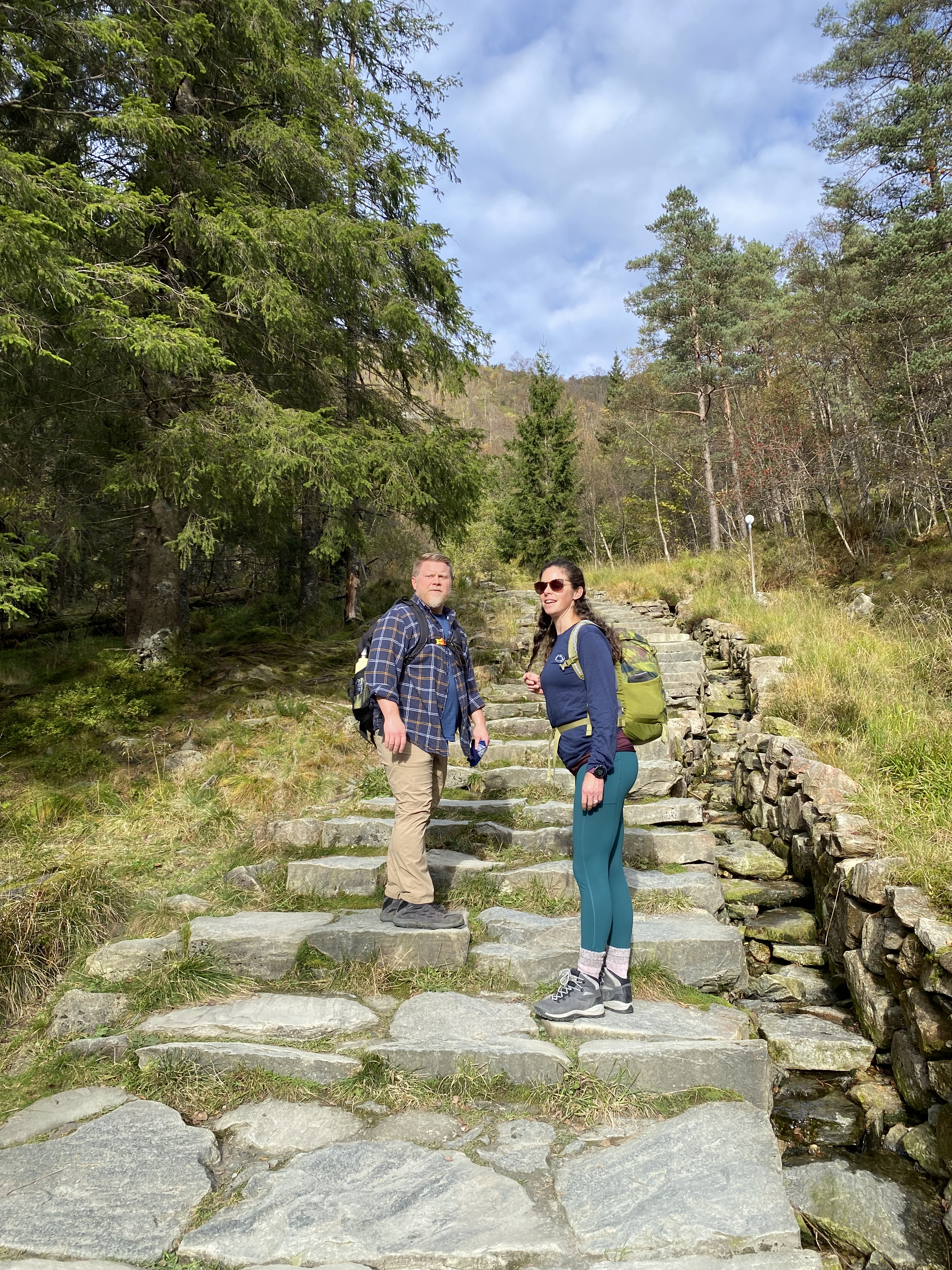
The following morning, Kelly suggested we try a hike she’d read about, from Ulriken around to Mount Fløyen. Based on her research, triangulated by some research in Outdoor Active on my part, the hike looked like it would be between 12-13km. Our main ascent, we reasoned, would be the approximately 1300 steps leading from a neighborhood up to Ulriken. Known as the Sherpa Steps because they were constructed by Nepalese Sherpas, the steps promise a quicker ascent up to Ulriken, unless you’re hopping in the cable car instead. The website for the steps notes that there are benches available so you can stop and take in the view, but that you will also spy local Norwegians out there running up the steps.
All of this was accurate. But first, we had to get there.
From our AirBnB, we caught a bus to Loddefjord, then the Number 3 bus into town. From there, we had a 15-minute wait for a bus that would take us to a place called Montana, something like a 40-minute ride from where we were. This was time to pop into a nearby bakery, where Kelly and I grabbed coffees to go before she and Michael pointed out a bakery called BIT, where employees were hand-rolling and twisting dough around their fingers into beautiful, cinnamon-filled nests of pastry joy.

Mouths watering, we decided to order two of their cinnamon rolls, named kanelbolle, for the hike. As I ordered them, the cashier said, “That’s 120 kronor, but if you get four of them, it’s 149 kronor.” I had to get him to repeat this amazing deal before asking which other two he recommended. I ended up walking away with two cinnamon rolls, one vanilla roll, and one cardamom roll. In addition to the sandwiches we’d made that morning and some other tasty treats Kelly and Michael packed – including beers – we were ready for our hike.
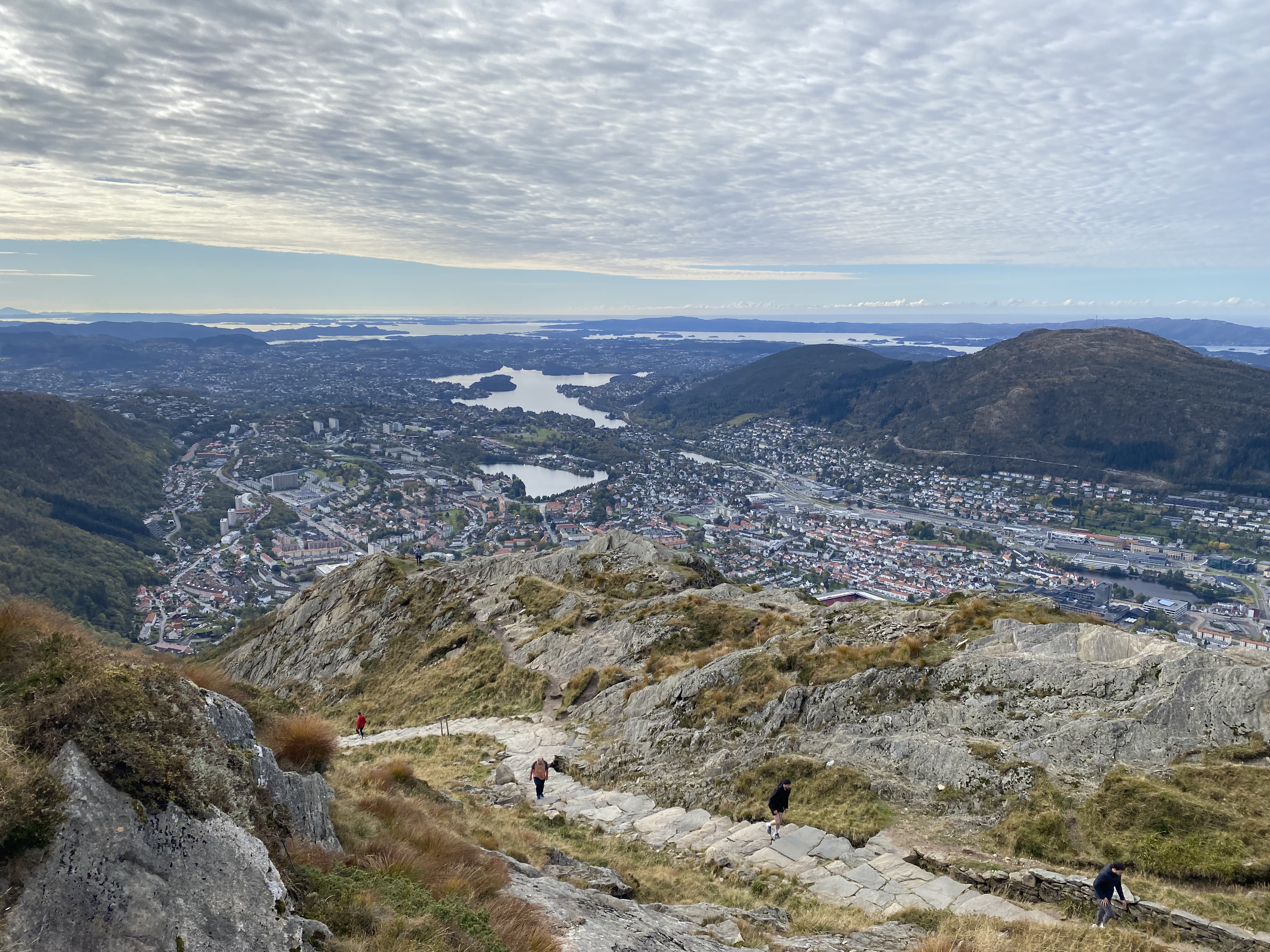
We arrived in Montana around 12/12:30 and immediately began the climb upward. The sky was blue, the air was crisp, and halfway up the steps, I found myself removing my flannel and finishing the hike up in just a T-shirt. At the top, we celebrated our achievement: we’d made it to Ulriken and gained jawdropping views of Bergen’s harbors and fjords extending out to the ocean to the west. It was stunning.
We celebrated by cracking open some beers and eating our sandwiches on some wooden benches carved out behind the more expensive restaurant at the top of the mountain. To our right, Dan pointed out another tower.
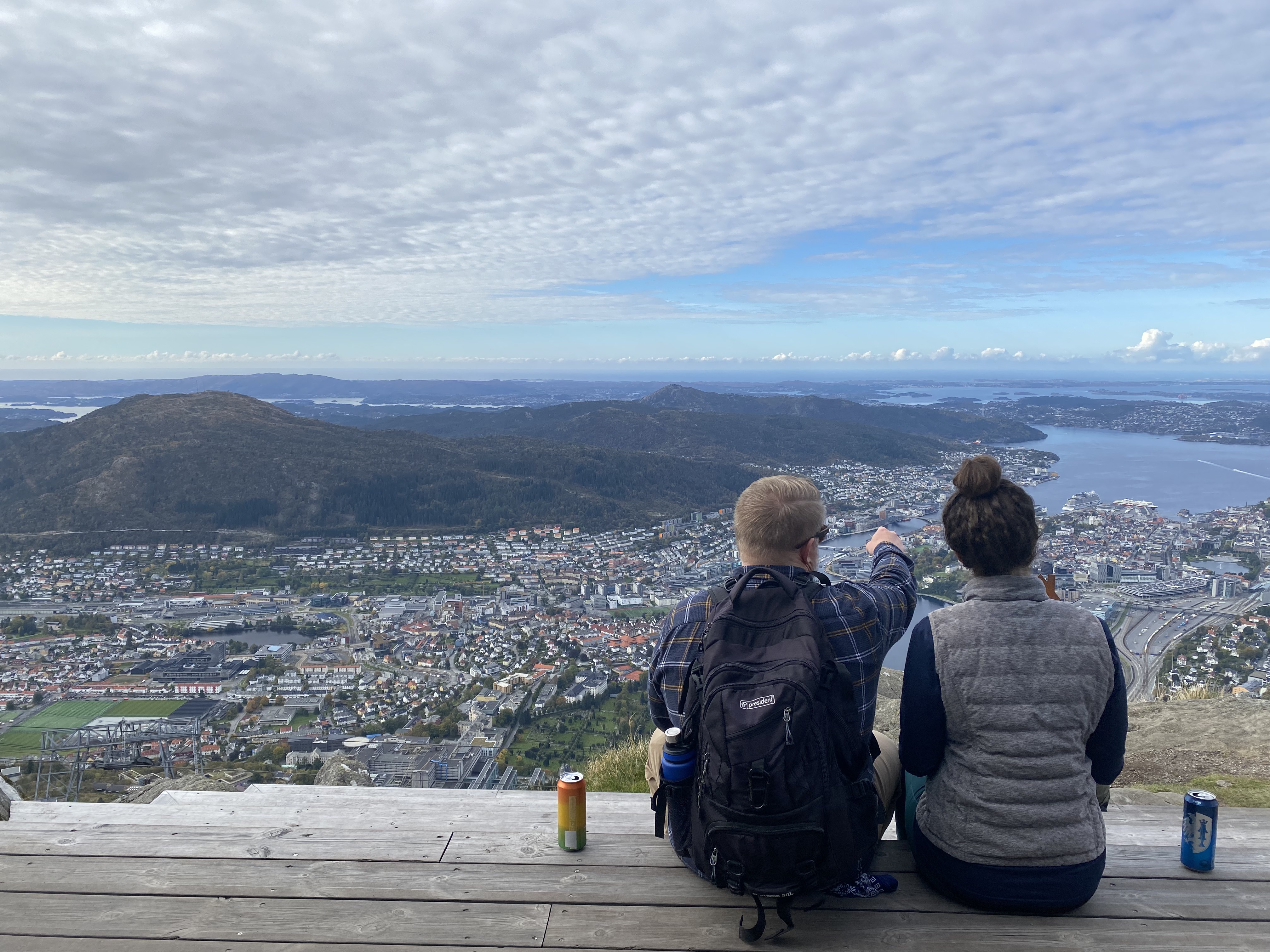
“That’s where we’re going,” he said. “We’ll probably hike down along that ridge near the reservoir and then up a short way to the top.”
This seemed reasonable and beautiful. By this point, we knew we’d finished one kilometer and should have about 12 or 13 left to go. We began our descent around the back of Ulriken, where we came to a cluster of signs pointing this way and that. One pointed toward Fløyen and advertised a distance of 14km.
“Well that’s weird,” we said, but carried on anyway. Kelly was using All Trails and I had Outdoor Active, and both seemed to confirm we were on the right track. The path, if you could call it that, was loose gravel and rocks, with large boulders to clamber over that climbers over a very consistently rolling landscape. You’d clamber up some rocks, then see a large cairn at the top and head straight back down again. As we progressed, we wondered if this was the hike we’d signed up for. For one thing, it was leading us away from Mount Fløyen, which was rather disheartening. For another, every time we reached a new sign advertising our direction, by some cruel magic, the distance to our destination had not shrunk but had grown.
We’d hit an intersection advertising 11 more kilometers to Fløyen, follow the path, and arrive at our next sign, which would advertise 11.8 more kilometers. How this was possible was a real mystery. Perhaps there was some Norwegian troll magic at play here.
The landscape was unearthly, lunar, and absolutely marvellous. Mossy stones, mountain lakes, glimpses of white glaciers on faraway mountain tops. As is the way with hikes like this, the more gorgeous the view, the more strenuous the climb. Dan leapt spryly from rock to rock like a child given free roam of a massive outdoor play area. The path was his playground. Michael and Kelly followed along at a brisk clip while I clambered slowly down, rolling my ankles every fourth step. Downhills are tough for me for some reason, and about a third of the way through the hike, my knee started screaming in pain, so I got even slower.

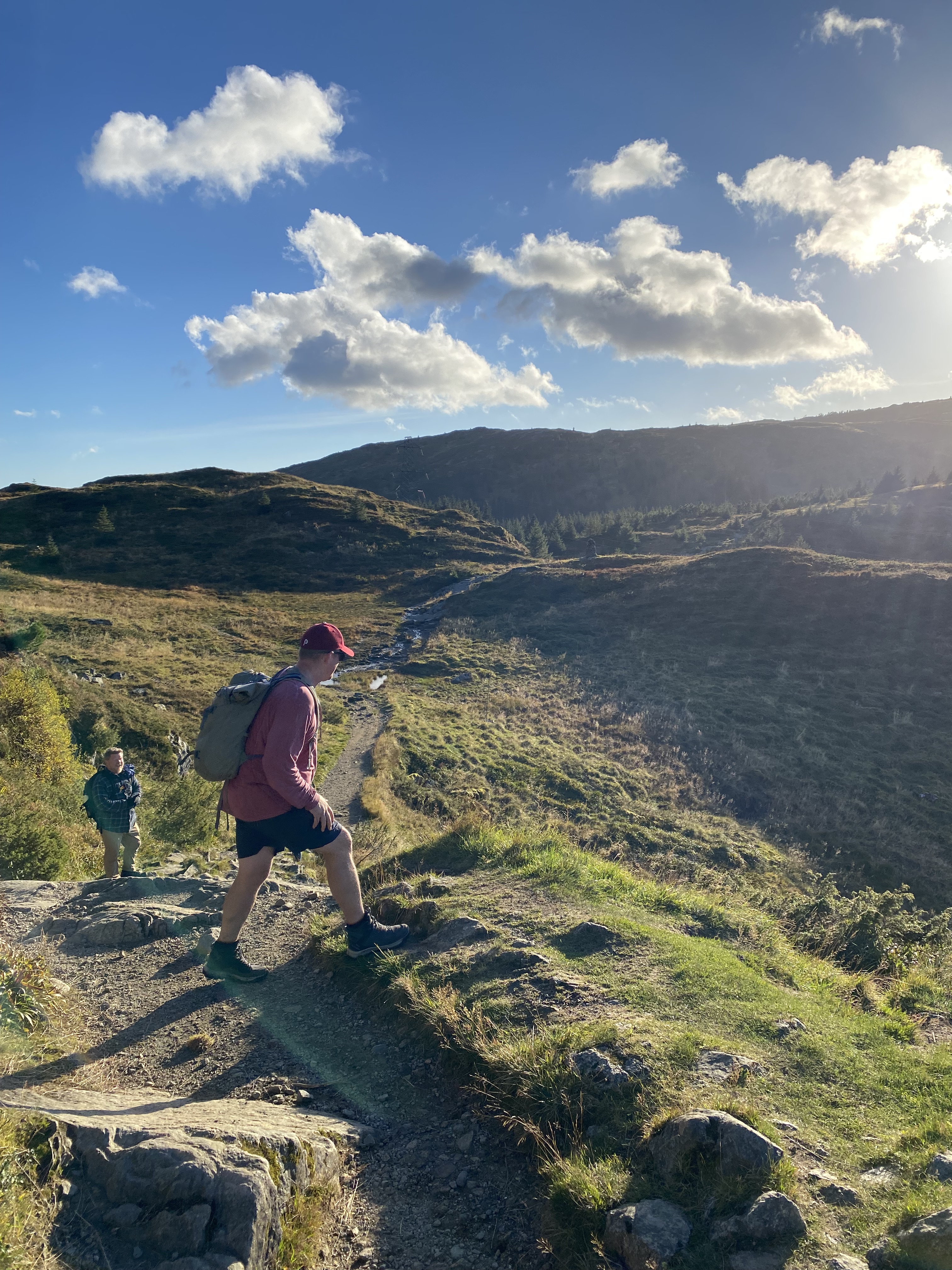
Even so, every time I looked up, there was beauty to behold.
By the time the path started snaking back toward Fløyen, the sun was dipping in the sky and the wind was getting colder. We’d started off around 12:30 from the sherpa steps and departed Ulriken around 1:30. My app and Kelly’s research claimed that one could complete this hike in 3 hours and 55 minutes. In the end, it took us about 5 hours.
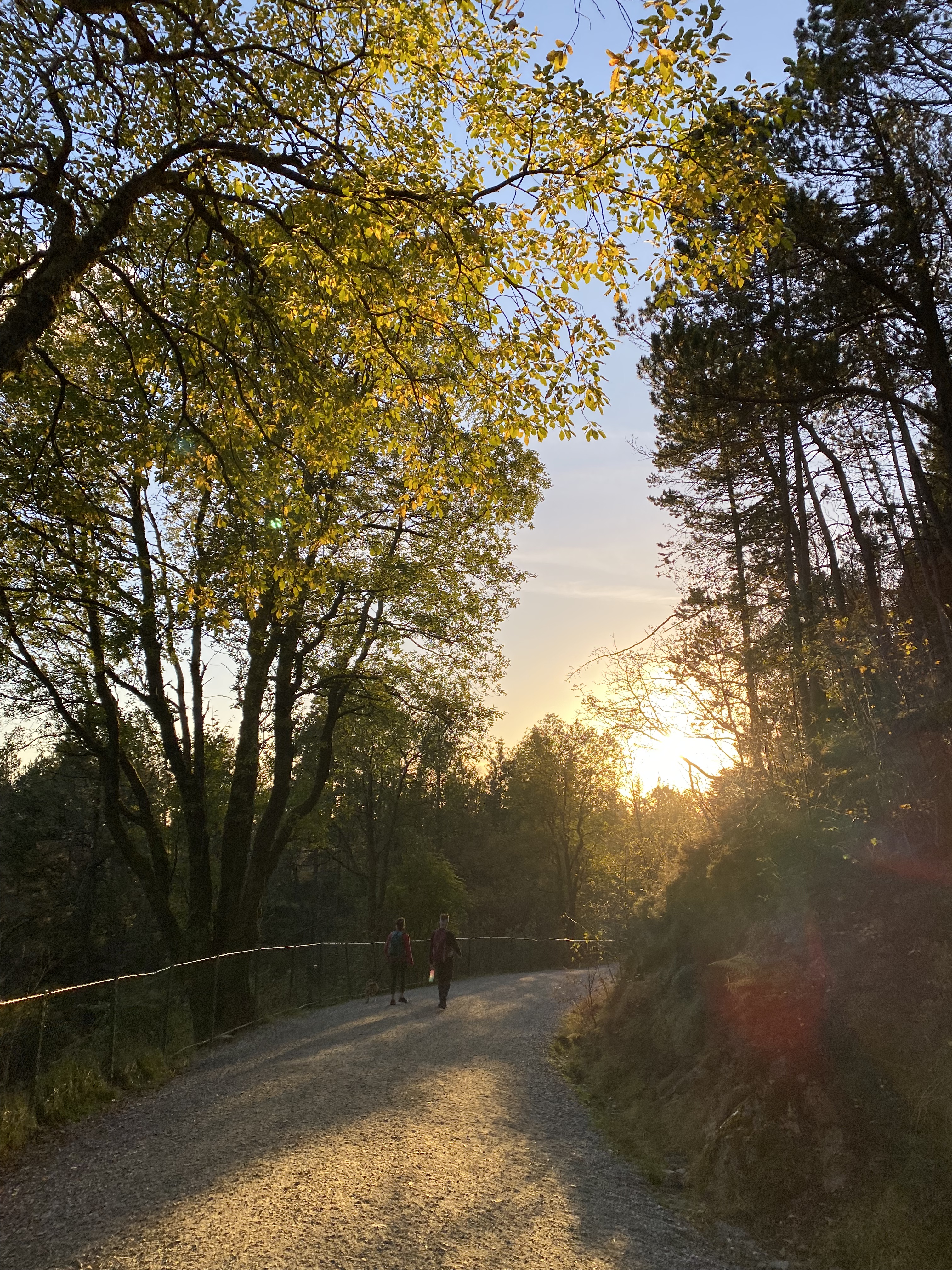
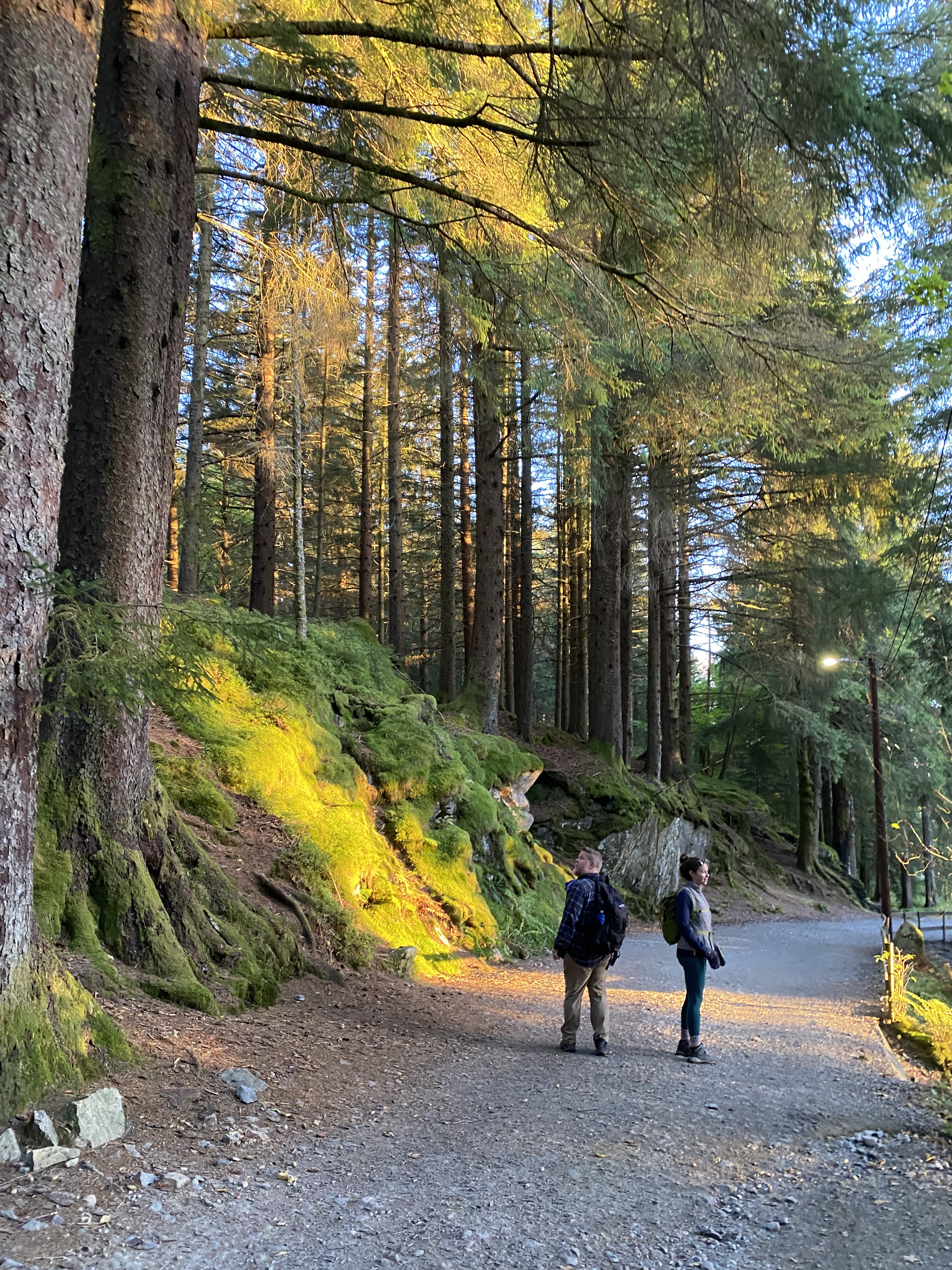
Fortunately, the sun was still out, and when we peaked above Fløyen, the rock scramble finally turned into springy dirt and gravel and I could keep up with my friends again. There was a 3-5 kilometer walk to the funicular station, give or take, but our timing was perfect. The late afternoon sun was streaming through tall trees like dozens of gold waterfalls pouring over the forest and the path. It was absolutely beautiful.
After hitting a sign that advertised we had 3km left to go, we rejoiced! And then hit the next sign, a short ways away, pointing right and advertising 4.2 kilometers. Throughout the entire hike, we really had no solid idea of how much longer we’d be out there, but single digits and lots of people on the paths were both reassuring.


Equally reassuring, inspiring, and somewhat embarrassingly for me, was the amount of trail runners out there. As I crawled over the rocks, they’d spring down the mountain behind me like speedy goats, leaping from rock to rock. It was really incredible watching them go. Maybe for them the trail was 3 hours and 55 minutes.
We finally arrived at our destination, the funicular, where a crowd had gathered on a viewing platform overlooking Bergen and a gorgeous afternoon sunset. It may have taken us 5 long hours to get here, but if we’d done it faster, we would have missed seeing the wharf in the dazzling October sunlight. We took in the view, then walked – or, if it was me, limped – to the funicular, which we took down the mountain back into town.

A 13-minute walk to Royal Gourmetburger og Gin, our dinner choice, sounded extremely far on tired legs, but we hoofed it anyway, certain that at least Google Maps would not be adding mystery kilometers to our journey.
What a find this place was. I’d seen it in Lonely Planet and they had free tables when I called, and it was perfect. Reasonably priced, warm, and dimly lit, the restaurant offered a range of burgers and several frosty beers on tap, perfect for a post-hike meal.
Kelly and I went up to the bar to order from a friendly bartender. We told her how we’d completed the hike, and she perked up.
“Oh yeah, they do a marathon up there every year. The 7 mountains marathon,” she told us. “A lot of us are up there training throughout the week.”
As she poured our beers – from a brewery called 7 Fjell, with their on-tap draft called Ulriken after the mountain we’d climbed – she told us how she had also run that marathon and typically ran up to Fløyen every day of the week. As one does.
Kelly reasoned that we’d probably hit 2-3 of the 7 mountains, and now that I’m comfortably in front of a laptop, I think I can confirm that. A quick perusal of Visit Norway puts our hike into a much clearer perspective. The 15km hike is a popular one, taking us across 3 of the mountains, and the estimated time for completion on the website is a more reasonable 5 hours, though there’s a disclaimer about improper hiking shoes tacking on an extra few hours to that time.
We cheersed our tasty draft beers, or fatøl in Norwegian, and laughed at our past selves celebrating what we thought was the climax of our hike back at Ulriken. The burgers tasted divine and the beer restorative, and we nailed our bus times, getting back to the AirBnB with plenty of time for a post-hike dip in our hot tub to repair our achy muscles and take advantage, one last time, of the beautiful perks of our AirBnB.

Categories: Norway
 Lost Among Latitudes