You’ll want to grab a coffee or a beer for this one, because it’s a wild ride.
We landed in Oslo at 4:30pm but didn’t make it to our hotel until something like 8pm. Even as I write this, I don’t remember how it took so long, but we arrived at the 4-star Karl Johan Hotel a little bedraggled and in need of food.
Dan and Michael gave their names at the check-in to two slightly frowning concierges.
“Are you sure you’re staying with us?” asked the woman.
“I don’t think this is the right hotel,” cut in the man with a simpering smile. “Maybe you’re staying at the Clarion?”
I was so plane-tired that I was half-heartedly paying attention to all of this, but it became a running joke with us the last few days of the trip.
“Is there a dress code or something? Do we really look that bad?” Michael wondered. Then he’d say, in a snooty voice, “Oh, maybe you’re staying at the Radisson.”
“They could have gone about it in a different way,” he pointed out. “Like, ask if we have a reservation under a different name. Say, Could the reservation be under someone else’s name? Don’t just assume we got it wrong.”
“Do you have a confirmation number or email?” asked the woman in a voice that sounded like she was certain we did not. But it was at this point that I snapped awake, because I’d been the one getting all of the emails from Karl Johan, even if Dan had paid.
“Oh!” I said. “The reservation is under my name. Sorry.”
And so, we crossed the mahogany threshold into the posh and historied hallways of the Karl Johan Hotel. Our rooms were small but comfortable, with nice showers. The best part was that the hotel was centrally located, and so we exited and made our way to dinner at a restaurant Kelly had found called Den Glade Gris. The place was small and cozy and warm, and the entire interior was packed with little porcelain pig figurines and pig posters and large pigs dancing in aprons.
The menu was also mostly pig. We began by ordering beers, which tasted delightful after our long travels, and then we perused the menu. A colorful bubble declared, “Vegetarian? Ask your server!”
When a man appeared at our table a few moments later and briskly asked what we wanted, I said, “What’s your vegetarian dish?”
Without hesitating, he replied, “Fake pork and beans.” I’ve never heard of fake pork before, so I ordered the baked cod instead while everyone else ordered their meals. The man was giving owner vibes, and after each order, he’d nod once and look at the next person, creating an atmosphere of quick.
Once he’d gone, I said, “Fake pork? Do you think that was a joke?”
“Maybe, actually,” said Kelly. “This is a pork restaurant, so maybe they don’t serve vegetarian?”
I wondered what would have happened if I’d ordered it. Would they have told me they were kidding, or would they have just served me regular pork, which seemed like some kind of violation of integrity or health or personal beliefs. It didn’t matter, though. The cod was very tasty, and despite feeling exhausted, I joined everyone at a jazz bar next to our hotel where I ordered some kind of paloma cocktail and then went to bed.
On our only full day in Oslo, Kelly and I woke up and went for a run. Oslo’s sidewalks may host a runner or two, but most people we passed were blissfully unaware of us and at one point, I daringly jumped off the sidewalk to avoid someone and nearly got hit by a tram. Whoops.

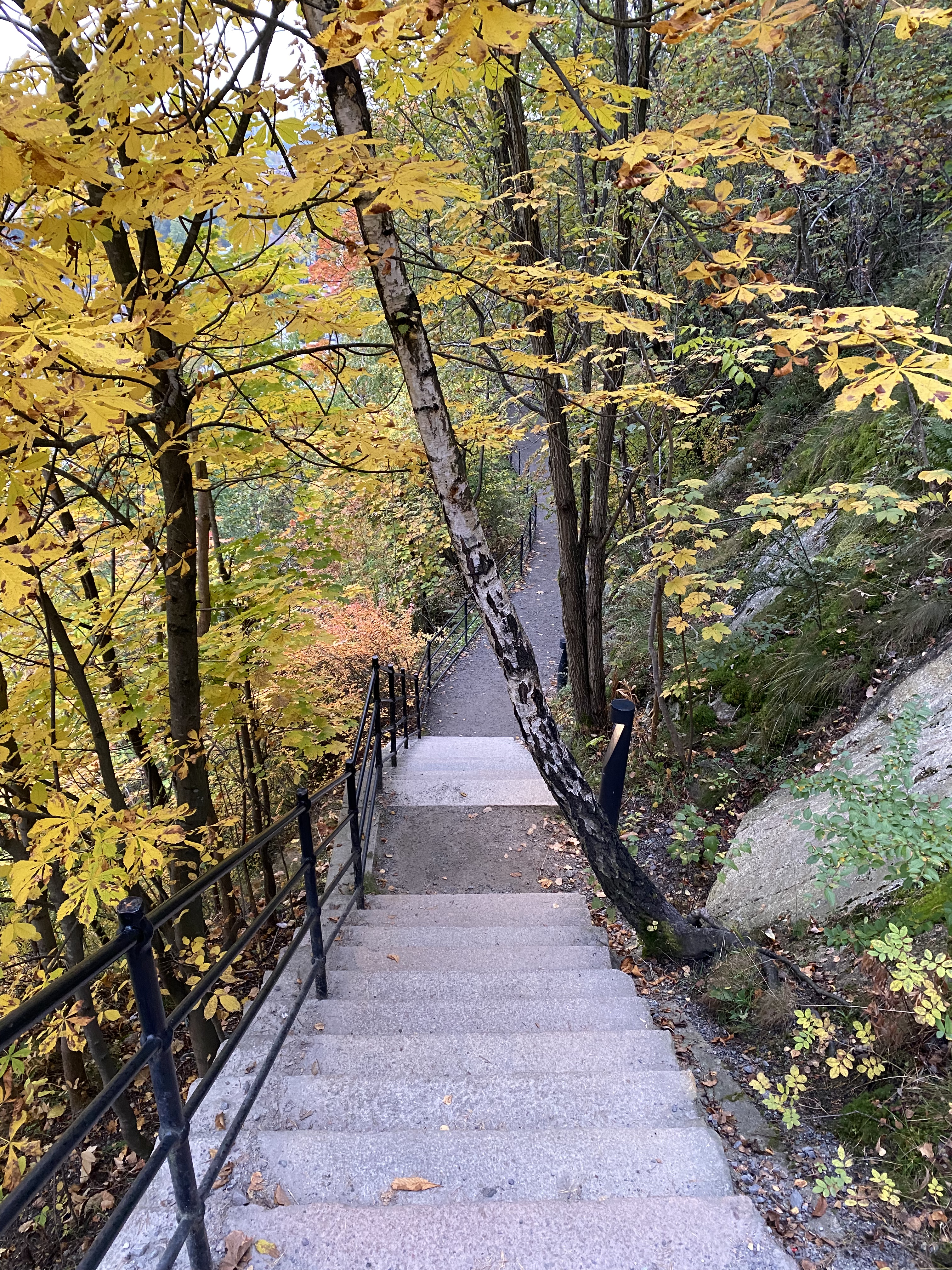
Our destination was a nearby sculpture park called Ekebergparken, which required three sets of stairs and a long, winding path to climb in order to gain access to these cool sculptures. The path was leaf-strewn and autumnal, and while I struggled to catch my breath, I appreciated the smell of dying leaves in my nostrils and a fairly expansive view of Oslo’s fjord between the trees. In the harbor, Kelly and I noticed what looked like a sinking ship, but we assumed it was more art.
The sculpture park is worth exploring. We only managed to get a short way in, past some beautiful lights strung up in the trees to our end point, a statue named “Walking Woman”, before turning around to head back. We’d only wanted to do 5k, and we also wanted to get the most out of our hotel’s breakfast buffet, which ended at 10.
We got down there at 9am and did our very best to sample everything. We’d enjoyed making breakfast for ourselves the past week or so, but there’s something about being served a wide range of food and unlimited coffee on dishes you do not have to wash yourself.
We shut down the breakfast buffet, squeezing ourselves out of our booth around 10:30, fully caffeinated and stuffed. There had been fruit – and passionfruit, a tropical surprise! – and Norway’s brown cheese and waffles you could pour yourself into a heart-shaped waffle maker, and jams and eggs and omelettes and breads and vitamin shots and smoothies you could enjoy to your heart’s content.
Our hearts were very content as we gathered in the lobby to take on Oslo. Our goal was to see as much of the city as we could, with the crown jewel on our itinerary being the Fram museum, which closed at 5pm. We decided to purchase the Oslo Pass, which you can do through an app. For a little over 500 Norwegian Kronor, something upwards of 50 USD, you are entitled to free transportation around Oslo – including ferries! – as well as free admission into several museums. There was also a list of bars and restaurants that offered discounts on food and drinks. We were sold.
We took the tram out of town to Vigeland Sculpture Park, Norway’s more famous sculpture park, which we’d viewed in a Rick Steves documentary a few nights before, after we’d finished watching Frozen. Michael had been to the park on a previous visit and highly recommended it, so he led us to the end of the tram line where we emerged at the entrance to a large and beautiful cemetery.

Accessing the park by way of the cemetery was actually quite fitting. It was quiet and autumnal. Two deer rested in the shade beneath a tree on the opposite side of our path. The gravestones were a mixture of rough stone or carved with little spaces for lanterns. Almost all of the graves had small squares of soil in front of them where people seemed to maintain small gardens for the deceased. This was lovely. Pink flowers – calluna or ling, apparently – blossomed in bunches in front of many graves. Some had small trees at various stages of growth. At the corner of every stretch of gravestones stood several watering cans and a water spigot. There was a sense that this was a place frequently visited and tended to.
One grave had a massive pile of larger flowers strewn on top of it. Each bunch of flowers was tied together with a thick satin ribbon bearing the names of family members. Kelly walked over to it and announced that the person had passed away on September 25, less than ten days earlier. It was a beautiful sight to behold.
Walking through a quiet cemetery in early October as the leaves are slowly falling from the trees and the natural world is colorful in its annual death, I thought a lot about life and death and the space in between, and the sort of sorrow that lingers over graveyards but also this interesting sense of beauty and growth and hope that was embodied in the colorful gardens blooming in front of the gravestones.
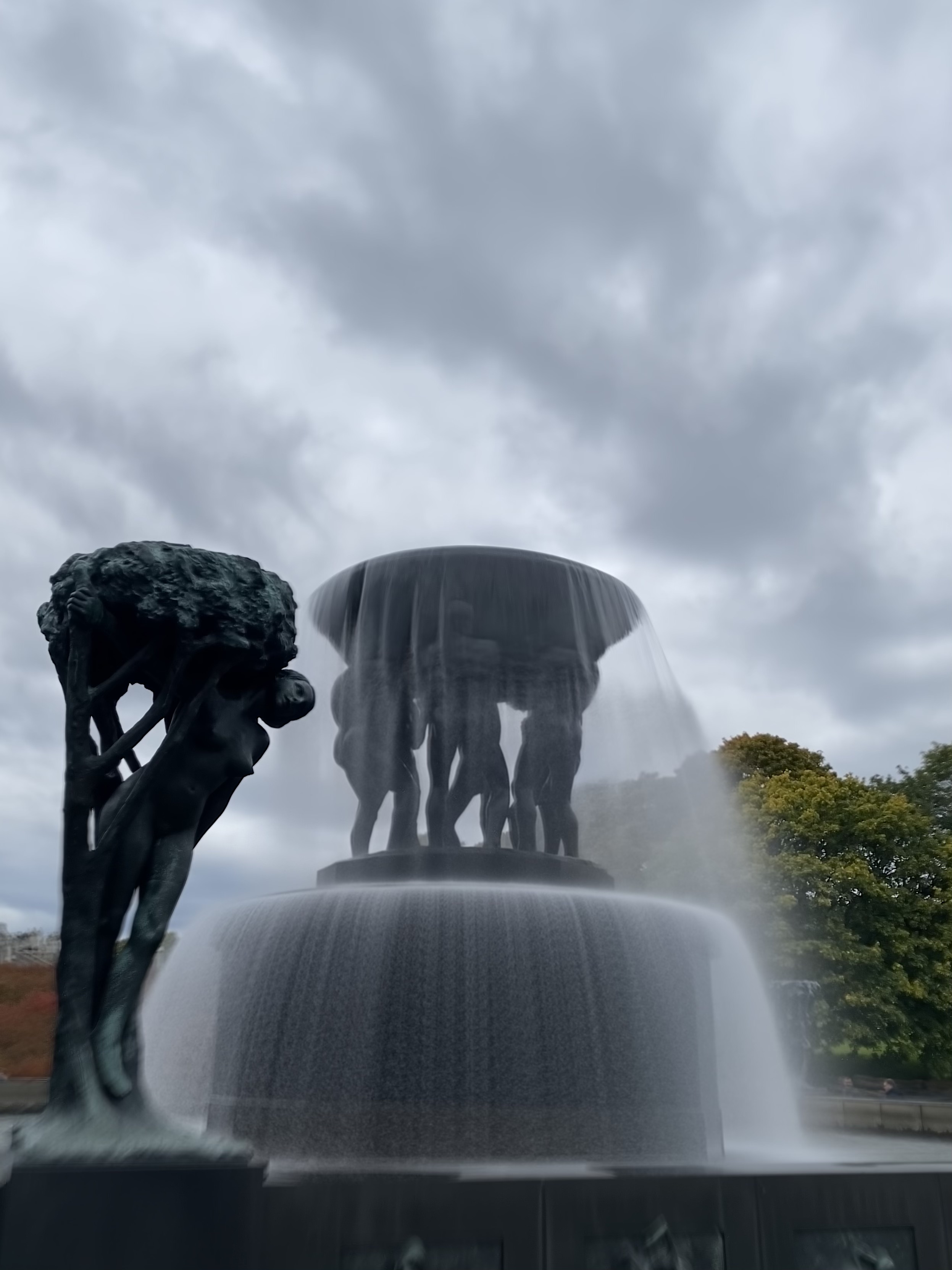
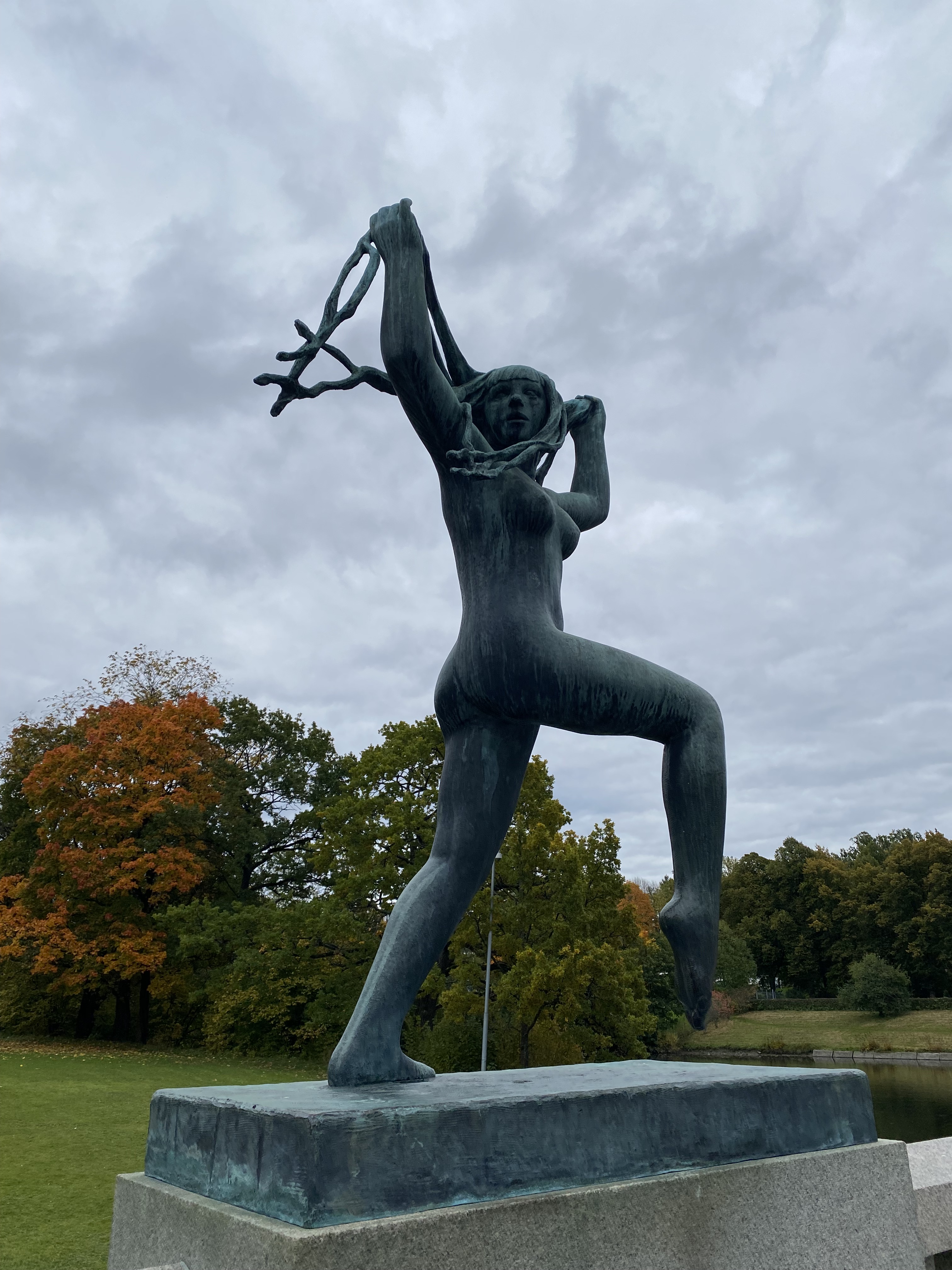
This was a fitting gateway to the sculpture park, whose 200+ sculptures (carved from granite and other materials by Gustav Vigeland) embody themes of life and death. Here were smoothly carved humans, naked and in all moments of life – infancy, playful childhood, adulthood, dance, fear, aggression, old age – whose expressions felt universal and specific. There were fountains and bridges and around us, wide swathes of grass littered with fall leaves and the tops of trees turning gold and orange.
We left the sculpture park and headed back towards the opera house, where you can meander along the slanted roof. Here, we glimpsed the sunken ship Kelly and I had spied from our run, only to find it was also a sculpture made of what looked like glass panels and was meant to represent ice. From there, we found our way to an old fortress, which we wandered through and paused at to take in views of the city.
The harbor was bustling with ferries and rowboats, and it was beginning to drizzle, so we headed down to the bar street to grab a beer in a pub called Jarmann.
The bar was tended by a friendly man named Kevin, who hails from Croatia but moved to Norway, he told me quite bluntly, “for the money.” We downed our beers – which were almost too delicious – and I ordered an amazing salad that tasted even better with my 20% Oslo Pass discount. Glimpsing our empty glasses, Kevin said, “So, what next? Shots of Aquavit?”
I mean, when in Norway, right? Kevin showed us a number of Aquavits and we decided on a dill-flavored one, not only because we enjoy dill, but because Kevin mentioned that this was a female-run distillery, which is quite cool.
With the shots came more beers, and Kevin recommended a cool cocktail bar-slash-speakeasy we could visit later on the evening if we wanted. It was a little after 3pm when we left the darkness of the bar for the bright grey afternoon of the harbor. Dan and Michael had found us a ferry that would depart from a pier nearby and deposit us on the shores of Bygdøy, the peninsula on whose land you can find two famous ships: the Fram and the Kon-Tiki. After learning about the Fram in Tromsø, the idea of seeing it in person felt akin to meeting your idol after a lifetime of inspiration.
We hustled to the dock where our ferry would arrive and encountered four or five bemused-looking people who smiled sadly at us.
“The ferry isn’t running anymore,” they said. “Yesterday was the last day of the season.”
“But…the Fram!” I cried. (At least in my head.)
“We were going there, too,” said the woman. “But without the ferry, it’s a long bus ride.”
I pulled it up on my map. It was indeed long, taking us around the whole of Oslo it seemed, but it would get us there by 4pm and give us one hour with our beloved Fram. If we hurried, we could make it.
As we speed-walked toward the bus stop, Dan swore.
“This is some shoulder season bullshit!”
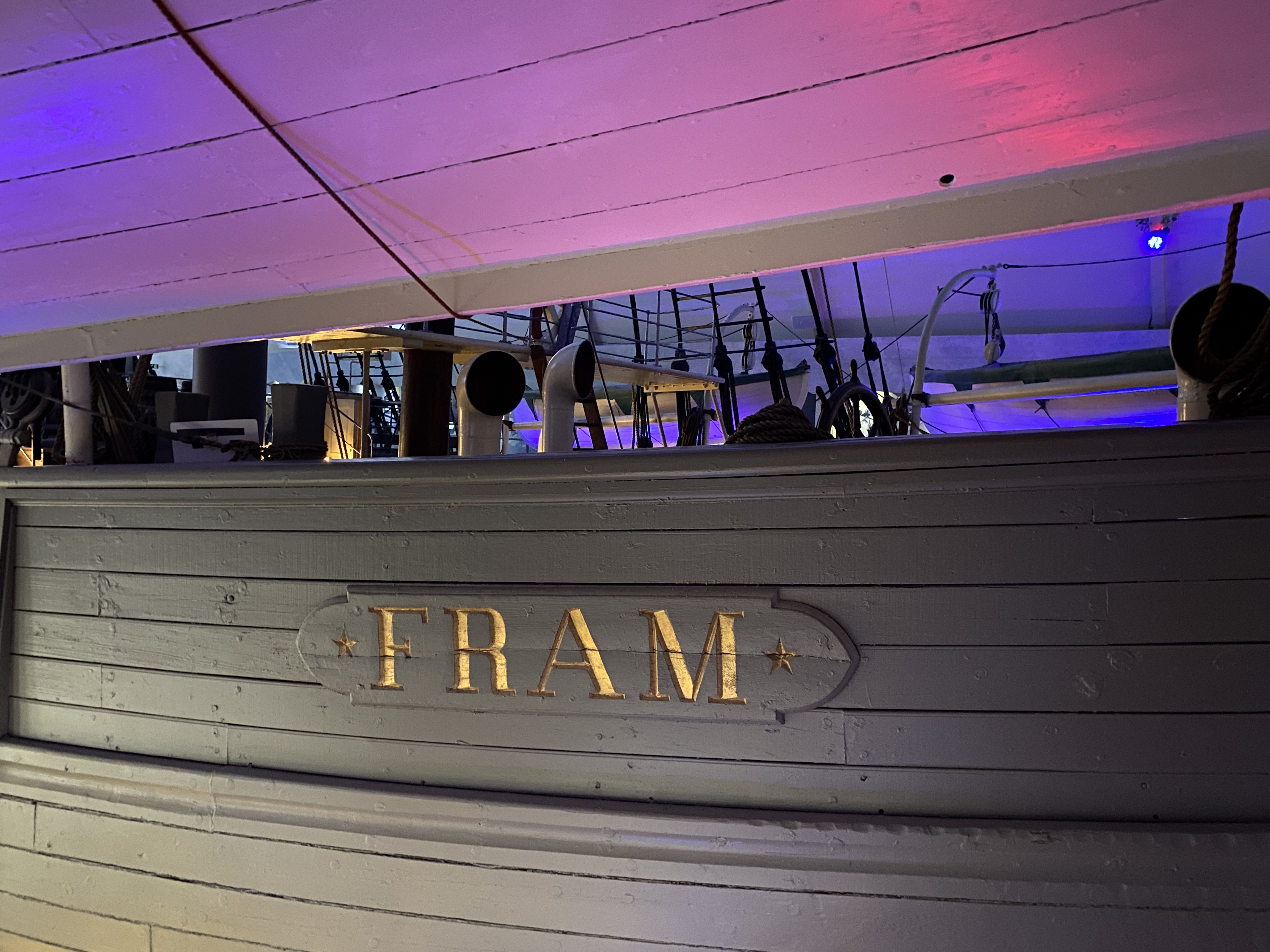
We managed to get on the bus we needed and rode it around the city. And then we found ourselves in front of two triangular museums. To our left, the Kon-Tiki. To our right, the Fram. We went right, showing our Oslo Passes to the museum attendant and walking through the mechanical gates to – The Fram.
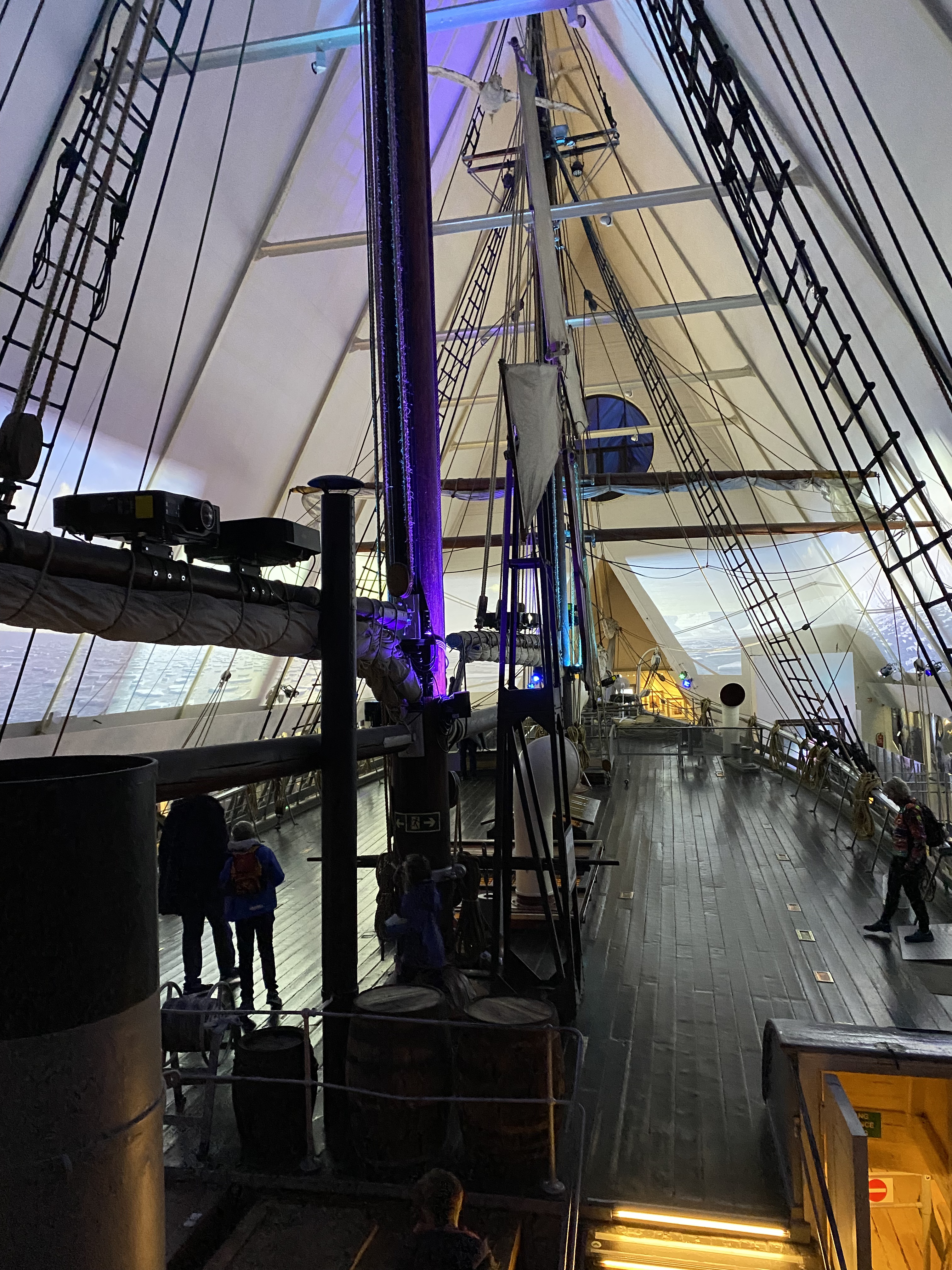
It – she? – was a sight to behold. Entering the museum, you find yourself standing at the bow of the ship, which towers high above you. It is a huge ship. And then – take a breath – you can board the Fram.

We started on the deck, which was massive, and walked all over. A wooden bench simulated the rocking of the sea, and screens draped all around the walls projected 360 views of the ice pack you’d be stuck in, the northern lights you might espy at night, or the rough seas carrying you north. The ship must have been set up at some kind of angle, because as we walked along the deck and then, floor by floor, below it, it felt like we were always atilt. Amazingly, they also seemed to mimic the sea-faring feel by doing something with sound. You could hear gulls squawking or wind blowing or the ship creaking, and it felt like I was tasting my sea legs. Or maybe it was the aquavit from Jarmann.

When we reached the boiler room, it smelled like a boiler room. There were cabins preserved, with clear plexiglass you could peer through to see what Nansen’s room looked like or the 4-bunk room shared by other sailors or the cook standing in the kitchen.


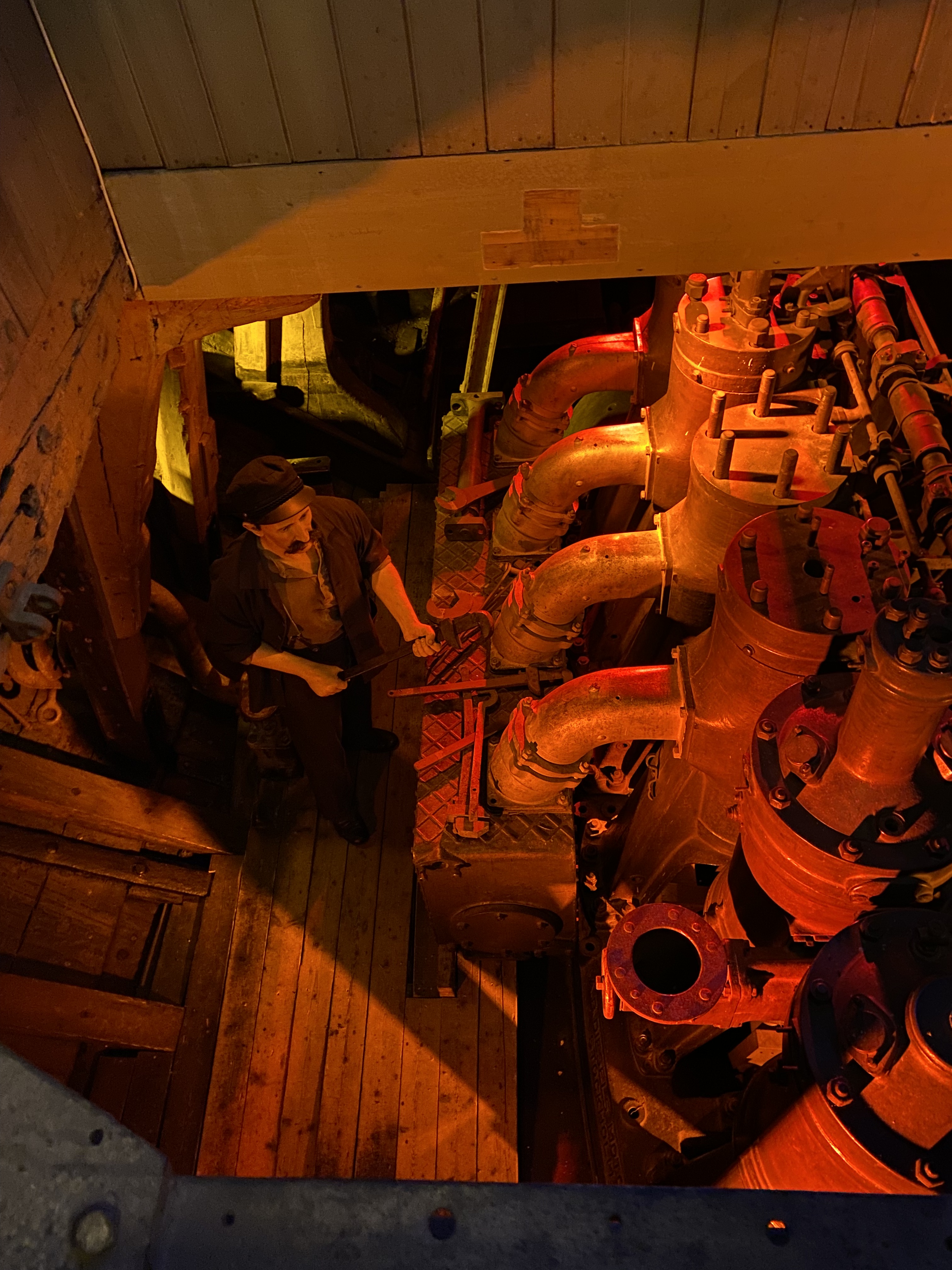

The Fram’s first voyage in the late 1800s was our favorite, the one we’d read about in the Polar Museum in Tromsø. For me, this was because it was the first. It was just a theory being tested. If a ship was packed in sea ice, would it drift through the North Pole? And more importantly, was it even possible to construct a seagoing ship that could withstand the pressure of crushing sea ice and then sail again when the ice broke up? Amundsen’s journeys to Antarctica on the Fram sounded impressive also, but it was testing that theory the first time that made Nansen’s journey so mesmerizing to me. 13 people signed up with the possibility of never returning, knowing it was possible that their ship break apart in the ice pack.
Kelly got to experience what this might feel like. As we made our way through the Fram to a series of announcements every 15 minutes declaring that the museum was closing soon, Dan and Michael quickened their paces in hopes of also seeing the Kon-Tiki museum, in part because that was also a cool sea journey and in part because it, too, was free with the Olso Pass and we wanted to get our money’s worth.
Kelly was ahead of me and noticed a small room with a button on it. When the button turned green, she pressed it, and found herself in some kind of tiny cavern where the floor was shifting, the temperature dropped, and some kind of horror-movie ice mummy stared out at her.
“I didn’t look closely at it,” she told us, “I just ran through it. I tried to get your attention, Michael.”
Kelly had apparently found a simulator that allows visitors to experience what it might be like if you died on the journey because your ship was being crushed all around you. A thoughtful exhibit, but I am not too heartbroken to have missed it.

We darted across the way to the Kon-Tiki museum with 15 minutes to spare. This was a raft that lashed together lots of logs and bamboo, and apparently sailed across the seas to prove that people could have sailed from parts of Polynesia. I’m not sure. I think the Kon-Tiki is super cool and the story of its journey is probably fascinating, but my heart was with Nansen and the Fram.
I must pause a moment to really fangirl about Nansen. Here was a man who had this theory about the ice pack. Not only did he get his crew up there, he survived a two-year journey across Arctic Seas and ice floes with his pal, and returned to Norway with loads of information about the sea (they thought it was shallow before him, and not so salty) and the northern lights, as well as flora and fauna samples. He went on to work with refugees and win the Nobel Peace Prize for his work. He was also apparently a decent organ player and artist, and I bought a postcard with a drawing of the Northern Lights on it.
“Did Nansen photograph this?” I asked the clerk at the gift shop.
“No, he painted it,” the man told me.
“What a guy,” I swooned.
It was a real sprint through the Kon-Tiki museum, with Michael exploring a fake rock cavern and crying out as he ducked to avoid an air burst aimed at his neck.
“I think it’s meant to be arrows being shot at you!” he called out.
Really, we could have spent a few hours just at the museums. If you ever find yourself in Oslo, you should do that.

We’d ambitiously made a reservation at a very cool bar called Røør about a week ago, claiming one of the many shuffleboard tables. I’d canceled it that morning and received a very pleasant email in return, inviting me there whenever I wanted to go.
We decided to stop by before dinner. It was getting dark and we rode the bus back from the museum, along with most of the museum staff themselves. The bar was supremely cool. There were something like 50 beers on tap, and our bartender was a helpful guy. He helped Michael decide on his beer, and then turned to Dan.
“I’ll have what he’s having,” Dan said. The bartender shook his head and gave him a sample of something else, and then something else. In the end, Dan chose Michael’s beer.
“But at least now it’s a choice,” said the bartender. “You tried and you chose.”
We took our beers upstairs and paid for a shuffleboard table, where we faced off again and Kelly and I finally claimed our victory after 4 games. The beers were juicy, the music catchy and played on records on a record player downstairs, and the Shuffleboard educational, as we realized we’d been playing incorrectly the past few times. Life was good.

It was time for our final meal in Oslo, so we departed the warmth and beery comfort of Røør in favor of Oslo’s chilly and drizzling streets. We found a Norwegian restaurant around the corner, but it didn’t seem appealing. Kelly had found another one a short tram ride away, so we hopped on and traveled 15 minutes to Lorry, Oslo’s oldest restaurant.
We were seated in a booth against the wall, and another table stretched out beside us, giving the place a very cozy feel. All of the other booths around us were full. The lights were warm and the decor eccentric: a stuffed lion without any back legs reclined on a shelf above the booth opposite us. Above us, dangling from the ceiling, was a set of legs in fishnet tights with black pumps.
“I got it wrong, guys,” Kelly told us, “This is the place where they invite you to walk around and look at the artwork. Not the place last night!”
“OK this is weird,” said Michael, leaning in and lowering his voice. “But that booth over there? There’s a portrait of a man hanging on the seat. The man has an eyepatch. And…there’s a man in the booth…with an eyepatch.”
We all craned our necks to see. It was true. What was this place?
“There’s another portrait on that booth,” I said, pointing to a portrait that was only visible from the eyes up, the bottom half of the face obscured by a scarf on the table. “And…doesn’t that guy look like the portrait?”
A large man in the booth wore the same small glasses as the man in the portrait and had the same receding hairline.
“Do you think…there are portraits of us on this booth?” we wondered. Our thoughts were broken when our waiter appeared at the table. Youthful and blonde-haired with a little yellow bowtie, he spoke in a lilting voice and introduced himself as Andreas.
Kelly and I ordered wine and Michael and Dan opted for beers before Andreas glided away ethereally.
I turned again to look at the booths to our right and nearly leapt out of my seat. Someone had removed the scarf from beneath the large man’s portrait, and –
“I think that portrait has changed!” I whispered. Kelly gasped, but Michael and Dan shook their heads.
“It has!” Kelly assured me, and it was mildly frightening. The man’s mouth looked toothy and sort of demonic.
“This place has a great menu, though,” we agreed, and Kelly skimmed through her phone. “Their Christmas menu is on here, too.”
That’s when it hit me. I pulled out my phone and typed in my blog, and there it was.
“Oh my God. I’ve been here before.”
I only had two photographs on my blog post, but one captured the floor tiles and the back of a chair, and it was unquestionably Lorry. I also wrote the name of the restaurant in the blog post, which helped.
“This is where I came the last time I was here, where I had the Christmas dinner and was served 18 potatoes. I can’t believe it.”
From there, the conversation descended into wild imaginings. We were in The Shining. We were in Midnight in Paris. An old tram was going to appear outside the door and escort us all into the 1800s. A bizarre piece of artwork was going to reveal one of our faces, but from the whaling era. We ordered fish and reindeer and more wine. Lorry was a mysterious time vortex, and we were never going to leave.
When Andreas returned to check on us, we asked him about the portraits.
“Oh, those are famous Norwegians,” he told us. “If you were here two hours ago, you would have seen that man, with the eyepatch. He’s a famous journalist.”
Andreas left, and we all stared at each other, agog.
“But he was here just now!” we hissed. “Not two hours! Time vortex!”
To add certainty to our claim, I’d ended up behind the man with the eyepatch on his way to the bathroom earlier. Kelly had told me about the two painted toilet bowls in the first stall on the right in the women’s room, so when I’d arrived in the stall and saw only one toilet bowl, I thought it was weird. Then I realized I’d followed the man into the men’s room. (I think this man is Odd Karsten Tveit.)
Andreas told us that the portraits on our booths were of famous Norwegian actors. Kelly Googled them, and I asked Andreas what would happen if the actors arrived there. Would we need to move? He laughed unconvincingly and told us no.
We learned soon after that Andreas was only working here to make ends meet while he auditioned as an actor. He would be appearing on Norway’s The Voice in December, singing “Prince Ali” from Aladdin. He asked us to wish him luck.
“That’s the one with Robin Williams, with all the voices,” I said. “That sounds like it would be really hard.”
“Maybe it’s from a Broadway version and they don’t do the voices,” Kelly suggested.
“Maybe he’s really good at voices,” said Dan.
We finished our meal and, with our glasses half-full, stood up.
“On your website, it says we can walk around and look at the art. Can we do that with our drinks?” Kelly asked. Andreas nodded enthusiastically.
“Please feel free to explore,” he said, gesturing around him. “All of this art is authentic. Our owner continues to collect pieces and update the collection all the time. We have a dinosaur egg by the bar, and several fabergé eggs upstairs. But there’s some politicians meeting to decide on a budget up there right now, so maybe wait until they come down.”
We thanked him and went off in search of eggs. Michael pointed out a stone in a glass case near the bar.
“The dinosaur egg,” he said.
“That is not what I was picturing,” I admitted, wiping visions of Jurassic Park from my mind.
“The upstairs isn’t roped off,” Kelly pointed out as we circled around the bar. “Should we just try to go up?”
We agreed that would be a good idea, and then we would leave. Kelly and I had our winter hats on, ready for a quick glimpse upstairs and then off to bed. But then, as we passed the bar, a man’s voice called out to Kelly.
“Hey, is there an REI here?”
We turned to see a large man sitting at the bar beside a slightly older-looking man who was smaller and wiry. The larger man was pointing at Kelly’s backpack.
“Oh,” she said, after piecing it together. “No, this is from the US.”
“I knew you guys were American,” he said, then stuck out his hand. “I’m Andrew. Where are you from?”
And so we began a different vortex, not of time, but of conversation. Andrew was from somewhere in the US – Indianapolis? – and loved Iceland. Matt – “My name? What has no arms and no legs and lets you walk all over it? A doormat. I’m Matt” – was also from the US. Both men were in Oslo because they sold insurance for submarines, and there was a submarine conference happening.
I immediately looked up to pull Dan into the conversation, but he was nowhere to be found. I texted him and learned he’d simply left, thinking we’d be sucked into staying behind and that if he left the restaurant, we’d all be able to leave with him. He came back in looking defeated, his backpack still on.
“What would happen if my submarine ran aground on a reef?” I asked Andrew. “Would I be insured?”
“Well, that’s when I’d turn to Matt here. That’s his area of expertise.”
I wondered what Andrew’s area of expertise was, but before I could ask, a tall Norwegian man with floppy white hair strode directly through our group on his way to the bathroom. He glanced at Kelly and I and said, “What’re you wearing this stupid ski shit for? Might as well be wearing helmets.”
“Well, we were leaving…” Kelly went on to answer him.
“Where are you from? Why are you here?” he asked. When we told him we were living in Switzerland, he shook his head. “Switzerland. I lived there once. Fucking boring.”
His name was Helga – “A stupid fucking girl’s name!” – and he had a lot to say about many things. In my memory, he’s at least 6 feet tall. A close talker, Helga took time to explain to us the different things in the world he found “fucking boring” and empathize with teachers, wondering how we teach anything in this “fucked up world.”
Between cigarette breaks and buying us all a round of Aquavit – when Andrew offered one to him, he waved it off and said, “Tastes like shit. I don’t want that shit.” – Helga talked about his time in the Special Forces (“I was shit at it”), his other years spent at Goldman Sachs, and his children (“Only reason I’m back in Norway”). Before Kelly and I went off to the bathroom, he flashed his cell phone screen at Kelly.
“Who’s Richard Branson?” she asked me once we were in the women’s room.
“I don’t know. Is he Richard Branson?”
“He just showed me his phone screen with Richard Branson’s number on it.”
“He doesn’t know Richard Branson,” Michael told us later. “Have you considered that Helga is a liar?”
We returned to the bar and the night continued to descend into fun house territory. Andreas came over to thank us for being a friendly table before he left us with the bartender, who was closing soon, and our new pals. Andrew wistfully told us about wanting to move to Iceland and insisted he and Michael become Instagram friends.
“He has one post,” Michael told us. “I hope he makes it to Iceland.”
Helga talked about everything and anything. Andrew bought us all beers – and then bought us more. Matt finally came over to talk to me and Dan after hanging around Kelly for a half hour. With a thumb jerk in her direction, he told us, “Just been convincing your friends to foster a teenager. You know, there’s so many kids out there who need homes, and my wife and I, it’s the best thing we’ve ever done. We knew she wouldn’t be able to get pregnant, so…”
I do not remember how exactly we extricated ourselves from this situation, but we left Andrew and Matt in the care of Helga, even after they invited us back to their AirBnB 40 minutes outside the city. Helga had a flight to London the next day, and we half-expected to run into him at the Oslo Airport.
Back on the crisp streets of Oslo, we were giddy from the night. It was after midnight and we were walking back to our hotel, disbelieving. This was one of those mythical nights where you go out to dinner and plan on going home without anything exciting happening and suddenly it’s midnight and you’re definitely not getting up early to run the next morning.
If our October break trip to Norway was a television series and every city a season, then this final night at Lorry in Oslo was a fitting series finale to our trip. And even if we slept poorly that night, there was a substantial breakfast buffet to bolster our spirits for the flight back to Zurich.
Categories: Norway
 Lost Among Latitudes